Incorporated
Policy changes from this SAMM E-Change memo have been incorporated into the SAMM.
DEFENSE SECURITY COOPERATION AGENCY
2800 DEFENSE PENTAGON
WASHINGTON, D.C. 20301-2800
1/29/2026
MEMORANDUM FOR :
DEPUTY UNDER SECRETARY OF THE AIR FORCE FOR INTERNATIONAL AFFAIRS
DEPUTY ASSISTANT SECRETARY OF THE ARMY FOR DEFENSE EXPORTS AND COOPERATION
DEPUTY ASSISTANT SECRETARY OF THE NAVY FOR INTERNATIONAL PROGRAMS
DIRECTOR, DEFENSE CONTRACT MANAGEMENT AGENCY
DIRECTOR, DEFENSE INFORMATION SYSTEMS AGENCY
DIRECTOR, DEFENSE LOGISTICS AGENCY
DIRECTOR, DEFENSE THREAT REDUCTION AGENCY
DIRECTOR, MISSILE DEFENSE AGENCY
DIRECTOR, NATIONAL GEOSPATIAL-INTELLIGENCE AGENCY
DIRECTOR, SECURITY COOPERATION ACCOUNTING DIRECTORATE, DEFENSE FINANCE AND ACCOUNTING SERVICE, INDIANAPOLIS OPERATIONS
DIRECTOR OF CYBERSECURITY DIRECTORATE AND DEPUTY NATIONAL MANAGER FOR NATIONAL SECURITY SYSTEMS, NATIONAL SECURITY AGENCY
SUBJECT :
Defense Security Cooperation Agency Policy Memorandum 26-06, Overseas Humanitarian, Disaster, and Civic Aid Updates [SAMM E-Change 804]
This policy memorandum provides updates to Chapter 2 and Chapter 12 for Overseas Humanitarian, Disaster, and Civic Aid (OHDACA) to include organization names, reporting requirements, and other administrative and clarification updates. The policy is incorporated into the Security Assistance Management Manual (SAMM) at https://samm.dsca.mil. If you have questions concerning this guidance, please contact DSCA (Office of Strategy, Plans, and Policy, Execution Policy and Analysis Directorate (SPP/EPA)) at dsca.ncr.spp.mbx.epa@mail.mil.
Hussam Bader
Acting Assistant Director
Strategy, Plans, and Policy
ATTACHMENT :
SAMM E-Change 804 - OHDACA Updates
Attachment : Security Assistance Management Manual E-Change 804
OHDACA Updates
Update Section C2.1.7.3. per below:
Current:
C2.1.7.3. Humanitarian Assistance Programs. DoD humanitarian-focused programs and activities include Humanitarian Assistance (HA), Humanitarian Assistance Program - Excess Property (HAP-EP), Humanitarian Mine Action (HMA), Humanitarian and Civic Assistance (HCA), Denton (Space Available) and Funded Transportation, and Foreign Disaster Relief/Emergency Response (FDR/ER). Chapter 12 provides a detailed description of HA programs and processes. IAs with all SC programs, the SCO should, to the greatest degree possible, integrate HA activities into CCMD security cooperation planning.
Revised:
C2.1.7.3. Humanitarian Assistance Programs. DoD humanitarian-focused programs and activities include Humanitarian Assistance (HA), Humanitarian Assistance Program - Excess Property (HAP-EP), Humanitarian Mine Action (HMA), Humanitarian and Civic Assistance (HCA), Denton (Space Available and Funded Transportation Programs, and Foreign Disaster Relief/Emergency Response (FDR/ER). Chapter 12 implements DoD HA and FDR policy and provides program guidance for the administration and execution of DoD activities funded with the DoD Overseas Humanitarian, Disaster, and Civic Aid (OHDACA) appropriation. provides a detailed description of HA programs and processes. IAs with all SC programs, The SCO should, to the greatest degree possible, integrate HA activities into CCMD security cooperation planning.
Update Chapter 12 Sections per below:
Current:
C12.1.2.2.1. Other United States Government Agency and DoD Demining Efforts. In addition to DoD activities under 10 U.S.C. 407, Congress provides authority and funding for international mine action to other USG agencies. The Department of State (State) Weapons Removal and Abatement (WRA) office provides demining support to foreign countries through in-kind contributions, contractor support, and Non-Governmental and international organizations (IOs) funded using Non-proliferation, Anti-terrorism, Demining, and Related (NADR) programs funds. State WRA also manages a Quick Reaction Force (QRF) which can respond globally to unexpected conventional weapons emergencies. The U.S. Agency for International Development (USAID) provides holistic support to mine survivors and their families through the Leahy War Victims Fund. Finally, the DoD Humanitarian Demining Research and Development (HDR&D) program develops and demonstrates new technologies, techniques, and equipment that make demining operations safer, more cost effective, and more efficient (see https:/www.humanitarian-demining.org).
C12.1.2.5. Foreign Disaster Relief. DoD Components may provide non-reimbursable FDR as HA using available OHDACA funds, using Presidential drawdown authority (see Section 506 of Public Law 87-195), or using other available authorities (see DoD Directive (DoDD) 5100.46). Additionally, DoD Components may provide FDR assistance when requested and funded on a reimbursable basis by other USG departments and agencies. DoD components shall provide disaster assistance in support of U.S. FDR efforts only at the direction of the President; when the SECDEF or a designee approves, with the concurrence of the Secretary of State (SECSTATE), a request for assistance from another Federal department or agency; or in emergency situations in order to save human lives, where there is not sufficient time to seek the prior concurrence of the SECSTATE. In this last instance, the SECDEF shall advise and seek the concurrence of the SECSTATE as soon as practicable. An Executive Secretary (ExecSec) memo from USAID or State requesting support for FDR cites a need for unique DoD capabilities pertaining to logistics, transportation, and security (see Section C12.8.). Responsibilities. Specific roles and responsibilities pertaining to the management of OHDACA-funded HA activities are summarized below.
C12.1.3.1. Under Secretary of Defense for Policy. The Under Secretary of Defense for Policy (USD(P)) serves as the Principal Staff Assistant and advisor to the SECDEF for all matters on the formulation of SC policy and oversight to further national security objectives (see DoDD 5132.03). The USD(P) is also responsible for the oversight and management of the SC Assessment, Monitoring, and Evaluation (AM&E).
C12.1.3.4. Director, Defense Security Cooperation Agency. Under the authority, direction, and control of the USD(P), the Director, DSCA, provides DoD-wide guidance to the DoD components and DoD representatives to U.S. missions for the execution of DoD SC programs (see DoDD 5132.03). The Director, DSCA, provides oversight and exercises overall program management responsibility for DoD HA, disaster relief, and demining activities funded with the OHDACA appropriation, to include administration of the Denton program, the EP program, and AM&E of OHDACA-funded activities, in coordination with ASD(SO/LIC) (see DoDD 5105.65). The Director, DSCA, is also responsible for the management of the Humanitarian Demining Training Center (HDTC), located at Fort Lee, Virginia, which provides technical expertise in support of the HMA Program and trains/certifies DoD personnel to execute HMA assistance. The Director, DSCA, completes and coordinates congressional notifications and reporting required for OHDACA-funded programs and activities.
C12.2.2.3. Primary Education. There is a direct correlation between population education, poverty reduction and improvement in population health. Basic education empowers the civilian populace by eliminating dependence, especially in conflict-affected countries, and supports the basic literacy and knowledge necessary for self-reliance (U.S. Agency for International Development (USAID) Education Policy, https://www.usaid.gov/education/policy). Further, secure and healthy school facilities provide refuge for at-risk youth populations. OHDACA-funded education projects, in collaboration with the partner's Ministry of Education (MoE) (or relevant government institution), enable a partner's provision of basic education services, as required under the partner's domestic law, and provide equal access to all demographics of the population. Project examples include: construction, expansion, or improvement of primary and secondary education facilities and provision of school furniture and equipment. Renovation of a school facility may include renovation of associated physical education areas, but a project's primary purpose may not be support to athletics, playground construction, or art/music programs. Education projects may not support child daycare centers or before/after school programs that are not part of the partner's mandatory educational curriculum. Education projects do not include vocational training.
C12.2.3.1. Overseas Humanitarian, Disaster, and Civic Aid Project Management Tool. OHASIS is a comprehensive project management tool for OHDACA-funded HA (as well as certain other Service Operations and Maintenance (O&M) funded activities (e.g. HCA, the Asia Pacific Regional Initiative (APRI)) that enables the development, nomination, staffing, coordinating, approval and management of projects by various organizational users, including project officers, Security Cooperation Organizations (SCOs), USAID coordinators, CCMDs, DSCA, Joint Staff (JS), and Deputy Assistant Secretary of Defense for Stability and Humanitarian Affairs (DASD(SHA)). An OHASIS user manual and training materials are found on the OHASIS website on the main Help page and in the Document Library.
C12.2.3.4. Overseas Humanitarian Shared Information System Governance Board. The OHASIS Governance Board (OGB) provides enterprise-wide transparency, coordinated priority of effort, and overall guidance for the development and use of OHASIS. DSCA (IOPS/GEX/HDD) is the OGB Chair, and DASD(SHA), JS, CCMD HA, and Army Geospatial Center (AGC) stakeholders are the voting members. The OGB reviews proposed OHASIS system changes and coordinates the OHASIS Development Team work plan. The OGB Chair has final decision authority on approval and execution of OHASIS change requests and management decisions. OHDACA funds for OHASIS development will only be used in support of OHDACA-funded programs. Non-OHDACA programs supported in OHASIS may participate in the OGB as non-voting members.
C12.2.3.5. Non-Overseas Humanitarian, Disaster, and Civic Aid Funded Activities. DSCA may allow DoD components to use OHASIS for specific non-OHDACA activities as long as such use does not result in increased OHASIS costs or negatively impact the use of OHASIS for the OHDACA-funded programs. If non-OHDACA activities result in increased OHASIS costs, DSCA will conclude a support agreement with the DoD component to ensure that OHASIS costs are proportionately shared by the non-OHDACA activity. DSCA (IOPS/GEX/HDD) will review, and coordinate with DASD (SHA) and JS J5 as appropriate, requests to utilize OHASIS for non-OHDACA funded activities before providing written approval/denial of such requests.
C12.2.4.1. Principles. OHDACA AM&E efforts are intended to be low-cost and risk-based; leverage and improve existing processes/products and mechanisms; monitor at all levels as an integral part of program/project execution; use objective data to evaluate achievement of long-term strategic goals; and recognize there are external factors affecting humanitarian conditions which OHDACA-funded activities may not be able to influence. DSCA (IOPS/GEX/HDD), in coordination with the CCMDs and DASD (SHA), as appropriate, establishes and maintains performance objectives for OHDACA-funded activities to ensure standardization across the CCMDs.
C12.2.6.1. Budget Estimate Submission (August). DSCA submits the Program Objective Memoranda (POM) and Budget Estimate Submission (BES) for OHDACA two years prior to the target program year. DSCA (IOPS/GEX/HDD) coordinates the OHDACA submission with DASD(SHA) prior to submittal.
C12.2.6.3. Assessment and Budget Submittal Review (July-August). DSCA reviews each CCMD ABS to understand the CCMD's assessment of humanitarian needs in the region, learn the CCMD's project priorities, and consider compliance with legal, DSCA, and (OUSD (P) guidance. DSCA staffs each ABS to DASD(SHA) for review and coordination with appropriate regional offices within OUSD (P). DSCA provides each ABS to JS J5 for informational purposes. During review, DSCA may return the ABS to the CCMD for clarification or adjustment. If the ABS contains any projects which appear to risk non-compliance with legal or policy criteria, DSCA will identify these to the CCMD for removal from the ABS and submittal as out-of-cycle projects (see Section C12.4.4.2.). After completion of DSCA and DASD(SHA) reviews and any CCMD adjustments, and no later than 1 September, DSCA marks the ABS Review Complete in OHASIS. This product represents the CCMD's program, i.e. the FY22/23 ABS represents the CCMD's FY22/23 Program.
C12.2.6.5. Overseas Humanitarian, Disaster, and Civic Aid Allocation Decision (September). DSCA, in coordination with DASD(SHA) and JS J5, determines funding allocations for the geographic CCMDs based on current DoD priorities, the CCMD ABS (see Section C12.2.5.), and CCMD program execution in accordance with established performance objectives (see Section C12.2.4.1.). The Director, DSCA, issues the OHDACA allocation decision memorandum to the JS J5 and the CCMDs. Allocation amounts are subject to change when the annual appropriation bill is enacted, and a revised allocation memo may be provided at that time.
C12.2.6.7. Overseas Humanitarian, Disaster, and Civic Aid Workshop (March). DSCA hosts a worldwide OHDACA Workshop to enable collaboration and information sharing and to address and resolve select policy, program guidance, or other issues of relevance to further the execution of OHDACA-funded programs and enable development of CCMD budget submissions. Attendees include program stakeholder personnel from the CCMDs, DASD(SHA), and JS.
C12.2.7. Congressional Reporting. As required, CCMDs will provide data necessary to support congressional reporting requirements and other inquiries.
C12.2.7.1. Denton Report. DSCA prepares an annual Denton report (reference 10 U.S.C. 402) which identifies the origin, contents, destination, and disposition of HA supplies transported during the 12-month period ending on the preceding June 30. This report is due not later than July 31 of each year and is submitted by State.
C12.2.7.2. Humanitarian Assistance Report. DSCA prepares and submits the annual HA report (reference 10 U.S.C. 2561 & 10 U.S.C. 2557) to Congress, which provides information on the provision of OHDACA-funded HA, disaster relief, and transportation of HA in the prior FY The report is due at the time of the Presidential Budget (PB) submission for the next FY and must include the total amount of funds obligated for humanitarian relief; the number of scheduled and completed HA transportation missions; and a description of any donated EP items, to include the date of each transfer, the entity to which the transfers were made, and the quantity of items transferred. When DoD intends to transport humanitarian relief to a country not specifically authorized by law, Congress must be notified not less than 15 days prior to commencing the transportation.)
C12.2.7.3. Humanitarian Mine Action Report. CCMDs complete and submit the input for the HMA report (reference 10 U.S.C. 407) to DSCA not later than November 1 of each year (see Figure C12.F2.). DSCA aggregates this information and submits an annual report to Congress, due no later than March 1 of each FY. Information reported includes travel, transportation, and subsistence expenses of DoD personnel, equipment, services, or supplies acquired for the purpose of carrying out or supporting humanitarian demining activities, including any nonlethal, individual, or small-team equipment or supplies for clearing landmines or other ERW that are to be transferred or otherwise furnished to a partner in furtherance. In addition to required data outlined in Figure C12.F2., CCMDs submit a brief narrative for each partner describing the number of missions conducted, type of assistance delivered, objectives met, type and number of instructors, and type and number of partner personnel trained.
C12.2.7.5. Foreign Disaster Relief Report. In the event that FDR activities are conducted under the authority of 10 U.S.C. 404, DoD will provide Congress with a report containing notification of the assistance provided, and proposed to be provided, not later than 48 hours after the commencement of disaster assistance activities. The report will include a description of the following: the manmade or natural disaster for which disaster assistance is necessary; the threat to human lives presented by the disaster; the U.S. military personnel and material resources involved; the disaster assistance provided by other nations or public or private relief organizations; and the anticipated duration of the disaster assistance activities.
C12.3.2.2. Humanitarian Assistance Minimal Cost Projects. MCP are HA efforts under 10 U.S.C. 2561 costing $30,000 or less and do not provide any equipment, supplies or other items to a security force. Except for projects that transfer items to a security force, CCMDs may approve an MCP if CCMDS can effectively achieve project objectives at this cost, in accordance with OHDACA legal and policy requirements (see Section C12.4.4.). MCPs must meet the same legal, policy, coordination, and management criteria, and are subject to the same requirements for Assessment, Monitoring, and Evaluation (AM&E) as other OHDACA-funded projects. In the immediate aftermath of a foreign disaster, CCMDs will notify ASD/SOLIC and DSCA before approving an MCP to ensure activities do not interfere with USG response or inadvertently undermine Secretary of Defense (SECDEF) authorization for approval of DoD FDR (See DoD Directive (DoDD) 5100.46). The DSCA (Office of International Operations, Global Execution Directorate, Humanitarian Assistance and Demining Division (IOPS/GEX/HDD)) in coordination with Deputy Assistant Secretary of Defense for Stability and Humanitarian Affairs (DASD (SHA)) may approve CCMD requests to increase the MCP approval limit if the CCMD provides sufficient justification.
C12.3.6.4. Multi-lateral Training. Multi-lateral HA training events are conducted in one of the attending partners and will be submitted as Umbrella projects with a subproject for each of the benefiting partners. SCO, Chief of Mission (COM), and U.S. Agency for International Development (USAID) coordination from each of the partners participating in the training is required and annotated in each subproject.
C12.3.6.9. Disaster Management. Disaster management training events generally entail training and/or exercises for national and local-level authorities in disaster preparation, response, mitigation, and emergency operations planning and management. CCMDs should consult with the local or regional USAID Bureau of Humanitarian Assistance (BHA) representatives to de-conflict interagency efforts and strengthen requirements development.
C12.3.9.2.2. Safety. DoD personnel conducting PSSM assessments will strictly follow DSCA PSSM guidelines. If, at any time during an RDSS, any assessment team member observes a hazard or condition that is a critical safety or imminent explosive hazard, the team will immediately cease the assessment and withdraw to a safe location. The RDSS team will notify partner authorities and report the unsafe situation to the SCO and the CCMD HMA Program Manager for further reporting to DSCA, DASD(SHA), and Department of State, Office of Weapons Removal and Abatement (State (WRA)). The assessment will not resume in the identified hazard area until the safety concern has been remedied. An on-site explosive ordnance disposal (EOD) team may continue assessment of facilities or areas that are outside the identified hazard area.
C12.4.3.6. United States Agency for International Development, Bureau of Humanitarian Assistance. CCMDs will ensure local or regional U.S. Agency for International Development, Bureau of Humanitarian Assistance (USAID (BHA)) representatives coordinate on HA and EP project nominations in a partner's territory where the United States is actively responding to a declared disaster.
C12.4.5. DSCA Review and Approval. DSCA (Office of International Operations, Global Execution Directorate, Humanitarian Assistance and Demining Division (IOPS/GEX/HDD)), in coordination with DSCA (Front Office, Office of the General Counsel (FO/OGC)), reviews all CCMD project submittals for compliance with statutory, policy, and program requirements prior to issuing an approval decision. DSCA obtains Deputy Assistant Secretary of Defense for Stability and Humanitarian Affairs (DASD(SHA)) review on all out-of-cycle project submittals. Once DSCA (IOPS/GEX/HDD) approves the project submission, the CCMD has the authority to expend OHDACA funds from the approved FY appropriation for a project in accordance with the approved project scope. In the rare case a proposed project is disapproved, the CCMD may contact the DSCA (IOPS/GEX/HDD) Division Chief to request an appeal of the decision.
C12.4.5.1. Humanitarian Mine Action Projects. In addition to DSCA (FO/OGC) review, DSCA (IOPS/GEX/HDD) obtains DASD(SHA) and State Office of Weapons Removal and Abatement (State(WRA)) review on all HMA projects (Annual Plan and out-of-cycle) before DSCA (IOPS/GEX/HDD)issues an approval decision. DSCA (IOPS/GEX/HDD) will also communicate HMA physical security and stockpile management (PSSM) engagements with DSCA (Office of International Operations, Global Execution Directorate, End Use Monitoring Division (IOPS/GEX/EUM)) to identify opportunities for collaboration.
C12.6.7.3.2. Review. DSCA (IOPS/GEX/HDD) reviews the request and coordinates with DASD (SHA), as needed.
C12.7.2.4. Denton Program. The Denton Program leverages the United States Transportation Command (USTRANSCOM) military transportation resources to provide space-available or opportune transportation, and coordinates transportation of the donated cargo from a military POE to a POD in the destination country. Movement and arrival dates are not guaranteed, and transportation of the cargo can take several months, depending on the frequency of DoD assets moving into a partner's territory and space-availability on the U.S. military transportation. In accordance with 10 U.S.C. 402, DSCA coordinates closely with the Department of State (State) and United States Agency for International Development (USAID) on the administration of the Denton program.
C12.7.4.3. Coordination. DSCA coordinates each HATP application with the CCMD, USAID, and State. Coordinators review and register their concurrence for each shipment within the HA Transportation website (non-account-holders can do so by following the Uniform Resource Locator (URL) provided in the coordination e-mail). CCMDs should consult with the Security Cooperation Organization (SCO) in the partner country prior to providing their coordination response.
C12.8.2. Prompt Action to Save Human Lives. Commanders with assigned forces at or near the immediate scene of a foreign disaster may take prompt action to save human lives. Commanders should obtain the concurrence of the foreign government (partner) and the Chief of Mission (COM) before committing forces. In taking prompt action to save lives, commanders may use or pre-position the commander's own resources, but may not transfer equipment or supplies to a partner unless they have a separate authority to do so. The Combatant Commands (CCMDs)shall follow up as soon as possible, but no later than 72 hours after the start of relief operations (life-saving assistance), to secure SECDEF or Deputy SECDEF approval for continuing assistance. A CCMD may seek SECDEF approval for OHDACA reimbursement of the cost of prompt action activities by submitting a request in writing to Deputy Assistant Secretary of Defense for Stability and Humanitarian Affairs (DASD(SHA)) with copy to DSCA. HA and EP projects executed concurrently with prompt action will comply with standard processes and requirements..
C12.8.3. Foreign Disasters. Foreign disasters (i.e., calamitous situations or events) may be natural or man-made and may be sudden-onset (such as tropical storms or earthquakes) or slow-onset (such as famine or draught). The United Nations Office for the Coordination of Humanitarian Assistance (UN (OCHA)) coordinates international humanitarian response efforts. United States Agency for International Development (USAID) Bureau of Humanitarian Assistance (BHA) is the lead federal agency for U.S. foreign disaster relief efforts when the U.S. responds to an international disaster, serving as liaison between involved U.S. organizations and the international community.
C12.8.3.1. United States Disaster Declaration. If an affected partner requests USG assistance or is willing to accept USG assistance, the U.S. Ambassador to the affected partner may issue a Disaster Declaration cable to prompt USG response. USAID (BHA) requires a disaster declaration from the Ambassador before it will evaluate and/or commence disaster response. USAID (BHA) and State determine the appropriate level of USG assistance, and USAID (BHA) determines what, if any, requirements may be most effectively met by support from DoD.
C12.8.4. Secretary of Defense Foreign Disaster Relief Authorization. If the SECDEF intends to authorize DoD FDR activity, DASD(SHA), in coordination with DSCA, prepares a SECDEF FDR authorization memorandum. The SECDEF memorandum outlines parameters of the approved FDR operation, including associated authorities and funding. DASD(SHA), Joint Staff (JS), pertinent CCMDs, and their components develop cost estimates for anticipated DoD FDR support requirements and communicate them to DSCA. The DoD FMR Volume 12, Chapter 23, provides specific financial management responsibilities and instructions for the development of DoD FDR cost estimates as well as the request for funding or subsequent reimbursement from DSCA. DASD(SHA) coordinates the SECDEF FDR Authorization memorandum with DSCA, JS, relevant Office of the Under Secretary of Defense for Policy (OUSD(P)) regional offices, DoD Office of General Counsel (DoD (OGC)), OUSD(C), and, as appropriate, the Under Secretary of Defense for Acquisition and Sustainment (USD (A&S)).
C12.8.5. Funding. If non-reimbursable FDR funding requirements exceed the amount of OHDACA funds available for DoD FDR support, DSCA will coordinate with DASD(SHA) and Under Secretary of Defense (Comptroller) (USD(C)) to identify and, if necessary, reprogram other available DoD funds. DSCA may pull OHDACA funds from the CCMDs to cover FDR requirements, but every effort will be made to avoid impacting the CCMD Humanitarian Assistance (HA) and Humanitarian Mine Action (HMA) programs. OUSD(C) may seek supplemental funding to restore OHDACA funds spent on FDR. DSCA provides FDR funds to the affected CCMD in accordance with FDR cost estimates and SECDEF authorization limitations. The CCMD will only use FDR funding to reimburse DoD FDR activities which meet legal and policy purposes for the use of OHDACA funds and which are determined to be within the scope of the FDR authorization. If DoD stock material support is provided to fulfill an FDR Mission Tasking Matrix (MiTaM), the CCMD will calculate the reimbursement amount in accordance with DoD FMR Volume 11A, Chapter 1. OHDACA funds are not provided to partners or third parties for reimbursement or payment of the partner's disaster relief activities.
C12.8.6. Communications and Coordination. DSCA may initiate regular resource calls with the CCMD and involved components to ensure all organizations are apprised of requirements, resources, and FDR funding statuses. Close and continued communications between the CCMD, DSCA and DASD(SHA) is essential during FDR activities. The Overseas Humanitarian Shared Information System Disaster Response (OHASIS DR) module is a collaboration platform for DoD points of contact (POCs) at DSCA, DASD(SHA) and CCMDs. OHASIS DR module also serves as an information source for historical disaster relief activities.
C12.8.7.1. Requests for Specific Assistance. USAID (BHA) submits requests for specific DoD assistance activities under an approved FDR via a MiTaM document. CCMDs ensure that all subsequently provided support is within the scope of the SECDEF FDR authorization and complies with OHDACA policy and legal requirements. USAID (BHA) may deploy a Disaster Assessment and Response Team (DART) to the affected area to assess response requirements. The DART members coordinate directly with other USAID representatives and DoD components on the ground.
C12.8.8. Completion of Foreign Disaster Relief Activities. DSCA, DASD(SHA), CCMDS, Components, and USTRANSCOM are responsible for the completion of activities under their responsibility and reconciliation of funding associated with FDR upon termination of FDR requirements or the FDR authorization, whichever comes first.
Revised:
C12.1.2.2.1. Other United States Government Agency and DoD Demining Efforts. In addition to DoD activities under 10 U.S.C. 407, Congress provides authority and funding for international mine action to other USG agencies. The Department of State (State) Bureau of Political-Military Affairs, Office of Weapons Removal and Abatement (PM/WRA) office provides demining support to partners through in-kind contributions, contractor support, and Non-Governmental and international organizations (IOs) funded using Non-proliferation, Anti-terrorism, Demining, and Related (NADR) programs funds. State PM/WRA also manages a Quick Reaction Force (QRF) which can respond globally to unexpected conventional weapons emergencies. The U.S. Agency for International Development (USAID) provides holistic support to mine survivors and their families through the Leahy War Victims Fund. Finally, the DoD Humanitarian Demining Research and Development (HDR&D) program develops and demonstrates new technologies, techniques, and equipment that make demining operations safer, more cost effective, and more efficient (see https:/www.humanitarian-demining.org).
C12.1.2.5. Foreign Disaster Relief. DoD Components may provide non-reimbursable FDR as HA using available OHDACA funds, using Presidential drawdown authority (see Section 506 of Public Law 87-195), or using other available authorities (see DoD Directive (DoDD) 5100.46). Additionally, DoD Components may provide FDR assistance when requested and funded on a reimbursable basis by other USG departments and agencies. DoD components shall provide disaster assistance in support of U.S. FDR efforts only at the direction of the President; when the SECDEF or a designee approves, with the concurrence of the Secretary of State (SECSTATE), a request for assistance from another Federal department or agency; or in emergency situations in order to save human lives, where there is not sufficient time to seek the prior concurrence of the SECSTATE. In this last instance, the SECDEF shall advise and seek the concurrence of the SECSTATE as soon as practicable. An Executive Secretary (ExecSec) memo from USAID or State requesting support for FDR cites a need for unique DoD capabilities pertaining to logistics, transportation, and security (see Section C12.8.). Responsibilities. Specific roles and responsibilities pertaining to the management of OHDACA-funded HA activities are summarized below.
C12.1.3.1. Under Secretary of Defense for Policy. The Under Secretary of Defense for Policy (USD(P)) develops, coordinates, and oversees the implementation of DoD policy for humanitarian assistance, foreign disaster relief, and humanitarian demining programs (see DoDD 5111.01). serves as the Principal Staff Assistant and advisor to the SECDEF for all matters on the formulation of SC policy and oversight to further national security objectives (see DoDD 5132.03). The USD(P) is also responsible for the oversight and management of the SC Assessment, Monitoring, and Evaluation (AM&E).
C12.1.3.3. Director, Defense Security Cooperation Agency. Under the authority, direction, and control of the USD(P), the Director, DSCA, provides DoD-wide guidance to the DoD components and DoD representatives to U.S. missions for the execution of DoD SC programs (see DoDD 5132.03). The Director, DSCA, provides oversight and exercises overall program management responsibility for DoD HA, disaster relief, and demining activities funded with the OHDACA appropriation, to include administration of the Denton program, the EP program, and AM&E of OHDACA-funded activities, in coordination with ASD(SO/LIC) (see DoDD 5105.65). The Director, DSCA, is also responsible for the management of the Humanitarian Demining Training Center (HDTC), located at Fort Lee, Virginia, which provides technical expertise in support of the HMA Program and trains/certifies DoD personnel to execute HMA assistance. The Director, DSCA, completes and coordinates congressional notifications and reporting required for OHDACA-funded programs and activities.
C12.2.2.3. Primary Basic Education. There is a direct correlation between population education, poverty reduction and improvement in population health. Basic education empowers the civilian populace by eliminating dependence, especially in conflict-affected countries, and supports the basic literacy and knowledge necessary for self-reliance. (U.S. Agency for International Development (USAID) Education Policy, https://www.usaid.gov/education/policy). Further, secure and healthy school facilities provide refuge for at-risk youth populations. OHDACA-funded education projects, in collaboration with the partner's Ministry of Education (MoE) (or relevant government institution), enable a partner's provision of basic education services, as required under the partner's domestic law, and provide equal access to all demographics of the population. Project examples include: construction, expansion, or improvement of primary and secondary education facilities and provision of school furniture and equipment. Renovation of a school facility may include renovation of associated physical education areas, but a project's primary purpose may not be support to athletics, playground construction, or art/music programs. Education projects may not support child daycare centers or before/after school programs that are not part of the partner's mandatory educational curriculum. Education projects do not include vocational training.
C12.2.3.1. Overseas Humanitarian, Disaster, and Civic Aid Project Management Tool. The Overseas Humanitarian Assistance Shared Information System (OHASIS) is a comprehensive project management tool for OHDACA-funded activities HA (as well as certain other Service Operations and Maintenance (O&M) funded activities (e.g. HCA, the Asia Pacific Regional Initiative (APRI)) that enables the development, nomination, staffing, coordinating, approval and management of projects by various organizational users, including project officers, Security Cooperation Organizations (SCOs), USAID coordinators, CCMDs, DSCA, Joint Staff (JS), and other offices, as appropriate. Deputy Assistant Secretary of Defense for Stability and Humanitarian Affairs (DASD(SHA)). An OHASIS user manual and training materials are found on the OHASIS website on the main Help page and in the Document Library.
C12.2.3.4. Overseas Humanitarian Shared Information System Governance Board. The OHASIS Governance Board (OGB) provides enterprise-wide transparency, coordinated priority of effort, and overall guidance for the development and use of OHASIS. DSCA (IOPS/GEX/HDD) is the OGB Chair, and DASD(SHA), JS, CCMD HA, and Army Geospatial Center (AGC) stakeholders are the voting members. The OGB reviews proposed OHASIS system changes and coordinates the OHASIS Development Team work plan. The OGB Chair has final decision authority on approval and execution of OHASIS change requests and management decisions. OHDACA funds for OHASIS development will only be used in support of OHDACA-funded programs. Non-OHDACA programs supported in OHASIS may participate in the OGB as non-voting members.
C12.2.3.5. Non-Overseas Humanitarian, Disaster, and Civic Aid Funded Activities. DSCA may allow DoD components to use OHASIS for specific non-OHDACA activities as long as such use does not result in increased OHASIS costs or negatively impact the use of OHASIS for the OHDACA-funded programs. If non-OHDACA activities result in increased OHASIS costs, DSCA will conclude a support agreement with the DoD component to ensure that OHASIS costs are proportionately shared by the non-OHDACA activity. DSCA (IOPS/GEX/HDD) will review, and coordinate with DASD (SHA) and JS J5 and other offices as appropriate, requests to utilize OHASIS for non-OHDACA funded activities before providing written approval/denial of such requests.
C12.2.4.1. Principles. OHDACA AM&E efforts are intended to be low-cost and risk-based; leverage and improve existing processes/products and mechanisms; monitor at all levels as an integral part of program/project execution; use objective data to evaluate achievement of long-term strategic goals; and recognize there are external factors affecting humanitarian conditions which OHDACA-funded activities may not be able to influence. DSCA (IOPS/GEX/HDD), in coordination with the CCMDs and DASD (SHA), as appropriate, establishes and maintains performance objectives for OHDACA-funded activities to ensure standardization across the CCMDs.
C12.2.6.1. Budget Estimate Submission (August). DSCA submits the Program Objective Memoranda (POM) and Budget Estimate Submission (BES) for OHDACA two years prior to the target program year. DSCA (IOPS/GEX/HDD) coordinates the OHDACA submission with DASD(SHA) prior to submittal.
C12.2.6.3. Assessment and Budget Submittal Review (July-August). DSCA reviews each CCMD ABS to understand the CCMD's assessment of humanitarian needs in the region, learn the CCMD's project priorities, and consider compliance with legal, DSCA, and (OUSD (P) guidance. DSCA staffs each ABS to DASD(SHA) for review and coordination with appropriate regional offices within OUSD(P). DSCA provides each ABS to JS J5 for informational purposes. During review, DSCA may return the ABS to the CCMD for clarification or adjustment. If the ABS contains any projects which appear to risk non-compliance with legal or policy criteria, DSCA will identify these to the CCMD for removal from the ABS and submittal as out-of-cycle projects (see Section C12.4.4.2.). After completion of DSCA and DASD(SHA) completes reviews and after any CCMD adjustments, and no later than 1 September, DSCA marks the ABS Review Complete in OHASIS. This product represents the CCMD's program, i.e. the FY25/26 FY22/23 ABS represents the CCMD's FY22/23 FY25/26 Program.
C12.2.6.5. Overseas Humanitarian, Disaster, and Civic Aid Allocation Decision. (September). DSCA, in coordination with DASD(SHA) and JS J5, ,determines Ffunding allocations for the geographic CCMDs are based on current DoD policy and priorities, the CCMD ABS (see Section C12.2.5.), and CCMD program execution in accordance with established performance objectives (see Section C12.2.4.1.). The Director, DSCA, issues the OHDACA allocation decision memorandum to the JS J5 and the CCMDs. Allocation amounts may be are subject to change when the annual appropriation bill is enacted, and a revised allocation memo may be provided at that time.
C12.2.6.7. Overseas Humanitarian, Disaster, and Civic Aid Workshop (March). DSCA may hosts a worldwide OHDACA Workshop to enable collaboration and information sharing and to address and resolve select policy, program guidance, or other issues of relevance to further the execution of OHDACA-funded programs and enable development of CCMD budget submissions. Attendees include program stakeholder personnel from the CCMDs, DASD(SHA),, the Office of the Under Secretary of Defense for Policy (OUSD(P)), and JS.
C12.2.7. Congressional Notification and Reporting. As required, CCMDs will provide data necessary to support congressional notification and reporting requirements and other congressional inquiries.
C12.2.7.1. Space Available Transportation Report. DSCA prepares an annual Denton report (reference 10 U.S.C. 402) which identifies the origin, contents, destination, and disposition of HA supplies furnished by a nongovernmental source and transported on a space-available basis during the 12-month period ending on the preceding June 30. This report is due not later than July 31 of each year and is submitted by State.
C12.2.7.2. Congressional Humanitarian Assistance Report. DSCA prepares and submits an annual HA report (reference 10 U.S.C. 2561 & 10 U.S.C. 2557) to Congress, which provides information on the provision of OHDACA-funded assistance under all provisions of lawHA, disaster relief, and transportation of HA in the prior FY. The report is due at the time of the Presidential Budget (PB) submission for the next FY and must include the total amount of funds obligated for humanitarian assistance; a list of humanitarian assistance efforts for which support was provided; a description of the manner in which such efforts address the humanitarian needs of the partner and DoD and broader U.S. national security objectives; the number of scheduled and completed HA transportation missions; and a description of any transfer of EP items, to include the date of each transfer, the entity to which the transfers were made, and the quantity of items transferred. Humanitarian Assistance data is also included in the annual security cooperation report required by 10 U.S.C. 386. When DoD intends to transport humanitarian relief to a country not specifically authorized by law, Congress must be notified not less than 15 days prior to commencing the transportation.)
C12.2.7.3. Humanitarian Mine Action Report. CCMDs complete and submit the input for the HMA report (reference 10 U.S.C. 407) to DSCA not later than November 1 of each year (see Figure C12.F2.). DSCA aggregates this information for the HMA report (see Figure C12.F2.) and submits an annual report to Congress, due no later than March 1 of each FY (reference 10 U.S.C. 407). The report includes a list of the countries to which HMA assistance was provided; the type and description of assistance provided to each country; a list of countries to which assistance could not be provided due to insufficient numbers of personnel to carry out the activities or insufficient funding; the amount expended in providing such assistance to each country; and a description of interagency efforts to coordinate and improve research, development, test, and evaluation for humanitarian demining technology and mechanical clearance methods.travel, transportation, and subsistence expenses of DoD personnel, equipment, services, or supplies acquired for the purpose of carrying out or supporting humanitarian demining activities, including any nonlethal, individual, or small-team equipment or supplies for clearing landmines or other ERW that are to be transferred or otherwise furnished to a partner in furtherance. In addition to required data outlined in Figure C12.F2., CCMDs submit a brief narrative for each partner describing the number of missions conducted, type of assistance delivered, objectives met, type and number of instructors, and type and number of partner personnel trained.
C12.2.7.5. Foreign Disaster Relief Report Notification. In the event that FDR activities are conducted under the authority of 10 U.S.C. 404, DoD will provide Congress with a report containing notification of the assistance provided, and proposed to be provided, not later than 48 hours after the commencement of disaster assistance activities. The report will include a description of the following: the manmade or natural disaster for which disaster assistance is necessary; the threat to human lives presented by the disaster; the U.S. military personnel and material resources involved; the disaster assistance provided by other nations or public or private relief organizations; and the anticipated duration of the disaster assistance activities.
C12.3.2.2. Humanitarian Assistance Minimal Cost Projects. MCP are HA efforts under 10 U.S.C. 2561 costing $30,000 or less and do not provide any equipment, supplies or other items to a security force. Except for projects that transfer items to a security force, CCMDs may approve an MCP if CCMDS can effectively achieve project objectives at this cost, in accordance with OHDACA legal and policy requirements (see Section C12.4.4.). MCPs must meet the same legal, policy, coordination, and management criteria, and are subject to the same requirements for Assessment, Monitoring, and Evaluation (AM&E) as other OHDACA-funded projects. In the immediate aftermath of a foreign disaster, CCMDs will notify ASD/SOLIC and DSCA before approving an MCP to ensure activities do not interfere with USG response or inadvertently undermine Secretary of Defense (SECDEF) authorization for approval of DoD FDR (See DoD Directive (DoDD) 5100.46). The DSCA (Office of International Operations, Global Execution Directorate, Humanitarian Assistance and Demining Division (IOPS/GEX/HDD)) in coordination with Deputy Assistant Secretary of Defense for Stability and Humanitarian Affairs (DASD (SHA)) may approve CCMD requests to increase the MCP approval limit if the CCMD provides sufficient justification.
C12.3.6.4. Multi-lateral Training. Multi-lateral HA training events are conducted in one of the attending partners and will be submitted as Umbrella projects with a subproject for each of the benefiting partners. SCO, and Chief of Mission (COM), and U.S. Agency for International Development (USAID) coordination from each of the partners participating in the training is required and annotated in each subproject.
C12.3.6.9. Disaster Management. Disaster management training events generally entail training and/or exercises for national and local-level authorities in disaster preparation, response, mitigation, and emergency operations planning and management. CCMDs should consult with the local or regional Department of StateUSAID Bureau of Humanitarian Assistance (BHA) representatives to de-conflict interagency efforts and strengthen requirements development.
C12.3.9.2.2. Safety. DoD personnel conducting PSSM assessments will strictly follow DSCA PSSM guidelines. If, at any time during an RDSS, any assessment team member observes a hazard or condition that is a critical safety or imminent explosive hazard, the team will immediately cease the assessment and withdraw to a safe location. The RDSS team will notify partner authorities and report the unsafe situation to the SCO and the CCMD HMA Program Manager for further reporting to DSCA, DASD(SHA), the Office of the Under Secretary of Defense for Policy (OUSD(P)), and Department of State, Bureau of Political-Military Affairs, Office of Weapons Removal and Abatement (State PM/WRA). The assessment will not resume in the identified hazard area until the safety concern has been remedied. An on-site explosive ordnance disposal (EOD) team may continue assessment of facilities or areas that are outside the identified hazard area.
C12.4.3.6. Department of State Regional Representative United States Agency for International Development, Bureau of Humanitarian Assistance. CCMDs will ensure local or regional U.S. Agency for International Development, Bureau of Humanitarian Assistance (USAID (BHA)) State representatives coordinate on HA and EP project nominations in a partner's territory where when the United States is actively responding to a declared disaster.
C12.4.5. DSCA Review and Approval. DSCA (Office of International Operations, Global Execution Directorate, Humanitarian Assistance and Demining Division (IOPS/GEX/HDD)), in coordination with DSCA (Front Office, Office of the General Counsel (FO/OGC)), reviews all CCMD project submittals for compliance with statutory, policy, and program requirements prior to issuing an approval decision. DSCA obtains Deputy Assistant Secretary of Defense for Stability and Humanitarian Affairs (DASD(SHA)) review on all out-of-cycle project submittals. Once DSCA (IOPS/GEX/HDD) approves the project submission, the CCMD has the authority to expend OHDACA funds from the approved FY appropriation for a project in accordance with the approved project scope. In the rare case a proposed project is disapproved, the CCMD may contact the DSCA (IOPS/GEX/HDD) Division Chief to request an appeal of the decision.
C12.4.5.1. Humanitarian Mine Action Projects. In addition to DSCA (FO/OGC) review, DSCA (IOPS/GEX/HDD) obtains DASD(SHA) and approval from the Secretary of State via Office of Weapons Removal and Abatement (State (PM/WRA)) review on all HMA projects (Annual Plan and out-of-cycle) before DSCA (IOPS/GEX/HDD) issues an approval decision. DSCA (IOPS/GEX/HDD) will also communicate HMA physical security and stockpile management (PSSM) engagements with DSCA (Office of International Operations, Global Execution Directorate, End Use Monitoring Division (IOPS/GEX/EUM)) to identify opportunities for collaboration.
C12.6.7.3.2. Review. DSCA (IOPS/GEX/HDD) reviews the request and coordinates with other offices DASD (SHA), as needed.
C12.7.2.4. Denton Space-Available Transportation Program. The Denton Space-Available Transportation Program (sometimes referred to as the Denton Program) leverages the United States Transportation Command (USTRANSCOM) military transportation resources to provide space-available or opportune transportation, and coordinates transportation of the donated cargo from a DoD military POE to a POD in the destination country. Movement and arrival dates are not guaranteed, and transportation of the cargo can take several months, depending on the frequency of DoD assets moving into a partner's territory and space-availability on the U.S. military DoD transportation. In accordance with 10 U.S.C. 402, DSCA coordinates closely with the Department of State (State) and United States Agency for International Development (USAID) on the administration of the Denton Space-Available Transportation program.
C12.7.4.3. Coordination. DSCA coordinates each HATP application with the CCMD, USAID, and State. Coordinators review and register their concurrence for each shipment within the HA Transportation website (non-account-holders can do so by following the Uniform Resource Locator (URL) provided in the coordination e-mail). CCMDs should consult with the Security Cooperation Organization (SCO) in the partner country prior to providing their coordination response.
C12.8.2. Prompt Action to Save Human Lives. Commanders with assigned forces at or near the immediate scene of a foreign disaster may take prompt action to save human lives using authorities and funds already available to the Commander (see FMR Volume 12, Chapter 23). Commanders should obtain the concurrence of the foreign government (partner) and the Chief of Mission (COM) before committing forces. In taking prompt action to save lives, commanders may use or pre-position the commander's own resources, but may not transfer equipment or supplies to a partner unless they have a separate specific transfer authority to do so. The Combatant Commands (CCMDs) shall follow up as soon as possible, but no later than 72 hours after the start of relief operations (life-saving assistance), to secure SECDEF or Deputy SECDEF approval for continuing assistance. A CCMD may seek SECDEF approval for OHDACA reimbursement of the incidental cost of prompt action activities by submitting a request in writing through DSCA to the Under Secretary of Defense for Policy (OUSD(P)) no later than 30 days following termination of the life-saving activity. Reimbursement may be limited by funds availability. to Deputy Assistant Secretary of Defense for Stability and Humanitarian Affairs (DASD(SHA)) with copy to DSCA. HA and EP projects executed concurrently with prompt action will comply with standard processes and requirements. The Combatant Commands (CCMDs) shall follow up as soon as possible, but no later than 72 hours after the start of relief operations (life-saving assistance), to secure SECDEF or Deputy SECDEF approval for continuing assistance.
C12.8.3. Foreign Disasters. Foreign disasters (i.e., calamitous situations or events) may be natural or man-made and may be sudden-onset (such as tropical storms or earthquakes) or slow-onset (such as famine or draught). The United Nations Office for the Coordination of Humanitarian Assistance (UN (OCHA)) coordinates international humanitarian response efforts. The Department of State Bureau of Populations, Refugees, and Migrants, Office of International Disaster Response (State PRM/IDR) United States Agency for International Development (USAID) Bureau of Humanitarian Assistance (BHA) is the lead federal agency for U.S. foreign disaster relief efforts when the U.S. responds to an international disaster, serving as liaison between involved U.S. organizations and the international community.
C12.8.3.1. United States Disaster Declaration of Humanitarian Need. If an affected partner requests USG assistance or is willing to accept USG assistance, the U.S. Ambassador to the affected partner may issue a Disaster Declaration of Humanitarian Need (DHN) cable to prompt USG response. PRM/IDR USAID (BHA) requires a DHN disaster declaration from the Ambassador before it will evaluate and/or commence disaster response. USAID (BHA) and State PRM/IDR determines the appropriate level of USG assistance, and USAID (BHA) determines what, if any, requirements may be most effectively met by support from DoD.
C12.8.4. Secretary of Defense Foreign Disaster Relief Authorization. If the SECDEF intends to authorize DoD FDR activity, USD(P)DASD(SHA), in coordination with DSCA, prepares a SECDEF FDR authorization memorandum. The SECDEF memorandum outlines parameters of the approved FDR operation, including associated authorities and funding. DASD(SHA), Joint Staff (JS), pertinent CCMDs, and their components develop cost estimates for anticipated DoD FDR support requirements and communicate them to DSCA. The DoD FMR Volume 12, Chapter 23, provides specific financial management responsibilities and instructions for the development of DoD FDR cost estimates as well as the request for funding or subsequent reimbursement from DSCA. USD(P)DASD(SHA) coordinates the SECDEF FDR Authorization memorandum with DSCA, JS, relevant Office of the Under Secretary of Defense for Policy (OUSD(P)) regional offices, DoD Office of General Counsel (DoD (OGC)), OUSD(C), and, as appropriate, the Under Secretary of Defense for Acquisition and Sustainment (USD (A&S)).
C12.8.5. Funding. If non-reimbursable FDR funding requirements exceed the amount of OHDACA funds available for DoD FDR support, DSCA will coordinate with the Under Secretary of Defense for Policy (OUSD(P)DASD(SHA) and Under Secretary of Defense (Comptroller) (USD(C)) to identify and, if necessary, reprogram other available DoD funds. DSCA may pull OHDACA funds from the CCMDs to cover FDR requirements, but every effort will be made to avoid impacting the CCMD Humanitarian Assistance (HA) and Humanitarian Mine Action (HMA) programs. OUSD(C) may seek supplemental funding to restore OHDACA funds spent on FDR. Additionally, DoD may provide reimbursable FDR assistance when requested and funded by other USG departments and agencies (see DoDD 5100.46). DSCA provides FDR funds to the affected CCMD in accordance with FDR cost estimates and SECDEF authorization limitations. The CCMD will only use FDR funding to reimburse DoD FDR activities which meet legal and policy purposes for the use of OHDACA funds and which are determined to be within the scope of the FDR authorization. If DoD stock material support is provided to fulfill an FDR Mission Tasking Matrix (MiTaM), the CCMD will calculate the reimbursement amount in accordance with DoD FMR Volume 11A, Chapter 1. OHDACA funds are not provided to partners or third parties for reimbursement or payment of the partner's disaster relief activities.
C12.8.6. Communications and Coordination. DSCA may initiate regular resource calls with the CCMD and involved components to ensure all organizations are apprised of requirements, resources, and FDR funding statuses. Close and continued communications between the CCMD and, DSCA and DASD(SHA) is essential during FDR activities. The Overseas Humanitarian Shared Information System Disaster Response (OHASIS DR) module is a collaboration platform for DoD points of contact (POCs) at DSCA, DASD(SHA) and CCMDs. OHASIS DR module also serves as an information source for historical disaster relief activities.
C12.8.7.1. Requests for Specific Assistance. USAID (BHA) PRM/IDR submits requests for specific DoD assistance activities under an approved FDR via a MiTaM document. CCMDs ensure that all subsequently provided support is within the scope of the SECDEF FDR authorization and complies with OHDACA policy and legal requirements. USAID (BHA) PRM/IDR may deploy a Disaster Assessment and Response Team (DART) to the affected area to assess response requirements. The DART members coordinate directly with DoD components and other USG USAID representatives and DoD components on the ground.
C12.8.8. Completion of Foreign Disaster Relief Activities. DSCA, DASD(SHA), CCMDS, Components, and USTRANSCOM are responsible for the completion of activities under their responsibility and reconciliation of funding associated with FDR upon termination of FDR requirements or the FDR authorization, whichever comes first.
Update Chapter 12 to delete sections per below:
C12.1.3.2. Assistant Secretary of Defense for Special Operations and Low-Intensity Conflict. The Assistant Secretary of Defense for Special Operations and Low-Intensity Conflict (ASD(SO/LIC)), acting through the Deputy Assistant Secretary of Defense for Stability and Humanitarian Affairs (DASD (SHA)), develops, coordinates, and oversees the implementation of policy for DoD HA, HMA, and FDR activities, including DoD response to migration emergencies; serves as the principal staff assistant and advisor to the USD(P) and the SECDEF for DoD humanitarian and refugee affairs policy (see DoDD 5111.10); coordinates DoD FDR operations and policies with USAID, State, and other involved Federal departments and agencies; and, in collaboration with the Director, DSCA, when appropriate, prepares and disseminates FDR guidance that includes implementation procedures (see DoDD 5100.46). ).
C12.4.2.4.2. United States Agency for International Development Coordination. The U.S. Agency for International Development (USAID) Mission Director's coordination is required for HA and EP project nominations, and SCOs or program managers obtain this through an OHASIS coordination task. In the absence of a USAID mission within the partner's territory, program managers should seek coordination from the USAID mission with regional responsibility for the partner.
Update Chapter 12 to add the below sections:
C12.2.7.7. Humanitarian Relief Transportation to an Unauthorized Country. Pursuant to 10 U.S.C. 2561, in any case in which the SECDEF provides for the transportation of humanitarian relief to a country to which the transportation of humanitarian relief has not been specifically authorized by law, the Department shall notify congress of the Secretary's intention to provide such transportation not less than 15 days before the commencement of humanitarian relief transportation to the unauthorized country.
C12.2.7.8. Section 8050 Notification. Pursuant to Section 8050 of the Department of Defense Appropriations Act, 2015 (division C of Public Law 113-235, codified at 22 U.S.C. 2323) (section 8050), the Department of Defense (DoD) is prohibited from obligating or expending funds to transfer to another nation or international organization any defense articles or services for international peacekeeping, peace-enforcement, or humanitarian assistance operations unless DoD provides 15-day advance notice to congress of such potential transfers. The report shall include a description of the equipment, supplies, or services to be transferred; a statement of the value; and, for proposed transfer of equipment or supplies, a statement of whether U.S. inventory requirements have been met.
C12.2.7.9. Notification of Program or Activity in Excess of $5 Million. Pursuant to 10 U.S.C. 2561, before providing any program or activity of assistance in excess of $5M, the SECDEF shall submit a notification to appropriation committees. If the SECDEF determines that extraordinary circumstances that affect the national security interests of the United States exist, DoD may provide assistance prior to notification but the provision of assistance must be reported to Congress within 48 hours of the provision of assistance. For the purposes of this requirement, DoD defines a "program or activity" as either a SECDEF-approved OHDACA-funded DoD support to a USG Foreign Disaster Relief effort; or an OHDACA-funded HA or HMA project in support of a foreign partner and approved by DSCA. The notification shall contain the amount, type, and purpose of assistance to be provided and the recipient of the assistance; the goals and objectives of the assistance; the number and role of any members of the Armed Forces involved in the provision of the assistance; and any other information the Secretary determines is relevant.
- Update Chapter 12 to renumber sections per below.
- C12.1.3.32.
- C12.1.3.43.
- C12.1.3.54.
- C12.1.3.65.
- C12.1.3.76.
- C12.4.2.4.32.
- C12.4.2.4.43.
Update Table C12.T2., item #3 per below:
#
Responsibility
3
Ensure all OHDACA-funded activities are coordinated with the appropriate Department of State USAID representatives in country (or region) and the Chief of Mission (COM).
Delete the following verbiage from Figure C12.F1.:
Deputy Assistant Secretary of Defense of Stability and Human Affairs (DASD/SHA) reviews CCMD Assessment and Budget Submittal (ABS) - August
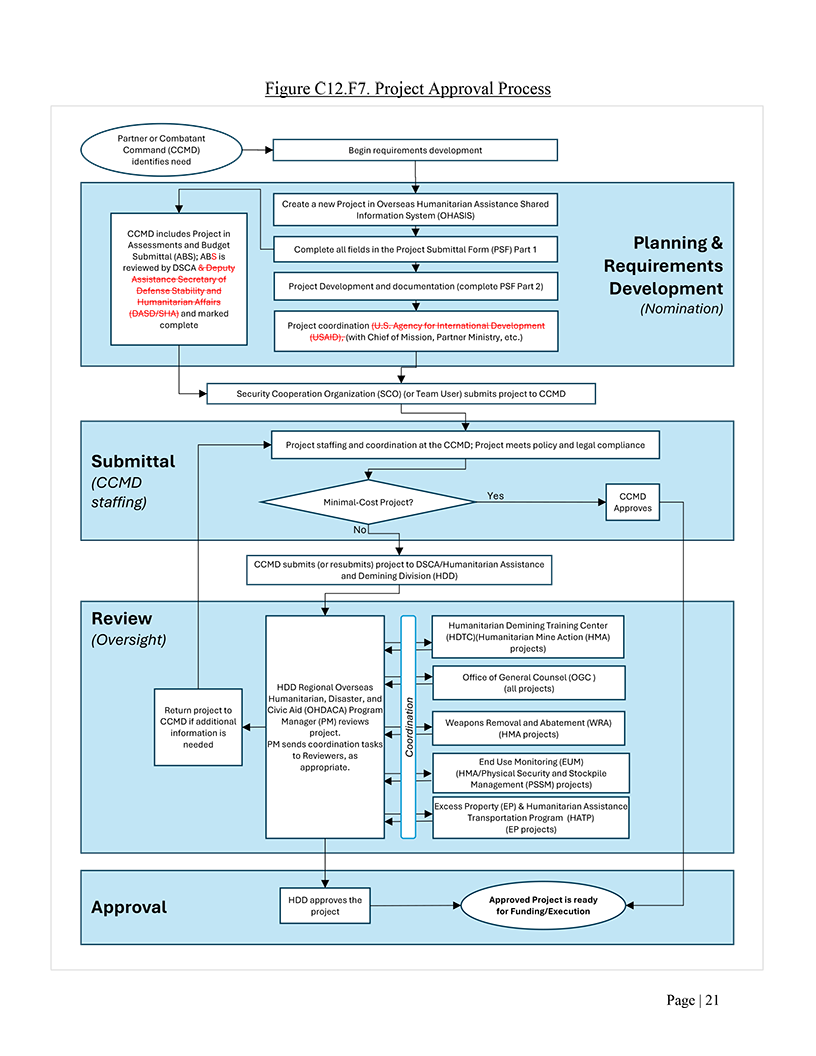
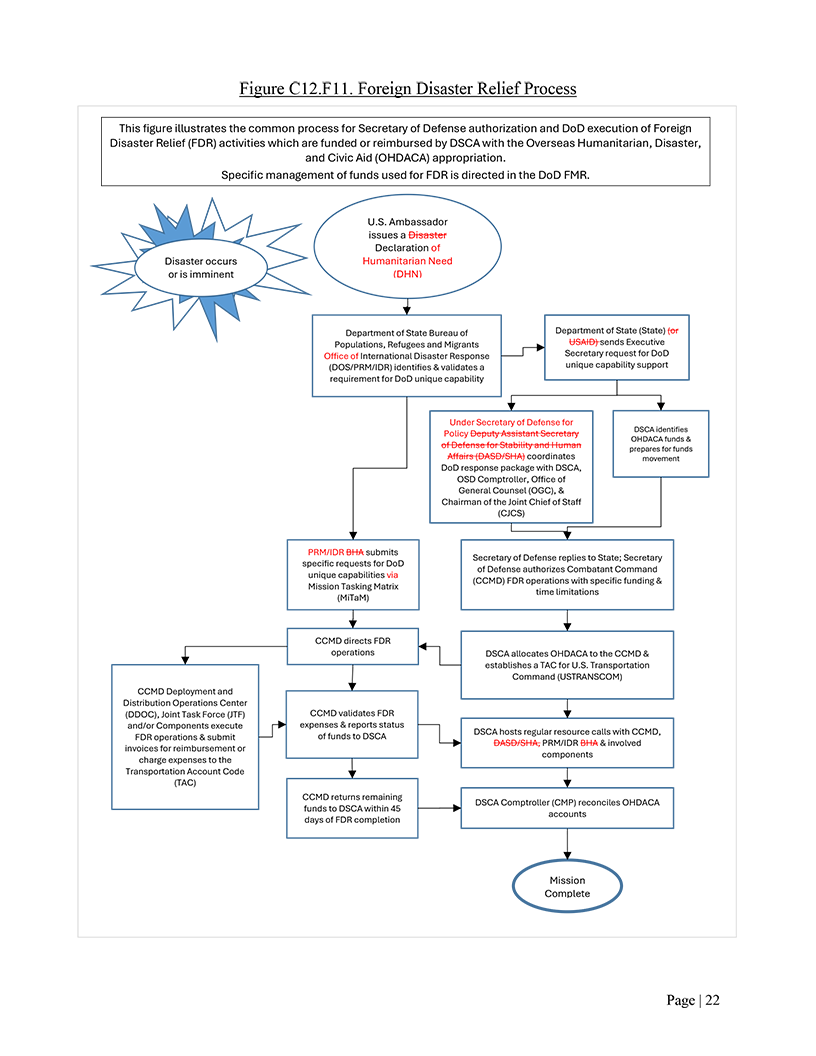
Update Figure C12.F2., Figure C12.F7., and Figure C12.F11. as shown below:
[Combatant Command] Input for Humanitarian Mine Action Congressional Report
The Department of Defense is authorized by Title 10 U.S.C. 407 to provide humanitarian demining assistance and stockpiled conventional munitions assistance to partner countries. Supplies, Equipment, and Services (SE&S) to participating partners in a worldwide amount not to exceed a specified limit. SE&S support during Fiscal Year (FY) 20XX totaled $X,XXX,XXX.
Partner Nation
1Total Cost
($000)2SE&S Cost ($000)3
Type of AssistanceHumanitarian Mine Action Activity 4
Country X
170 XX
125
1,3,4
Country Y
190 XX
36
1,2,4
Country Totals
360 XX
161
Humanitarian Demining Training Center(HDTC)
78 XX
37
Grand Total
X,XXX,XXX
X,XXX,XXX
Demining assistance and/or stockpiled conventional munitions assistance was not provided in the following Partner Nations during the preceding fiscal year due to insufficient numbers of DoD personnel:
(list of countries)
Note1: List of partners for which humanitarian demining assistance or stockpiled conventional munitions assistance was carried out during the preceding year.
Note2: The total amount expended in carrying out such assistance for each partner.
Note3: The amount expended to provide supplies, equipment, and services in each Partner Nation.
Note4: Type of Humanitarian Mine Action (HMA) assistance carried out in each Partner Nation. HMA activity type codes are as follows:
- Personnel Temporary Duty (TDY) and travel, Requirements Development Site Survey (RDSS) completion (all expenses which are not SE&S)
- Demining, and survey, marking, mapping, clearance, disposal, and quality assurance/control training;
- Physical Security and Stockpile Management (PSSM), to include training and technical assistance with respect to explosive safety, disposal, demilitarization, physical security, and stockpile management;
- Casualty care training, to include first responder/advanced medical, surgical, and rehabilitation training;
- Explosive Remnants of War (ERW) disposal training and mine risk education and awareness.