Chapter 8, End Use Monitoring (EUM), describes the EUM plan and procedures for defense articles and services provided by the USG to partners that are designated as Routine EUM (REUM) or Enhanced EUM (EEUM), which encompasses Case Unique Enhanced defense articles. It includes procedures for assisting partners in fulfilling Department of State (State) requirements prior to retransfers, changes of end use, disposals, and for verifying appropriate demilitarization requirements.
Section | Title |
|---|---|
C8.1. | |
C8.2. | |
C8.3. | |
C8.4. | |
C8.5. | |
C8.6. | |
C8.7. | |
C8.8. | End Use Monitoring at the Time of Disposal and Demilitarization. |
C8.9. |
C8.1.1. End Use Monitoring (EUM) is the process of verifying that defense articles and services transferred from the U.S. to our partners are being used, stored, and disposed of in accordance with the terms and conditions of the transfer agreements. It is a critical and mandatory component of U.S. security cooperation policy, helping to ensure defense articles and services are used in accordance with legitimate security needs and are not transferred to unauthorized recipients. In accordance with Section 505 of the Foreign Assistance Act (FAA) (22 U.S.C. 2314), as amended, Arms Export Control Act (AECA), Section 3 (22 U.S.C. 2753) and AECA, Section 4 (22 U.S.C. 2754), and as reflected in the Letter of Offer and Acceptance (LOA) Standard Terms and Conditions (see Figure C5.F8.), partners must agree to use U.S.-provided defense articles, training, and services only for their intended purpose; not to transfer title to, or possession of, any defense article or related training to anyone not an officer, employee, or agent of that partner or of the USG without prior written consent of the USG; to maintain the security of any article with substantially the same degree of protection afforded to it by the USG; and to permit observation and review by, and to furnish necessary information to, representatives of the USG with regards to use of such defense articles. EUM provides USG oversight to confirm that these conditions are met. All potential end use violations must be reported through Department of State (State) channels. Information regarding any potential violations should also be forwarded to the EUM team at the DSCA (Office of International Operations, Global Execution Directorate, End Use Monitoring Division (IOPS/GEX/EUM)), the appropriate geographic Combatant Command (CCMD), and the appropriate U.S. Military Department (MILDEP).
Table C8.T1. End Use Monitoring Legal and Policy References
Reference | Subject |
|---|---|
Requires EUM of defense articles and services sold, leased, or exported under the AECA or the FAA. | |
Establishes standards for identifying high-risk exports for end use verification. | |
AECA, Section 3(g) (22 U.S.C. 2753(g) and Section 4 (22 U.S.C. 2754) | Requires agreements for the sale or lease of articles on the United States Munitions List (USML) (made after November 29, 1999) to state that the USG retains the right to verify credible reports that the defense article(s) has been used for purposes not authorized under AECA, Section 3 (22 U.S.C. 2753). |
Requires Recipient agreement to use the materiel/services properly; return net proceeds from sales as required; and permit observation of the end use of articles, services, and training. | |
Implementation of Trade Security Controls (TSC) for Transfers of DoW USML and Commerce Control List (CCL) Personal Property to Parties Outside of DoW Control. | |
Registration and EUM of Defense Articles and/or Services. | |
DoD Manual (DoDM) 4160.28 | Defense Demilitarization Manual |
Physical Security of Sensitive Conventional Arms, Ammunition, & Explosives (AA&E). |
C8.2.1. End Use Monitoring Legislative Requirement. Arms Export Control Act (AECA), Section 40A (22 U.S.C 2785) requires the President to establish an End Use Monitoring (EUM) program to improve accountability with respect to defense articles sold, leased, or exported under the AECA or Foreign Assistance Act (FAA). The Director of DSCA has the delegated authority from the Secretary of War (SECWAR) and Under Secretary of War for Policy (USW (P)) to administer the DoW’s Golden Sentry EUM program to comply with AECA, Section 40A (22 U.S.C 2785). AECA, Section 40A (22 U.S.C 2785), requires the EUM program be designed to provide reasonable assurance, to the extent practicable, that the recipient is complying with the requirements imposed by the USG with respect to the use, transfer, and security of defense articles and services. The program must also provide for the end use verification of defense articles that incorporate sensitive technology, and/or are particularly vulnerable to diversion or other misuse, or whose diversion or other misuse could have significant consequences. Congress requires an annual report describing actions taken to implement AECA, Section 40A (22 U.S.C 2785), including a detailed accounting of the costs and number of personnel associated with the monitoring program.
C8.2.2. Department of War Golden Sentry Program. Golden Sentry is DSCA’s comprehensive EUM program for FMS and other government-to government transfers. It includes policies, procedures, tools, and a global network of EUM professionals who work with our partners to maintain accountability of U.S.-provided items throughout their life cycle. Golden Sentry promotes transparency, strengthens partner trust, and helps protect U.S. national security interests. Golden Sentry’s objective is to ensure compliance with technology control requirements in order to minimize security risks to the United States, partners, and Allies. EUM includes all actions to mitigate misuse or unauthorized transfer of defense articles from title transfer until disposal. The type of defense article generally determines the level of monitoring required. The Director of DSCA may also determine, in consultation at the General Officer, Flag Officer, or Senior Executive Service (SES) level, that a change in physical security and accountability monitoring may be warranted after considering the specific defense article in question and based on assessment of the threat to security in the area or for other compelling reasons. When changing events or other unusual circumstances prompt Security Cooperation Organization (SCO) concern regarding the end use and security of U.S.-provided defense articles, SCOs should contact DSCA (Office of International Operations, Global Execution Directorate, End Use Monitoring Division (IOPS/GEX/EUM)) to obtain further guidance. SCO requests for modification in physical security and accountability monitoring must be formally submitted in writing and endorsed by the geographic Combatant Command (CCMD) prior to being forwarded to DSCA.
C8.2.3. End Use Monitoring Responsibilities. Monitoring the use of U.S.-provided defense articles is a joint responsibility of the partners and the USG, to include the MILDEPs, the CCMDs, and the SCOs. USG representatives have full responsibility for defense articles until title is transferred to the partner. The partner assumes this responsibility for transferred defense articles based on the terms under which the transfers are made, including restrictions on physical security and accountability. USG representatives retain a continuing responsibility under Golden Sentry to assist DSCA to verify the appropriate end use and security of U.S.-provided defense articles sold or transferred on a government-to-government basis. Table C8.T2. lists the EUM responsibilities for various DoW organizations.
Table C8.T2. Department of Defense End Use Monitoring Responsibilities
Organization | Responsibility |
|---|---|
DSCA (IOPS/GEX/EUM) |
|
DSCA (Defense Security Cooperation Service (DSCS)) |
|
MILDEPs and Implementing Agencies (IAs) |
|
CCMDs |
|
SCOs (including Defense Attaché Offices and U.S. Diplomatic Missions with Security Assistance responsibilities) |
|
|
C8.2.4. Post-Delivery Monitoring. Post-delivery monitoring is performed by USG personnel assigned to SCOs or deployed to the partner in support of SCO functions. The Golden Sentry program employs two post-delivery monitoring methodologies to perform DoW’s EUM responsibilities: Routine End Use Monitoring (REUM) and EEUM. To assist SCOs in conducting post-delivery monitoring of both types, an EUM application is available in SCIP-EUM as a repository of data, to record REUM and EEUM checks, and to generate reports. SCOs must develop EUM SOPs to implement country-specific EUM policy and procedures. A copy of the SOP must be forwarded to dsca.ncr.bpc.mbx.eum-helpdesk@mail.mil. Written SOPs must contain at a minimum the following information:
Table C8.T3. Standard Operating Procedures Minimum Information Requirements
# | Standard Operating Procedures Minimum Information Requirements |
|---|---|
1 | EUM responsibilities and procedures for conducting REUM and EEUM. |
2 | Partner EUM POCs and procedures for coordinating and conducting EUM-related visits. |
3 | Procedures for conducting timely physical security checks of the storage facilities and inventories of EEUM-designated defense articles and services in accordance with DoW Golden Sentry EEUM checklists; use of the SCIP-EUM database to track inventories and maintain an accurate disposition of EEUM-designated defense articles; maintenance of records of REUM and EEUM assessments (by using DoW Golden Sentry EEUM checklists); and notifying the partner of all EEUM assessments performed for information and/or corrective action. |
4 | Procedures for maintaining an accurate baseline of EEUM-designated defense articles transferred to the partner as per the EEUM Reconciliation Report provided in the SCIP-EUM database, and obtaining partner reports of losses, firings/expenditures, or disposal of all EEUM-designated defense articles. |
5 | Procedures for verifying the demilitarization and disposal of EEUM-designated defense articles; reporting inventories, losses, theft, unauthorized access, third party transfers, disposal, damaged, expended defense articles, and possible violations. |
6 | Procedures for capturing and submitting to DSCA and DSCS actual costs and projected FMF Administrative funding required to perform EEUM activities. |
C8.3.1. Routine End Use Monitoring. Unless designated otherwise, Routine End Use Monitoring (REUM) is required for all defense articles and services provided via government-to-government programs. Security Cooperation Organization (SCO) personnel are required to observe and report to the Combatant Command (CCMD), DSCA, and Department of State (State) any potential misuse or unapproved transfer of U.S.-provided defense articles. SCO personnel should perform REUM observations at every available opportunity in conjunction with other security cooperation functions to include visits to the partner’s installations, through interaction with other assigned embassy personnel, and from any other readily available or opportune source of information. SCOs must conduct REUM observations at least quarterly and must document all REUM observations in the Security Cooperation Information Portal (SCIP)- End Use Monitoring (EUM) database using the REUM check entry form available on the REUM page.
C8.3.1.1. Routine End Use Monitoring in the Security Cooperation Information Portal. To assist SCOs in conducting REUM checks, DSCA has developed a Foreign Military Sales (FMS) REUM Summary Report located in the SCIP-EUM database under the Queries/Reports menu. This report provides a list of specific categories of defense articles exported via FMS that includes, but is not limited to: battle tanks, armored combat vehicles, artillery systems, fixed and rotary wing aircraft, unmanned aerial systems (UAS), warships and military vessels, select missiles and missile systems, military vehicles, bombs, crew served and individual weapons, and other systems. To assist SCOs in electronically documenting REUM checks performed, DSCA developed a REUM template located in the SCIP-EUM database under the Support-Policy/Procedures Memos.
C8.3.2. Articles or Services Requiring Additional Controls on End Use. There are instances in which defense articles normally subject to REUM are transferred with notes restricting the conditions under which they may be transported, stored, or employed. SCOs should be aware of these restrictions and alert to indications or reports that suggest failure to comply.
C8.3.3. Arms, Ammunition, & Explosives. Arms, Ammunition and Explosives (AA&E) defense articles require unique protection and security measures. The DoW applies stringent AA&E controls while these defense articles are in U.S. custody and requires the partner to apply similar controls to the defense articles upon release to the purchaser. During Case Development, Implementing Agencies (IAs) should assess secure transportation and distribution options that support customer preferences. A detailed Transportation Plan is required by DoW prior to delivery of the materiel. Once approved, a Transportation Plan becomes an integral part of the Letter of Offer and Acceptance (LOA) and is available for review by U.S. Customs and security officials. Although recipient countries generally do not assume control of sensitive AA&E defense articles within the continental United States (CONUS), except as cargo loaded and prepared for departure, USG security standards must apply throughout the lifecycle of the defense article (e.g., transportation, delivery, testing, operational use, storage, and destruction processes). Additionally, a site survey may be required to ensure that appropriate physical security measures are in place at the destination prior to the delivery of the defense article. See Department of Defense Manual (DoDM) 5100.76 "Physical Security of Sensitive Conventional Arms, Ammunition, and Explosives (AA&E)", and the Section C7.15. for more information regarding AA&E defense articles.
C8.3.4. White Phosphorous and Cluster Munitions. Munitions containing White Phosphorous (See Section C4.4.8.) and cluster munitions permissible for transfer under U.S. law (See Section C4.4.6.) have additional end use restrictions. SCOs should be aware of partner inventories of these munitions, and the additional restrictions placed on them, and be informed on how the partner is employing them in operations. SCOs should report to DSCA (Office of International Operations (IOPS)), Country Portfolio Director (CPD) and DSCA (Office of International Operations, Global Execution Directorate, End Use Monitoring Division (IOPS/GEX/EUM)) any information that suggests these defense articles are not being used in accordance with the terms under which they were transferred.
C8.4.1. Definition. Enhanced End Use Monitoring (EEUM) is a designation mechanism that provides greater USG oversight and more robust assessment of partner compliance with the transfer conditions of Letters of Offer and Acceptance (LOAs) and other government-to-government (G2G) transfer agreements. Defense articles are designated EEUM based on criteria established in Section C8.4.4. EEUM-designated defense articles require enhanced accountability, which include physical security assessments of partner storage sites and inventories conducted by serial number. EEUM-designated defense articles transferred through the Foreign Military Sales (FMS) process (see Section C4.3.5.2.) must be sold on defined order lines using an EEUM-coded Military Articles and Services List (MASL) designator and include physical security and accountability notes. The defense articles listed in Table C8.T4. in the CAC-SAMM (DoW CAC holders only) have been designated for EEUM for all FMS-eligible countries. Other defense articles may require Case Unique EEUM and/or additional U.S. control measures (e.g. U.S. custody and/or electronic monitoring) which are determined on a case-by-case basis in the transfer approval process. Contact DSCA (Office of International Operations, Global Execution Directorate, End Use Monitoring Division (IOPS/GEX/EUM)) at dsca.ncr.bpc.mbx.eum-helpdesk@mail.mil for a list of such Case Unique EEUM-designated articles.
Table C8.T4. Defense Articles Designated for Enhanced End Use Monitoring for all Foreign Military Sales-eligible Countries
"Table C8.T4. Defense Articles Designated for Enhanced End Use Monitoring for all Foreign Military Sales-eligible Countries" is located in the Common Access Card (CAC)-Enabled SAMM site, which is located at: at: https://dod365.sharepoint-mil.us/sites/OSDDSCA-CUI-SAMM.
For information on EUM content in the CAC-Enabled SAMM, contact: DSCA (IOPS/GEX/EUM) at dsca.ncr.bpc.mbx.eum-helpdesk@mail.mil. DoW CAC Holders: please contact DSCA (Office of Strategy, Plans, and Policy, Execution Policy and Analysis Directorate (SPP/EPA)) at dsca.ncr.spp.mbx.epa@mail.mil with any questions regarding access to the site.
C8.4.2. Defense Articles Designated for Case Unique Enhanced End Use Monitoring. For information on defense articles that require Case Unique EEUM, contact DSCA ((IOPS/GEX/EUM)) at dsca.ncr.bpc.mbx.eum-helpdesk@mail.mil.
C8.4.3. Enhanced End Use Monitoring Designation Process. Performing EEUM activities requires commitment of USG and partner resources; therefore, DSCA provides oversight and administration of U.S. provided defense articles designated for EEUM. MILDEPs/Implementing Agencies (IAs) recommending a defense article to be designated for EEUM must submit a request to DSCA signed at the General Officer, Flag Officer or Senior Executive Service (SES)-level.
C8.4.4. Criteria for Recommending Enhanced End Use Monitoring Designation. DSCA and State PM shall review and approve a MILDEP/IA, Interagency, or Congressional recommendation to designate a defense article for EEUM. A MILDEP/IA recommendation may be justified due to a MILDEP/IA’s need for: (1) EEUM to serve a prerequisite requirement for the MILDEP/IA’s conditional transfer approval during the release review process; (2) DoW personnel to periodically verify a partner’s compliance with specific physical security requirements applicable to the transferred defense article; and/or (3) DoW personnel to accomplish an annual serial number inventory as the only reasonably available and necessary measure to mitigate the risk of an unauthorized transfer causing exceptionally grave or serious damage to U.S. national security interests. When assessing the potential adverse consequences to U.S. national security interests due to an unauthorized disclosure or transfer of a defense article, the MILDEP/IA must consider the following criteria:
- Critical Program Information: The potential degradation or loss of a U.S. critical military technical or intelligence advantage over adversaries due to the unauthorized disclosure of the transferred defense article’s critical program information.
- Embedded Cryptography: The degradation or compromise of the U.S. military’s ability to conduct secure communications due to the unauthorized transfer of a defense article’s embedded cryptography.
- Diversion Threat: The increased threat of hostile acts against U.S. forces, partner forces, or noncombatants due to the unauthorized transfer of a highly portable and concealable defense article which is susceptible for use by entities seeking to commit acts of sabotage, insurrection, or terrorism (e.g. man-portable air-defense systems (MANPADS)).
C8.4.4.1. Sources for Enhanced End Use Monitoring Recommendations. The following sources may potentially condition their transfer approval upon an EEUM designation:
C8.4.4.1.1. Military Department / Implementing Agency Releasability Determination. The MILDEP/IA releasability determination requires EEUM designation to mitigate concerns.
C8.4.4.1.2. Interagency Releasability Determination. An interagency releasability determination (e.g., for the transfer of classified information or sensitive technology) requires EEUM designation to mitigate concerns.
C8.4.4.1.3. Congressional Requirement. EEUM designation is accomplished to resolve U.S. Congressional concerns regarding a proposed transfer.
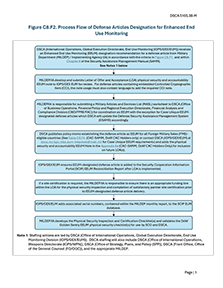
C8.4.5. Flow Chart of Enhanced End Use Monitoring Designation. Figure C8.F1. depicts the process for defense articles to be designated for EEUM. Figure C8.F2. depicts the execution work flow for defense articles designated as required for EEUM.
Figure C8.F1. Designating Defense Articles for Enhanced End Use Monitoring
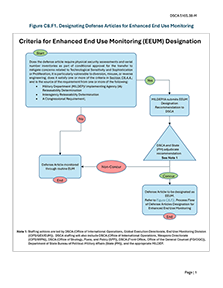
Figure C8.F2. Process Flow of Defense Articles Designation for Enhanced End Use Monitoring
C8.4.5.1. Controlled Cryptographic Items. All Controlled Cryptographic Items (CCI) are designated for EEUM and are documented in CCI management systems other than the Security Cooperation Information Portal (SCIP). Transferred CCI are changed from EEUM to Routine EUM in SCIP (unless it is EEUM for additional reasons) but retain the EEUM and documentation requirements, as follows:
C8.4.5.1.1. The assessments and reporting of EEUM for CCI purchased by Partners or Allies and retained by USG or industry for testing, integration, etc., are performed by the USG or industry's respective CCI safeguarding, accountability, and reporting procedures.
C8.4.5.1.2. The assessments and reporting of EEUM for CCI transferred to the North Atlantic Treaty Organization (NATO), NATO member nations, Australia, and New Zealand are performed by the respective partner in accordance with their CCI policies and regulations.
C8.4.5.1.3. The assessments and reporting of EEUM for CCI transferred to international organizations other than NATO and non-NATO member nations except Australia and New Zealand who have signed a Communications Interoperability and Security Memorandum of Agreement (CISMOA) or like agreement is accomplished by the FMS-funded U.S. CCI custodians.
C8.4.5.1.4. The assessments and reporting of EEUM of CCI transferred to non-NATO member nations who have not signed a Communications Interoperability and Security Memorandum of Agreement (CISMOA) or like agreement is accomplished by the SCOs and reported to their respective theater CCMD Theater CCI Account. CCMDs must ensure SCOs perform the required CCI physical security and accountability assessments.
C8.4.5.1.5. Network Enabled Weapons (NEW) with National Security Agency (NSA) Type 1 CCI encrypted datalink require CCI EUM in accordance with Section C8.4.5.1. and may require additional monitoring requirements. See Table C8.T4. in the CAC-SAMM (DoW CAC holders only) or contact DSCA (IOPS/GEX/EUM) at dsca.ncr.bpc.mbx.eum-helpdesk@mail.mil for more information on Case Unique EEUM requirements.
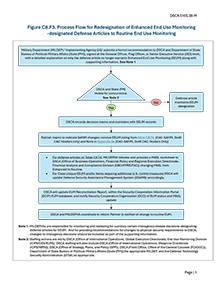
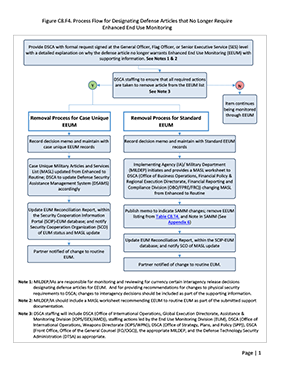
Figure C8.F3. Process Flow for Redesignation of Enhanced End Use Monitoring-designated Defense Articles to Routine End Use Monitoring
C8.4.5.2. Determining the Military Articles and Services List End Use Monitoring Code. DSCA (IOPS/GEX/EUM), will coordinate with DSCA (Office of Business Operations (OBO)) and the respective MILDEP/IA to determine the defense article's MASL EUM code. The MASL EUM code of a defense article designated as Enhanced for all FMS exports will be coded as "E". The MASL EUM code of a defense article designated for Routine EUM (REUM) will be coded as "R". If it is determined in the transfer approval process that a defense article that is normally identified as Routine is required to be treated as Enhanced for a specific sale, the MILDEP/IA will request DSCA to use a Case Unique MASL coded "E" for use of the sale.
C8.4.5.3. Developing Letter of Offer and Acceptance Physical Security and Accountability Enhanced End Use Monitoring Note. MILDEP/IAs are responsible for providing DSCA subject matter expert support in drafting security, accountability, and USG control measures included on the LOA to ensure that the parameters levied in the EEUM-designation are met for all EEUM defense articles. This includes the development of physical security and accountability EEUM notes to be incorporated in an LOA or other transfer agreement. The MILDEP/IAs shall provide any desired updates to EEUM notes to DSCA (IOPS/GEX/EUM) for coordination and approval. DSCA (IOPS/GEX/EUM) will coordinate with the other relevant MILDEP/IAs (Headquarters and Program Offices), DSCA (Office of Strategy, Plans, and Policy (SPP)), DSCA (Office of International Operations, Weapons Directorate (IOPS/WPN)), DSCA (Office of International Operations, Global Execution Directorate, Case Writing and Development Division (IOPS/GEX/CWD), and DSCA (Front Office, Office of the General Counsel (FO/OGC)). EEUM Notes that are coordinated and approved by DSCA (IOPS/GEX/EUM) for a Case Unique EEUM defense article will be used each time the same Case Unique EEUM defense article is included on a different LOA.
C8.4.5.4. Incorporation of Physical Security and Accountability Enhanced End Use Monitoring Notes for Letters of Offer and Acceptance. Physical security and accountability EEUM notes will be included in the LOA by the IA responsible for these defense articles. Additional information on EEUM is available on the CAC-SAMM (DoW CAC holders only). For additional information on EUM content in the CAC-Enabled SAMM, contact: DSCA (IOPS/GEX/EUM) at dsca.ncr.bpc.mbx.eum-helpdesk@mail.mil.
C8.4.5.5. Developing and Validating Enhanced End Use Monitoring Checklists. DSCA (IOPS/GEX/EUM) will coordinate with the respective MILDEP/IA, as required, to develop and publish in the SCIP EUM database the DoW Golden Sentry EEUM checklists for defense articles or technology designated for EEUM. The relevant SCO and DSCA (IOPS/GEX/EUM) will validate the DoW Golden Sentry EEUM checklists during EEUM checks and will provide the MILDEP/IA recommendations for improvement when required.
C8.4.6. Application of Additional Control Measure Requirements. Select defense articles may require additional U.S. control measures (e.g. U.S. custody, frequent testing, etc.) as a condition of the transfer approval. In these instances, all costs necessary to implement the additional USG control measures, levied as part of the transfer approval, that goes beyond EEUM assessments mentioned in this chapter, will be paid by the partner. The partner’s obligation to pay for these additional control measures through either national funds or via grant security assistance funds will be stated in the LOA security and accountability note.
C8.4.7. Review of Enhanced End Use Monitoring-Designated Defense Articles. Each MILDEP/IA must annually assess the applicability of continued EEUM for its respective defense articles in Table C8.T4. in the CAC-SAMM (DoW CAC Holders Only) and Case Unique EEUM (for Case Unique EEUM requirements, contact DSCA (IOPS/GEX/EUM) at dsca.ncr.bpc.mbx.eum-helpdesk@mail.mil for more information). The MILDEP/IA must notify DSCA (IOPS/GEX/EUM) upon completion of its assessment.
C8.4.8. Site Surveys/Certification of Storage Sites. With the exception of Night Vision Devices (NVDs), CCI, or DSCA designated hostile environments (see Section C8.5.9.), MILDEP/IAs are responsible for conducting physical security assessments to certify partner storage sites. EEUM-designated defense articles may not be transferred to an uncertified site. MILDEP/IA will certify partner defense article storage sites to standards specified in accordance with Department of Defense Manual (DoDM) 5100.76 “Physical Security of Sensitive Conventional Arms, Ammunition and Explosives,” or by other appropriate authorities for EEUM articles not listed in DoDM 5100.76. Discrepancies identified during the physical security storage site assessments shall be corrected or compensatory measures implemented prior to the transfer of any EEUM-designated defense articles.
C8.4.8.1. Security Managers and Storage Site Certification Reports. The MILDEP/IA will ensure DSCA has a current list, by defense article, of all security inspectors/managers responsible for conducting physical security assessments and certifications. The MILDEP/IA will provide DSCA a copy of all site certification reports within 30 calendar days of conducting the site certification by ensuring the reports are uploaded to the site certification repository within the SCIP-EUM database.
C8.4.8.2. Storage Site Certification Costs. Table C9.T2A. (lines L16 and CE43) addresses the proper source of funding to pay for partner site certifications. Certification and re-certification of partner storage sites storing EEUM-designated defense articles shall be case-funded. FMS admin funds may be used to certify partner storage sites prior to LOA implementation; however, these costs must be reimbursed on the subsequent LOA. If an LOA is never implemented, the IA Pre-Letter of Request (LOR) funds remain the proper funding source.
C8.4.8.3. Storage Site Certification Reciprocity. Partner storage site certifications shall be conducted consistently with the appropriate Security Risk Category (SRC) of the defense article to be stored. Including specified storage site compensatory measures, storage site certifications by one MILDEP/IA in one SRC are reciprocally accepted for storage of defense articles offered by another MILDEP/IA in the same SRC. MILDEP/IA security inspectors/managers will coordinate storage site assessment visits with DSCA, Security Cooperation Organizations (SCOs), and other MILDEP/IAs in advance to mitigate duplication when another MILDEP/IA has already certified the same storage site for the associated SRC. The storage site certification repository within the SCIP-EUM database informs whether another MILDEP/IA has previously certified a proposed storage site location. DSCA will work with the MILDEP/IA to ensure standardized physical security assessment/certification checklists are developed.
C8.4.8.4. Storage Site Compensatory Measures. All MILDEP/IA storage site certifications shall be conducted consistently with the appropriate SRC or terms within transfer agreement of the defense articles. The MILDEP/IA must document any areas where partner storage sites do not meet the physical security requirements stated in DoDM 5100.76, by other appropriate authorities, or transfer agreements such as the LOA. Risk management principles may be utilized to identify whether any acceptable compensatory measures are required. SCOs shall verify that compensatory measures remain in place during annual inspections as documented by the MILDEP/IA.
C8.4.9. Storage Site Changes. Changes to previously certified storage sites resulting in non-compliance with physical security requirements will need to be recertified. See Section C8.4.8.2. for guidance on Storage Site Certifications costs.
C8.5.1. End Use Monitoring Visit Guidance. The Golden Sentry End Use Monitoring (EUM) program includes in-country visits. There are three types of EUM visits.
- Familiarization and Assistance Visits (FAV)
- Compliance Assessment Visits (CAV) or Virtual Compliance Assessments (VCA)
- Focused EUM Verification Assessments (FEVA)
C8.5.2. End Use Monitoring Familiarization and Assistance Visits Guidance. The purpose of an EUM FAV is to assist the partner, the Security Cooperation Organization (SCO) (or equivalent organization/office), and the Combatant Command (CCMD) in developing an effective EUM compliance program. It also provides an opportunity for the DSCA EUM representative to determine the requirements for conducting potential future EUM visits. A FAV may be prompted by a request from the partner, SCO, the CCMD, or other USG stakeholder to validate EUM programs. A FAV can also be prompted by the introduction of a specific defense article into the country. Table C8.T5. outlines the timeline and formal requirements for a well-coordinated and documented EUM FAV. Informal correspondence may occur prior to these actions.
Table C8.T5. End Use Monitoring Familiarization and Assistance Visits Timeline and Requirements
Event No. | Timeframe | Description |
|---|---|---|
1 | Not later than 30 calendar days prior to visit |
|
2 | Upon receipt of Country/Theater clearance message |
|
3 | 15 calendar days prior to visit |
|
4 | Familiarization Visit |
|
5 | No later than 15 calendar days after return to Continental United States (CONUS) |
|
C8.5.3. End Use Monitoring Compliance Assessment Visit Guidance. The purpose of a CAV or VCA is to review and evaluate the SCO's (or equivalent organization/office) compliance with Golden Sentry EUM policy and procedures in accordance with Table C8.T2., by using the SCO checklist (available in the Security Cooperation Information Portal (SCIP)-EUM database), and the partner's compliance with specific physical security and accountability requirements, as well as other terms stated in the transfer agreements, such as an Letter of Offer and Acceptance (LOA). Activities during a CAV or VCA may include storage site visits, record and documentation reviews, review of Routine EUM (REUM) and Enhanced EUM (EEUM) policies and procedures, and inventories of U.S.-provided defense articles. EUM CAVs or VCAs are coordinated in advance with the CCMD, SCO, and the partner to ensure the success of the assessment. To maximize resources and minimize disruptions, EUM site visits should be arranged to coincide with the scheduled partner’s inventory dates whenever possible. Table C8.T6. outlines the timeline and formal requirements to ensure a well-coordinated and documented EUM CAV or VCA. Informal correspondence may occur prior to these actions. Inability to obtain proper entry credentials for the CAV or VCA Team from the partner will result in unfavorable reports.
C8.5.4. End Use Monitoring Virtual Compliance Assessments Guidance. A VCA is conducted similar to a CAV (See Section C8.5.3.); however, conducted remotely and without travel by DSCA personnel. DSCA may conduct a VCA when circumstances exist that impede travel or other limitations where DSCA deems a VCA necessary. A VCA consists of reviewing and evaluating SCO compliance with Golden Sentry EUM Policy and partners' compliance with specific physical security and accountability agreements, provisos, and other terms stated in transfer agreements. However, a VCA does not provide the same degree of assessment as a CAV. The VCA timeline and requirements are identified in Table C8.T6. The VCA Guidance Plan can be found in the SCIP-EUM database.
C8.5.5. Compliance Assessment Visit / Virtual Compliance Assessment Planning. To assist in planning and coordination with the partner, a two-year CAV plan has been institutionalized through formal message notifications to the CCMDs and SCOs. The two-year plan is published at the beginning of each fiscal year and provides an anticipated quarterly CAV or VCA schedule by CCMD and partner. DSCA may, in coordination with the appropriate CCMD, perform additional out-of-cycle CAVs or VCAs as necessary to execute the Golden Sentry mission.
C8.5.5.1.1. DSCA Compliance Assessment Visit / Virtual Compliance Assessment Considerations. DSCA considerations for scheduling CAVs or VCAs include, but are not limited to, the following:
- Risk assessments, which will include intelligence analysis and estimates to assess risk of transfers of defense articles monitored by the Golden Sentry program's process.
- The types and quantities of REUM and EEUM-designated defense articles.
- The partner's history of compliance with transfer agreements.
- Current or previous reports of concerns relative to the country's protection of U.S.-provided defense articles.
- The SCO's history of compliance with the policies and procedures of the Golden Sentry program.
- The region's political or military stability.
- Opportunities to conserve resources by visiting more than one country in a region.
Table C8.T6. End Use Monitoring Compliance Assessment Visit Timeline and Requirements
Event No. | Timeframe | Description |
|---|---|---|
1 | Initial Notification Annually by Fiscal Year (FY) |
|
2 | Upon receipt of the Annual Fiscal Year CAV Message |
|
3 | 90 calendar days prior to the visit |
|
4 | 80 calendar days prior to visit |
|
5 | 70 calendar days prior to visit |
|
6 | 60 calendar days prior to visit |
|
7 | Not later than 30 calendar days prior to visit |
|
8 | Upon receipt of Country/Theater Clearance Message |
|
9 | 15 calendar days prior to visit |
|
10 | EUM CAV (on site) |
|
11 | Immediately upon identification of problems that preclude successful completion of the CAV |
|
12 | Immediately upon discovery of a potential Arms Export Control Act (AECA) Section 3 or Foreign Assistance Act (FAA) Section 505 violation. (See Section 8.6.) |
|
13 | No later than 5 working days after the visit |
|
14 | No later than 10 working days after the visit |
|
15 | No later than 15 working days after the visit |
|
16 | No later than 90 days after receipt of the CAV Report |
|
C8.5.6. Compliance Assessment Visit Rating Criteria. The CAV or VCA ratings are Outstanding, Satisfactory, Needs Improvement, and Unsatisfactory.
C8.5.6.1. Security Cooperation Organization Compliance Assessment. SCO responsibilities are stated in the SCO checklist published in the SCIP-EUM database. Table C8.T2. depicts the type of information contained within SCO checklists:
- Implementation of written Standard Operating Procedures (SOP) to perform REUM and EEUM;
- Implementation of physical security and accountability plan(s) (Night Vision Device (NVD) Control Plan) for the protection, storage, use and accountability of NVDs;
- Maintenance of records assessing REUM and EEUM defense articles;
- Accuracy of the partner's EEUM-designated defense articles baseline as per the EEUM Reconciliation Report provided in the SCIP-EUM database;
- Timely performance of physical security and accountability assessments of all EEUM-designated or defense articles in accordance with DoW Golden Sentry EEUM checklists;
- Use of the SCIP-EUM database to track inventories and to maintain an accurate disposition of EEUM-designated defense articles;
- Verification and proper coordination with Department of State, Bureau of Political-Military Affairs, Office of Regional Security and Arms Transfers (State (PM/RSAT)) for the demilitarization, disposal, or destruction of EEUM-designated defense articles;
- Accuracy and timeliness of reporting losses, expenditures, and destruction of EEUM-designated defense articles; and
- Proper coordination with State PM/RSAT regarding third-party transfer requests and approvals.
C8.5.7. Partner Compliance Assessment. Partner responsibilities are stated in the terms of the transfer agreements for U.S.-provided defense articles and services, including:
- Cooperation and coordination with USG officials to implement and maintain a viable EUM program for REUM and EEUM, including CAVs, VCAs, and FEVAs conducted by DSCA or authorized USG personnel;
- Mitigation or resolution of potential end use violations found during the assessments or previously reported by the SCO;
- Implementation of NVD physical security and accountability plan(s) (NVD Control Plan) as required;
- Implementation of physical security and accountability measures at storage sites maintaining EEUM-designated defense articles in accordance with the terms of the LOA or other transfer agreements;
- Reporting of EEUM-designated defense articles losses and of actions taken to prevent future losses (as appropriate), and transparency in reporting history; and
- Accurate and timely requests for, and reports of, demilitarization, disposal, destruction, loss, expenditure, or other change of end use of USG-provided defense articles.
C8.5.8. Focused End Use Monitoring Verification Assessments. The purpose of a FEVA is to examine possible violations of AECA Section 3 (22 U.S.C. 2753), Foreign Assistance Act (FAA) Section 505 (22 U.S.C. 2314), and any applicable diplomatic notes or agreements regarding U.S. provided defense articles and services. A FEVA may be prompted by intelligence reports and/or other sources that indicate a partner may be using U.S.-provided defense articles and services in ways that do not comply with U.S. laws and policies. A FEVA is conducted as expeditiously as possible within the required coordination for foreign travel. Due to the unique nature associated with this type of assessment, each FEVA is handled on a case-by-case basis and is ad-hoc in nature. A FEVA is directed at the discretion of the Director of DSCA and provides greater visibility and real-time situational awareness of U.S.-provided defense articles. A FEVA is a mechanism by which the Director can proactively address and assess concerns that may lead to end use violations.
C8.5.8.1.1. Transmittal. DSCA will transmit FEVA requests to SCOs through their assigned CCMD. The transmittal will identify the type, quantity, and location of U.S.-provided defense articles to be inspected and the date by which the verification must be completed. FEVA requests may include one or more U.S.-provided defense articles at one or more locations.
C8.5.8.1.2. Focused End Use Monitoring Verification Assessments Execution. SCOs will conduct FEVAs in accordance with procedures based on the EUM-designation assigned to the U.S.-provided defense article(s) being assessed. DSCA personnel may conduct the FEVA. FEVAs are considered complete once the SCO or authorized USG personnel has uploaded or submitted all required documentation to the SCIP-EUM database, as identified in Section C8.3. Routine EUM and Section C8.4. Enhanced EUM. As with any EUM assessment, potential end use violations must be immediately reported to DSCA and State through their respective EUM Potential End Use Violation inbox (Unclassified: dsca.ncr.fo.mbx.eum-violations@mail.mil and PM-EUM-Incidents@state.gov; or Classified: dsca.ncr.fo.mbx.eum-violations@ mail.smil.mil and PM-EUM-Incidents@ state.sgov.gov).
C8.5.9. Conducting End Use Monitoring in a Hostile Environment. The declaration of a hostile environment identifies a geographic area as unsafe for personnel due to instability, conflict, or other dangers. The declaration's specific impact on EUM activities depends on the issuing authority.
C8.5.10. Hostile Environment Declaration - Force Protection. A Combatant Commander, U.S. Ambassador, or other authorized USG official may declare a hostile environment for force protection concerns. This declaration notifies personnel of safety concerns and restrictions. However, such a declaration does not modify EUM related policies, processes, or procedures enacted to comply with the requirement in Arms Export Control Act (AECA), Section 40A (22 U.S.C. 2785) and Foreign Assistance Act (FAA), Section 505 (22 U.S.C. 2314) (grant items) that the EUM program provides reasonable assurance, to the extent practical, that the partner is complying with U.S. end use requirements. When a SCO is unable to assess a defense article due to it being located within an area formally identified as a hostile environment for force protection concerns, the SCO will consult with the DSCA EUM Program Manager to obtain DSCA authorization to use “NOBSEC: Not Available Due To Security Concerns” as the disposition status of the defense article within SCIP-EUM. The SCO will also upload documentation to validate the hostile environment declaration.
C8.5.11. Hostile Environment Declaration - Defense Security Cooperation Agency. The Director of DSCA is the delegated authority to declare a hostile environment that formally modifies EUM policies, processes, and procedures to include reporting of potential violations and the accountability of EEUM-designated defense articles in accordance with the LOA or other USG transfer agreements. Such declarations will be determined on a case-by-case basis and detailed guidance will be provided by DSCA for each authorized instance. DSCA (IOPS/GEX/EUM) will provide further guidance as necessary.
C8.5.12. Accountability of U.S.-Provided Defense Articles in DSCA Declared Hostile Environment Areas. The SCO or an authorized designated U.S. official shall conduct an initial 100 percent inventory, by serial number, of all EEUM-designated articles prior to shipment/movement/delivery into a hostile environment area. A designated U.S. official is defined as a person who has received EUM training, has an CCMD endorsement, in writing, at the Senior Executive Service (SES)/07 General Officer/ Flag Officer level, has concurrence by the U.S. Ambassador, and is either USG personnel, to include serving in locally employed embassy staff positions, or a U.S. contractor. The SCO or designated U.S. official shall upload the Combatant Command written appointment or endorsement to the SCIP-EUM database. The SCO shall assist designated U.S. and partner officials in developing and implementing improved inventory management and accountability procedures of EEUM-designated defense articles that are located within the declared hostile environment area(s).
C8.5.13. Use of Partner Self-Reporting. When USG-led EEUM assessments are not feasible for DSCA declared hostile environment areas, partner self-reporting may be allowed with DSCA authorization and at the discretion of DSCA. Designated partner officials may satisfy EUM requirements by providing the SCO with records of inventories, or other physical and electronic accountability records to include records derived using EUM-approved barcode scanners. DSCA requires the following criteria to be submitted for review before a determination may be made to authorize partner self-reporting:
- A CCMD memorandum to the SCO and DSCA, endorsed at the SES/07 General Officer/Flag Officer level, outlining the heightened security risk situation, restricted areas within the partner’s borders, and the necessity to modify EUM accountability and physical security assessment processes outlined in Table C8.T2.
- A partner signed Control Plan for each EEUM-designated defense article that the USG has transferred to the partner under grant authorities (e.g., title 10 Building Partner Capacity (BPC), Presidential Drawdown Authority (PDA), Third Party Transfers (TPTs)).
- Signed Control Plans of EEUM-designated defense articles are required to establish EUM requirements for defense article transfers outside LOA EUM assurances.
- A Control Plan template is available in the SCIP-EUM database under Support-Policy/Procedures Memos.
- A partner signed EEUM self-reporting Concept of Operations (CONOPS) describing the partner’s self-reporting procedures for conducting EUM activities in the absence of USG led observation and assessments.
C8.5.14. Acceptable Partner Documentation. SCOs shall update, and keep current, the disposition status of U.S. provided EEUM-designated defense articles within the SCIP-EUM database based on acceptable partner self-reported documentation. The SCO shall use the disposition status, “Observed by Partner Nation” within the SCIP-EUM database, for defense articles self-reported by the partner. All documentation shall include the defense article description, the serial number of each defense article, date of observation for each defense article, and current disposition status (e.g., active, expended, destroyed, or lost) for each defense article. Acceptable partner documentation can include:
- Electronic records generated by EUM approved barcode scanners.
- Physical partner accountability/inventory reports in accordance with DSCA EUM requirements.
- Reports on partner loss, damage, destruction, and expenditure reports in accordance with DSCA EUM requirements.
- Partner Hand receipts of deployed USG provided defense articles in accordance with DSCA EUM requirements.
C8.5.15. Submission of sensitive or classified data. For classified or sensitive partner self-reported data, the SCOs shall forward such partner data to dsca.ncr.iops-gex-amd.mbx.eum@ mail.smil.mil
C8.5.16. Frequency of Partner Self-Reporting. Subject to DSCA discretion, the frequency of partner self-reporting is based on the partner’s inventory and accountability requirements in accordance with the LOA, the Control Plan for each EEUM-designated defense article, and the partner self-reporting CONOPs.
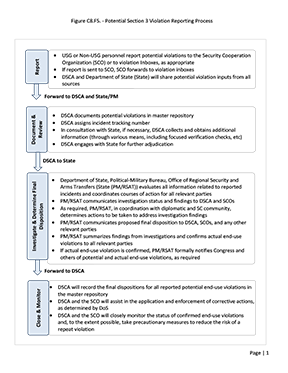
C8.6.1. Reporting Potential End Use Violations. The President is obligated, pursuant to the Arms Export Control Act, Section 3(c)(2) (22 U.S.C. 2753(c)(2)), to report end use violations to Congress. Department of State (State), with input from DoW, is the lead agency responsible for reporting end use violations. All DoW personnel must report any suspected end use violations of U.S.-provided defense articles, including unauthorized access, unauthorized transfers, security violations, or known equipment losses, to the USG either through the Security Cooperation Organization (SCO) or directly to DSCA and State through their respective End Use Monitoring (EUM) Potential End Use Violation inboxes (Unclassified: dsca.ncr.fo.mbx.eum-violations@mail.mil and PM-EUM-Incidents@state.gov; or Classified: dsca.ncr.fo.mbx.eum-violations@ mail.smil.mil and PM-EUM-Incidents@ state.sgov.gov). Any non-DoW personnel may also report suspected end use violations directly to these same organizations or through the same email addresses. In accordance with the AECA, Section 3 (22 U.S.C. 2753), State assesses reports of potential violations, leads the coordination of a USG response to include potential courses of action, and notifies Congress. When State receives information on potential end use violations through its channels, it will share that information with DSCA.
C8.6.1.1. Roles and Responsibilities for Investigation of a Suspected End Use Violation.
C8.6.1.1.1. Security Cooperation Organization. Forwards reports received from other USG or non-USG personnel as well as any potential violations uncovered during Enhanced or Routine EUM checks to the appropriate DoW and State EUM Potential Violation email inboxes. Assists in collecting or obtaining additional information related to a potential EUM violation. Assists in the enforcement and application of consequences, as determined by the State Department, resulting from confirmed end use violations.
C8.6.1.1.2. Defense Security Cooperation Agency (Office of International Operations, Global Execution Directorate, End Use Monitoring). DSCA (Office of International Operations, Global Execution Directorate, End Use Monitoring Division (IOPS/GEX/EUM)) monitors/manages the classified and unclassified DoW EUM Potential Violation email inbox. Maintains a master repository of reported potential end use violations. Ensures the SCO and proper points of contact (POCs) at the Combatant Command (CCMD) are aware of all reported potential violations in their Area of Responsibility (AOR). Assigns potential violation reports an incident tracking number. Assesses reports for completeness and credibility, and, when necessary, collects or obtains additional information. Assists in the enforcement and application of consequences, as determined by the State, resulting from confirmed end use violations.
C8.6.2. State Bureau of Political Military Affairs/Office of Regional Security and Arms Transfers. Department of State, Bureau of Political-Military Affairs, Office of Regional Security and Arms Transfers (State (PM/RSAT)) serves as the primary USG authority for responding to reports of potential end use violations, communicating to DoW the State investigation status of and other information related to potential end use violations. Receives potential end use violations and conducts investigations. In coordination with the diplomatic and security cooperation communities, determines the actions to be taken, if any, by the USG to address findings in the investigation reports. As necessary, reports findings to Congress.
C8.7.1. Third Party Transfer. In accordance with the Foreign Assistance Act (FAA), Section 505 (22 U.S.C. 2314); Arms Export Control Act (AECA) Section 3 (22 U.S.C. 2753); and the Letter of Offer and Acceptance (LOA) Standard Terms and Conditions (See Figure C5.F8.), foreign governments may not transfer title to or possession of any defense articles or services to anyone not an officer, employee, or agent (defined as freight forwarder only) of that country or of the USG until the country receives prior written consent from the USG. Nor may the foreign government use or permit the use of such articles or services for purposes other than for which they were furnished unless the foreign government receives prior written consent from the USG. The Security Cooperation Organizations (SCOs) should be aware of the pertinent agreements with the recipient country including any special diplomatic notes or agreements that apply to the defense articles involved. SCOs should contact their DSCA Country Portfolio Director (CPD) to ensure that they have all pertinent agreements.
C8.7.2. Third Party Transfer Responsibilities.
C8.7.3. Department of State. The Department of State (State) is responsible for authorizing all Third Party Transfers (TPTs) of U.S.-provided defense articles and/or services worldwide.
C8.7.4. Office of Regional Security and Arms Transfer. Department of State, Bureau of Political-Military Affairs, Office of Regional Security and Arms Transfers (State (PM/RSAT)) is responsible for coordinating State’s response for requests to transfer defense articles to a third party, including all associated components, technical data, training, and services originally acquired via Foreign Military Sales (FMS) or grant programs (e.g., Foreign Military Financing (FMF), P.L. 109-163, Military Assistance Program (MAP), Excess Defense Articles (EDA), Presidential Drawdown Authority (PDA)) and requests for the demilitarization and disposal of the defense articles. See the State’s Key Topics - Office of Regional Security and Arms Transfers web page for additional information.
C8.7.4.1.1. Directorate of Defense Trade Controls. Department of State Directorate of Defense Trade Controls (State (PM/DDTC)) Pursuant to AECA, Section 38 (22 U.S.C. 2778) and the International Traffic In Arms Regulations (ITAR) (22 C.F.R. 120-130), State (PM/DDTC) is responsible for processing requests to transfer defense articles or services originally acquired under a commercial export license or other commercial authorization (such as manufacturing license or technical assistance agreements). See ITAR Section 123.9. for additional information. State (PM/DDTC) also authorizes temporary imports of defense articles into the United States.
C8.7.5. Department of Justice. The Department of Justice’s (DoJ’s) Bureau of Alcohol, Tobacco, Firearms, and Explosives (BATFE) is responsible for control of the permanent import of U.S. Munitions List (USML) (22 C.F.R. 121.1) items into the United States. State approval of a retransfer request by a partner must precede and be separate from submission by the importer of an Bureau of Alcohol, Tobacco, Firearms and Explosives Form 6 import license application to BATFE.
C8.7.6. Department of War - Security Cooperation Organizations. SCOs are directly involved only in actions related to retransfers of defense articles received through DoW-administered programs. They do not process requests for retransfers of defense articles procured by commercial means. Partners make such requests directly to State (PM/DDTC) through their embassies in Washington, D.C. SCOs should refer partners to State on inquiries related to TPTs.
C8.7.7. Third Party Transfer Requests: Government-To-Government. The USG requires partners to obtain written consent from State (PM/RSAT) prior to transfer, disposal, or change of end use of its U.S.-provided articles, services, or technical data unless previously authorized by State. This includes defense articles and technical data obtained through FMS, MAP, or EDA programs. TPT decisions are made on a case-by-case basis and are guided by general criteria and specific TPT requirements of arms transfer law, regulations, and policies. The information required for the Standard Questionnaire is provided in Table C8.T7. See also State PM/RSAT’s Third Party Transfer (TPT) page for step-by-step instructions and an example of a completed questionnaire. Divesting partners may send TPT requests directly to the TPT Team at State (PM/RSAT) (PM_RSAT-TPT@state.gov), through their embassies, or through the SCOs. When a SCO receives documentation related to a TPT approval from State, the SCO must provide the pertinent documents to the End Use Monitoring (EUM) Help Desk (dsca.ncr.bpc.mbx.eum-helpdesk@mail.mil) for upload to Security Cooperation Information Portal (SCIP)-EUM. If the transfer involves EEUM-designated defense articles, the SCO must also provide the EUM Help Desk with the date the transfer was completed and the serial numbers of each defense article.
Table C8.T7. Required Information for Third Party Transfer Standard Questionnaire
# | Required Information |
|---|---|
1 | The name of the divesting government. |
2 | A clear description of the articles, services, technical data, or training being transferred including quantity, model, any associated equipment, spare parts and/or classified components or data. Also, where possible, indicate whether equipment is Significant Military Equipment (SME) or non-SME and the category under which the article is listed in the USML. Serial numbers must be provided for SME. If the equipment has been moved from the USML to the Commerce Control List (CCL) (a TPT is still required if items that are now on the CCL were acquired via FMS), please state if the equipment is on the CCL and identify the Export Control Classification Number (ECCN) if possible. If the items involve:
Requests involving the use of Foreign Integrators for U.S. COMSEC should include the following:
|
3 | The original acquisition source of the defense articles, services, technical data, or training proposed for transfer (e.g., FMS, grant, MAP, EDA, Building Partner Capacity (BPC) case transfer, etc.). The case identifier must be provided for FMS or an explanation as to why it is unavailable. |
4 | The year of original acquisition. |
5 | The original acquisition cost or best estimate of that cost. |
6 | The current value if available. |
7 | The reason the government wants to divest itself of the articles, services, technical data, or training. If by demilitarization and disposal, describe how it will be accomplished. |
8 | The proposed recipient. |
9 | Indicate whether the transfer is temporary or permanent. |
10 | If known, the proposed end use of the articles, services, technical data, or training by the proposed recipient. |
11 | Indicate whether the recipient has the defense article proposed for transfer in its inventory. |
12 | Estimation of net proceeds. In accordance with FAA, Section 505(f) (22 U.S.C. 2314(f)) and prerequisite bilateral agreements, if the defense articles were furnished to a country on a grant basis (e.g., MAP-grants, grant EDA), the net proceeds of the sale of the defense articles received by the grantee must be returned to the USG. The following factors relating to the defense articles should be considered in determining the net proceeds: the value of the defense articles when furnished by the USG as a percentage of the aggregate of the value of the defense articles when furnished by the USG added to the value of any capital investment incurred by the grantee in repairing, rehabilitating, or modifying the article (other than routine maintenance and repair expenses); depreciation of that value; and reasonable administrative costs of the sale or disposal. The party requesting the TPT of such defense articles must show it has employed a reasonable methodology in calculating the net proceeds [e.g., Net Proceeds = (Gross Sale Proceeds – Administrative Costs of Sale) x (Value at Transfer/(Value at Transfer + Value of Capital Investment))]. State may waive return of net proceeds in cases involving grant equipment delivered prior to 1985. There is no waiver authority for articles delivered after 1985. Requests for waiver consideration are included in written transfer requests and must include an estimate of the net proceeds expected, justification/rationale for the request to retain net proceeds, and how the funds will be used. |
13 | Indicate whether an intermediary is involved in the transfer. If so, provide a description of the role (broker, freight forwarder, etc.), the business address, and a point of contact. |
14 | Proposed timeframe or time constraints with regard to State processing of the request. If immediate action is required, provide explanation. |
15 | The name, title, and contact details for an official in the divesting and recipient countries with whom State (PM/RSAT) can discuss the transfer details and required end use, retransfer, and assurances. |
C8.7.7.1. End Use, Retransfer, and Security Assurances. State requires end use, retransfer, and security assurances from the proposed recipient’s Ministry of Foreign Affairs (MFA) unless the proposed recipient is a member of the Blanket Assurance Program. See Section C8.7.7.2. The assurances must be obtained by the divesting partner and submitted with the retransfer request. These assurances are mandatory, generally non-negotiable, and must be received by State before the transfer can be considered for approval. Assurances must be typed in English and signed by an official of the proposed recipient nation who can legally bind the entire government (usually the MFA). If the partner issues assurances signed by an official of a ministry other than the MFA, such as the Ministry of Defense, the U.S. Embassy in that nation must confirm in writing that his or her signature is binding. When language is supplied that does not appear to meet U.S. requirements, the State (PM/RSAT) TPT team coordinates with the Department’s legal counsel to determine whether the language will be accepted. If the language is deemed unacceptable, State (PM/RSAT) will not process the case.
C8.7.7.2. Blanket Assurances. Partners may sign blanket end use, retransfer, and security assurances to satisfy legislative requirements for future government-to-government retransfers. Partners that sign Blanket Assurances are not required to sign individual assurances to receive USG-provided defense articles from other U.S. partners.
C8.7.8. Third Party Transfer Requests Partner-to-Non-States or Private Entities. As stated in the FAA and AECA, defense articles and defense services are transferred to partners and international organizations to promote U.S. foreign policy objectives. Following the receipt of a request to transfer U.S.-provided defense articles and defense services from a partner or international organization, State adjudicates all requests for transfer of U.S.-provided military equipment to non-states, including private entities, nongovernmental organizations, international organizations, and other non-state groups, on a case-by-case basis. In submitting a government-to-non-state transfer request, the divesting partner and the SCO follow the same instructions as provided above in Table C8.T7. For retransfers to private entities, the request should include end use, retransfer, and security assurances from the proposed private entity recipient, as well as Country Over Private Entity (COPE) assurances from the government with legal jurisdiction over the private entity. The written transfer request should include contact details for a representative of the private entity. If a prime contractor is listed specifically on the LOA and is confirmed to be contracted by the USG in order to directly support and provide services to the USG on that FMS case, then a TPT request may not be required. DSCA (Office of International Operations (IOPS)) and State (PM/RSAT) will coordinate to identify the contractor in an LOA note.
C8.7.9. Congressional Requirements for Third Party Transfer. As provided in the FAA and the AECA, certain TPTs of defense articles, including all associated components, technical data, training, and services originally acquired via FMS or grant programs, are subject to congressional notification and reporting requirements.
C8.7.9.1. Congressional Notification. TPTs of defense articles and services originally acquired via FMS or grant programs are subject to requirements for congressional certification pursuant to AECA, Section 3(d) (22 U.S.C. 2753(d)) using certification thresholds similar to those for AECA, Section 36(b) (22 U.S.C. 2776(b)) notifications. See Table C5.T18. and Table C5.T22. A 30-day prior congressional certification is required for TPT requests that involve defense articles and services with original acquisition values that fall in one of the following categories: Major Defense Equipment (MDE) with an acquisition value equal to or greater than $14M for non-NATO recipients and $25M if the recipient is a member of NATO, Australia, Israel, Japan, the Republic of Korea, or New Zealand; or any other defense article or related training or defense service with an acquisition value of $50M or more for non-NATO recipients and $100M or more if the recipient is a member of NATO, Australia, Israel, Japan, the Republic of Korea, and New Zealand. For all recipients, approval is granted after the 30-day calendar day period has expired unless Congress enacts a joint resolution of disapproval.
C8.7.9.2. Transfers pursuant to arrangements among NATO members, or between NATO and any of its member countries for lead-nation procurement are exempt from AECA, Section 3(d) (22 U.S.C. 2753(d)) certification requirements if the defense article to be transferred was originally purchased from the United States, and the transferee on whose behalf the lead-nation procurement was proposed identified to Congress in a notification pursuant to AECA, Section 36(b) (22 U.S.C. 2776(b)). Information as to possible subsequent transfers by a NATO member country purchasing on behalf of a third NATO party shall be provided to DSCA for inclusion in AECA, Section 36(b) (22 U.S.C. 2776(b)) notifications. The certification requirement of AECA, Section 3(d) (22 U.S.C. 2753(d)) also does not apply to the following:
- Temporary transfer of defense articles for the sole purpose of receiving maintenance, repair, or overhaul;
- Transfer of maintenance, repair, or overhaul defense services, or of repair parts or other defense articles used in furnishing such services, if the transfer does not result in any increase, relative to the original specifications, in the military capability of the defense articles;
- Transfers pursuant to arrangements among NATO members for cooperative cross-servicing.
C8.7.10. Congressional Reporting. All approved TPTs involving defense articles and services with an original acquisition value of $1 million or more are submitted in a quarterly report to Congress (AECA, Section 36(a)(9) (22 U.S.C. 2776)).
C8.8.1. Changes to End Use. Requests to change the end use of U.S.-provided defense articles require Department of State, Bureau of Political-Military Affairs, Office of Regional Security and Arms Transfers (State (PM/RSAT)) authorization. Changes in end use for non-defense purposes may include partner demilitarization for museum display, conversion to commercial applications, and disposal. Defense articles used for purposes of static display may require demilitarization. Cannibalization is considered as disposal when the parts being removed will no longer be under the control of the ministry or agency that owns them or will be used for purposes other than for national defense.
C8.8.2. End Use Monitoring and the Disposal/Destruction Process. End Use Monitoring (EUM) of demilitarization is a key aspect of disposal activities due to the potential for unauthorized disclosure of classified or sensitive information, safety concerns, and other factors. During disposal, defense articles often move from operating units to holding areas, where personnel may not be aware of classified features, potential lethality, or other sensitivities. Security Cooperation Organizations (SCOs) are responsible for maintaining personnel trained in demilitarization procedures (by completing the Demilitarization Certifier/Verifier Course on the Defense Logistics Agency’s DEMIL Training webpage) and must ensure that DoW demilitarization procedures are followed by the partners unless State (PM/RSAT) has specifically authorized or required some other disposition. SCOs will witness the demilitarization and disposal of all Enhanced End Use Monitoring (EEUM)-designated and classified defense articles and will witness or otherwise verify through partner reports or other legitimate documentation the demilitarization and disposal of all other defense articles. SCOs should record demilitarization actions by uploading to the Security Cooperation Information Portal (SCIP)-EUM database a copy of the completed Demilitarization Certificate. A sample format of the demilitarization certificate can be found in Department of Defense Manual (DoDM) 4160.28, Volume 2 "Defense Demilitarization: Demilitarization Procedures.”
C8.8.2.1. Department of War Demilitarization Program Office. The DoW Demilitarization Program Office (DDPO) manages the DoW Demilitarization Program to ensure that policy, procedures, program implementation, and operational performance are consistent with U.S. Foreign Policy, National Security objectives and DoW interests. Demilitarization involves eliminating the functional capabilities and/or inherent military design features from DoW personal property. This procedure is required to prevent property from being used for its originally intended purpose and thereby prevents unauthorized use and release of inherent design information that could be used against the United States and its allies. The methods and degree of demilitarization can range from removal and destruction of critical features to total destruction.
C8.8.3. Security Cooperation Organization Involvement. At the time the partner requests State (PM/RSAT) approval to dispose defense articles, the SCO should begin working with partner counterparts to develop a demilitarization plan to ensure compliance with DoW demilitarization requirements. The SCO determines the appropriate demilitarization coding assignment in the DoDM 4160.28 Volume 2 or by obtaining the National Stock Number (NSN) from the Letter of Offer and Acceptance (LOA), 1000 Report or partner equipment manual; and accessing the DLA’s WebFLIS or the Pub Log, to determine the assigned demilitarization code. If the defense article needs to be demilitarized, the proper procedures are described in DoDM 4160.28 Volume 2 or by contacting the appropriate MILDEP demilitarization program administrator.” The Certifier and Verifier course website for online training can be found on DLA’s DEMIL Training webpage.
C8.8.4. Demilitarization of Controlled Cryptographic Items. Demilitarization of Controlled Cryptographic Items (CCI) must be conducted by a National Security Agency (NSA) approved CCI demilitarization/destruction facility. Implementing Agencies (IAs) will utilize their service CCI authority disposition guidance for demilitarization of CCI via FMS. CCI procured/transferred via Foreign Military Sales (FMS) must be returned and demilitarized via FMS. Partner request for the disposal or destruction of U.S. provided CCI should be routed to the appropriate CCI custodian to initiate the required process.
C8.8.4.1. Only NSA is authorized to demilitarize "S" type CCI.
C8.9.1. Mandatory Use of Security Cooperation Information Portal - End Use Monitoring. The Security Cooperation Information Portal (SCIP) - End Use Monitoring (EUM) database provides a centralized, secure information repository of EUM data gained from deliveries and inventories of U.S. provided defense articles transferred through Foreign Military Sales (FMS), grant assistance, and other security cooperation (SC) programs. This enables the establishment of baselines, inventory monitoring, and historical data tracking. Security Cooperation Organizations (SCOs) must use the SCIP-EUM database to maintain accountability to include final disposition (e.g., firings/expenditures, loss, disposal, destroyed, unavailable due to operational use, unavailable due to repair, etc.) of any Enhanced EUM (EEUM)-designated or Routine EUM (REUM)-designated defense article as required in the transfer agreement. For EEUM-designated defense articles, SCOs are required to use SCIP-EUM, including the Enhanced EUM Reconciliation Report, to maintain accurate baselines, reports, and inventory of all EEUM-designated defense articles transferred to the partner. An EEUM baseline is defined as an inventory of U.S. provided defense articles, by quantity and serial number, at a particular point in time.
C8.9.2. Enhanced End Use Monitoring Assessment Reporting Responsibilities. EEUM checks must be performed using DoW Golden Sentry EEUM checklists and the policy guidance and procedures published in the SCIP-EUM database. One checklist must be used and filled out for each storage facility assessed and must be attached to the inventory records electronically via the SCIP-EUM database. Golden Sentry seals (cables and labels) can be installed on containers (if feasible and the partner allows it) to increase security of the defense articles and reduce labor during future annual inventories. The seals are obtained from DSCA’s EUM team and must be controlled by USG personnel to prevent proliferation.
C8.9.3. Initial In-Country Receipt Enhanced End Use Monitoring Assessment. SCOs are required to conduct EEUM assessments, through planned/coordinated visits to the partner’s installations, to verify in-country receipt of EEUM-designated defense articles by serial number within 90 days of delivery. If during the conduct of the initial inventory, the defense articles are located at their storage sites (not temporary holding areas such as customs facilities), an assessment of the storage site(s) must also be performed. Subsequent EEUM assessments require serial number verification and physical security assessments of storage sites where EEUM-designated defense articles are kept assessing whether the partner is complying with the terms and conditions stated in the transfer agreements.
C8.9.4. Annual Enhanced End Use Monitoring Assessment. SCOs must visually inventory 100 percent of in-country EEUM-designated defense articles within one year from the last inventory performed and annotate the observations within SCIP-EUM. The Assessments and inventories must include review of the partner’s accountability procedures and inventory records as required by the Letter of Offer and Acceptance (LOA) or other transfer agreements. SCOs shall verify that compensatory measures remain in place during annual inspections as documented by the MILDEP/IA.
C8.9.5. Focused End Use Monitoring Verification Assessments. The SCO may be required to provide additional information to assist with Focused EUM Verification Assessments (FEVAs) to determine a partner’s compliance with U.S. transfer agreements.
C8.9.6. Articles Not Available for Observation. For EEUM-designated defense articles not available for observation (i.e. deployed, returned to the United States for repair, etc.), or as stipulated otherwise in the SCIP-EUM database or by separate policy memo, the SCO must select the appropriate disposition status at noted in SCIP-EUM. EEUM-designated defense articles not available to be inventoried during their annual inventory cycle due to deployment, returned to the United States for repair, or other legitimate reason, must be inventoried within 90 days after returning from deployment or repair. SCOs must confirm with the respective MILDEP program office or U.S. vendor, the accountability of all EEUM-designated defense articles under repair prior to annotating the defense articles’ disposition status in the SCIP-EUM database. For EEUM-designated defense articles not available due to hostile environment determinations, see Section C8.5.10. for further guidance.
C8.9.7. Reporting of Lost Enhanced End Use Monitoring Designated Defense Articles. SCOs must immediately report losses of EEUM-designated defense articles to DSCA (IOPS), the geographic Combatant Commands (CCMDs) and Department of State, Bureau of Political-Military Affairs, Office of Regional Security and Arms Transfers (State (PM/RSAT)) for situational awareness. After the initial report, the SCO must work with the partner to obtain a written report with details of the incident and forward the report to DSCA (Office of International Operations (IOPS)) within 30 calendar days. The report should include the steps being taken to recover the equipment (if applicable) and to prevent recurrence. SCOs must annotate the loss in the SCIP-EUM database by changing the defense article(s) disposition and must ensure that the partner’s report is properly uploaded in the database as supporting documentation and historical record of the loss.
C8.9.8. Involvement in Demilitarization and Disposal. SCOs are responsible for maintaining personnel trained in demilitarization procedures (by completing the Demilitarization Certifier/Verifier Course on the Defense Logistics Agency’s DEMIL Training webpage) and must ensure that DoW demilitarization procedures are followed by the partners unless otherwise directed by State. When a partner requests State approval to dispose or demilitarize U.S. provided defense articles, the SCO should begin working with partner counterparts to develop a demilitarization plan to ensure compliance with DoW demilitarization requirements. The SCO determines the appropriate demilitarization coding assignment in the Department of Defense Manual (DoDM) 4160.28 Volume 2 or by obtaining the National Stock Number (NSN) from the LOA, 1000 Report or partner equipment manual; and accessing the DLA’s WebFLIS or the Pub Log, to determine the assigned demilitarization code. If the defense article needs to be demilitarized the proper procedures are described in DoDM 4160.28 Volume 2 or by contacting the appropriate MILDEP demilitarization program administrator. The Certifier and Verifier course on DLA’s DEMIL Training webpage. For questions related to demilitarization, SCOs may contact the DoW Demilitarization Program Office.
Figure C8.F4. Certification of Demilitarization
C8.9.9. Routine End Use Monitoring Demilitarization and Disposal. For REUM defense articles, SCOs may witness or otherwise verify, through partner reports or other legitimate documentation, and upload documentation demonstrating that the demilitarization or disposal was completed.
C8.9.9.1.1. Enhanced End Use Monitoring Demilitarization and Disposal. For EEUM-designated defense articles, SCOs are required to witness the demilitarization and disposal of the article, annotate the article as disposed, and attached the upload the pertinent documents into SCIP-EUM. SCOs should record demilitarization actions by uploading to the SCIP-EUM database a copy of the completed Demilitarization Certificate. A sample format of the demilitarization certificate can be found in DoDM 4160.28, Volume 2 Defense Demilitarization: Demilitarization Procedures.
C8.9.10. Partner Notification of Findings. SCOs will provide the partner formal notification of all findings noted during EEUM assessments and will request the partner to provide within 60 days a report specifying the actions being taken to correct the findings.
C8.9.11. Partner Storage Site Reporting. SCOs will report partner storage site discrepancies and newly built sites storing EEUM-designated defense articles to DSCA and the MILDEP/IA within 72-hours after discovery. SCOs shall verify that site-specific compensatory measures remain in place during annual assessments as documented by the MILDEP/IA.
C8.9.12. Enhanced End Use Monitoring Expenditure Reporting Requirement. DSCA is responsible for submitting an annual report to Congress, as required by Arms Export Control Act (AECA) Section 40A (22 U.S.C. 2785), through State (PM/RSAT) that includes the costs for executing the Golden Sentry program.
C8.9.12.1. Expenditure Reporting. At the end of each fiscal year, SCOs are required to submit the actual annual expenditures and a two-year Foreign Military Financing (FMF) Administrative budget projection of expenditures associated with conducting EEUM. Such expenditures include travel to assess and perform physical security and accountability inventories of in-country EEUM-designated defense articles, forecasted travel to assess future deliveries of EEUM-designated defense articles, and to attend EUM training. SCOs must submit these expenditures to the DSCA (Defense Security Cooperation Service (DSCS)). To maintain accurate expenditure data and reporting, SCO or authorized EUM managers should ensure that, upon completion of each EEUM visit, EEUM related expenditures are documented and entered into the Defense Agencies Initiative (DAI) Code 210.15 (DoW CAC Holders Only). Each expenditure entry will include a brief description of the EEUM activity performed (e.g., number of personnel, equipment inventoried, locations visited). However, all expenditures necessary to implement additional USG control measures (e.g. U.S. custody) levied as a condition of the transfer will be paid by the purchaser as referenced in Section C8.4.6 or in accordance with the terms of the transfer agreements such as the LOA.
C8.9.12.1.1. Requests for Unanticipated Enhanced End Use Monitoring Unfunded Requirements. SCOs may request funding to address unanticipated requirements for EUM-related activities for which funding was not requested in the routine budget cycle process. Unfunded requirements must be submitted to DSCA (DSCS). DSCA (DSCS) will coordinate with DSCA (Office of International Operations, Global Execution Directorate, End Use Monitoring Division (IOPS/GEX/EUM)) and DSCA (Office of Business Operations, Comptroller Directorate (OBO/CMP)) for approval.
C8.9.13. Reporting of Potential End Use Violations. SCOs must be alert and report on all potential unauthorized end use, including unauthorized access, unauthorized transfers, security violations or known equipment losses, and any indications that U.S.-provided defense articles are being tampered with or defense articles, services, technical data, or training including information provided during continental United States (CONUS) or in-country training are being reverse engineered, to the CCMD, DSCA (IOPS/GEX/EUM), and State(PM/RSAT). Potential violations shall be notified via email or through appropriate channels immediately. SCOs must assess the sensitivity of the potential violation and other factors to determine the means of notification. The information gained during the assessment could be useful in correcting the immediate problem and may be used to improve future end use controls. See Section C8.6.1. for more information on methods to report potential end use violations.
C8.9.13.1. Potential End Use Violation Reporting Requirements. A SCO must report a potential end use violation or submit an update to a previously reported potential violation, on the basis of information from any source, including a private person unaffiliated with the USG or a foreign citizen. Reports involving classified information must be transmitted via appropriate channels. Suspected end use violation reports should include, to the maximum extent possible, the following information:
- The date(s) of the suspected violation.
- A description of the suspected violation to include exact location, defense article(s) or service(s) involved, nature of the violation (non-approved use, unauthorized access/transfer or inadequate physical security).
- Date and description of corrective action(s), if any, taken by the partner.
- Contact information for the person initially reporting a potential violation (Name, grade and title (as applicable), phone number, email, etc.)
- If different from #4, contact information for the person reporting the violation to the DoW EUM Potential Violations email inbox and the State email inbox.
- Any other relevant information.
End Use Violation Incident number (An incident number will only exist if the report constitutes an update to a previously reported potential violation).
Information for both the recipient country and the United States to determine whether a partner’s generally sound processes failed due to unusual circumstances, because security and accountability procedures are not given sufficient priority, or because country interests are diverging from those of the United States.
Figure C8.F5. Potential Section 3 Violation Reporting Process