
|
Section |
Title |
|---|---|
|
AP10.C3.1. |
|
|
AP10.C3.2. |
|
|
AP10.C3.3. |
|
|
AP10.C3.4. |
|
|
AP10.C3.5. |
|
|
AP10.C3.6. |
|
|
AP10.C3.7. |
|
|
AP10.C3.8. |
Foreign Military Sales Trust Fund Budget Execution Reports and Financial Statements |
|
AP10.C3.9. |
|
|
AP10.C3.10. |
|
|
AP10.C3.11. |
|
|
AP10.C3.12. |
Antideficiency Act Violations and Adverse Financial Condition Reports. |
AP10.C3.1.1. Purpose. This chapter establishes accounting requirements which:
AP10.C3.1.1.1. Assure proper DoW control and accountability of cases implemented in the Foreign Military Sales (FMS) Trust Fund;
AP10.C3.1.1.2. Provide accounting information that can be used for the preparation of Chief Financial Officer (CFO) financial statements, quarterly bills to FMS purchasers, and financial status reports to DoW case managers and DSCA staff;
AP10.C3.1.1.3. Integrate with physical delivery (logistics) reporting systems;
AP10.C3.1.1.4. Serve as a basis for timely identification and reporting of financial management problems; and
AP10.C3.1.1.5. Establish internal controls to assure compliance with the payment requirements of the Arms Export Control Act (AECA), codified at Title 22, United States Code, Chapter 39 (22 U.S.C. Chapter 39).
AP10.C3.1.2. Authoritative Guidance.
AP10.C3.1.2.1. AECA, (22 U.S.C. Chapter 39);
AP10.C3.1.2.2. 31 U.S.C. Chapter 15; and
AP10.C3.1.2.3. Statement of Federal Financial Accounting Standards (SFFAS) 1 “Accounting for Selected Assets and Liabilities”, issued by the Federal Accounting Standards Advisory Board.
AP10.C3.2.1. Accounting Characteristics.
AP10.C3.2.1.1. Each Foreign Military Sales (FMS) case is an accounting unit similar to a commercial job order. A case identifier is composed of the Security Cooperation (SC) customer code or international organization code, implementing agency (IA) code, and a three-position case designator assigned by the IA. See Table C4.T2 for more information. Obligational authority (OA) necessary to implement a case is released by case identifier and line-item number. All requisitions for materiel or services have a case identifier and line-item number. Report accrued costs and cash disbursements at this level of detail. Accumulate and report this accounting information to FMS purchasers and DoW case managers to allow proper monitoring of case execution.
AP10.C3.2.1.2. DoW manages cash at the country-level to ensure sufficient funds are available to meet expenditure requirements and to determine arrearages of a country’s dependable undertaking. See Department of War Financial Management Regulation (DoW FMR), DoW 7000.14-R, Volume 16, Chapter 6 for more information on arrearages. A cumulative summary cash account, including all sub-accounts of the FMS Trust Fund 11X8242, “Advances, Foreign Military Sales, Funds Appropriated to the President,” is needed to allow reconciliation with the U.S. Department of the Treasury (Treasury) cash records. Cumulative summary accounts showing OA, commitments, obligations, accounts payable, accounts receivable, accrued expenditures, and expenses are required to complete budget execution reports on the FMS Trust Fund account.
AP10.C3.2.1.3. DoW case management entails obtaining the necessary OA, releasing requisitions or procurement work orders, and reporting physical delivery of required items. The first two actions require efforts directed through the accounting system. Proper management controls require the use of the same source document for reporting to both the financial and logistical systems (including delivery reporting).
AP10.C3.2.2. Responsibilities.
AP10.C3.2.2.1. Defense Security Cooperation Agency. DSCA is responsible for providing oversight and monitoring usage of the FMS Trust Fund, including periodic reviews of funding levels and unused balances.
AP10.C3.2.2.2. Defense Finance and Accounting Service. Defense Finance and Accounting Service (DFAS) performs the accounting, billing, disbursing, and collecting functions for the FMS Trust Fund, as well as provides financial management and accounting support for SC programs. DFAS ensures entries in the accounting systems have audit trails to the source documents and generates financial statements. DFAS is responsible for:
AP10.C3.2.2.2.1. Monitoring for compliance, the centralized FMS case-line level accounts prescribed in this chapter, and the Bureau of the Fiscal Service (Fiscal Service), “U.S. Standard General Ledger (USSGL).” The DoW Standard Chart of Accounts are in the Standard Financial Information Structure (SFIS), DoW USSGL Transaction Library, and DoW FMR, Volume 1, Chapter 4, “Standard Financial Information Structure” and DoW FMR, Volume 1, Chapter 7, “Department of Defense Standard Chart of Accounts.” Use information accumulated in the accounts when preparing billing statements to FMS purchasers and financial management reports to DoW case managers and DSCA staff;
AP10.C3.2.2.2.2. Maintaining FMS Trust Fund budget execution records;
AP10.C3.2.2.2.3. Identifying and notifying DSCA when an FMS Trust Fund arrearage occurs as required in DoW FMR, Volume 16, Chapter 6, “Debt Owed to the DoW by Foreign Entities”;
AP10.C3.2.2.2.4. Summarizing all case-line level accounts at the FMS Trust Fund level, reconciling the summary cash accounts to Treasury’s records per Treasury guidance, and using the summary accounts as the basis for required reports on FMS Trust Fund operations;
AP10.C3.2.2.2.5. Maintaining audit trails and supporting documentation for entries made to the accounting system; and
AP10.C3.2.2.2.6. Preparing monthly, quarterly, and annual statements as required in DoW FMR, Volume 6A, “Reporting Policy” and DoW FMR, Volume 6B, “Form and Content of the DoW Audited Financial Statements.”
AP10.C3.2.2.3. Implementing Agencies. IAs are responsible for:
AP10.C3.2.2.3.1. Fulfilling FMS Trust Fund orders using these financing techniques:
AP10.C3.2.2.3.1.1. Issuing and accepting reimbursable orders into a financing appropriation or Defense Working Capital Fund (DWCF) account,
AP10.C3.2.2.3.1.2. Issuing allotments/OA of the FMS Trust Fund to the performing DoW Components, or
AP10.C3.2.2.3.1.3. Authorizing direct citation of the FMS Trust Fund (11X8242);
AP10.C3.2.2.3.2. Ensuring appropriation/fund budget execution records accurately reflect the status of the reimbursable FMS Trust Fund program;
AP10.C3.2.2.3.3. Performing and/or ensuring the completion of the Dormant Account Review Quarterly (DAR-Q) of obligations and unfilled customer orders as described in DoW FMR, Volume 3, Chapter 8, Section 16, “Standards for Recording and Reviewing Commitments and Obligations.”
AP10.C3.2.2.3.4. Maintaining audit trails between source documents and entries to the accounting system; and
AP10.C3.2.2.3.5. In coordination with DFAS, maintaining within the IAs' respective accounting system of record the centralized FMS case-line level accounts prescribed in this chapter and in the USSGL.
AP10.C3.2.2.4. Allotment Holders for Actual Foreign Military Sales Administrative Expenses. A DoW Component that receives a DSCA allotment of FMS Administrative Budget Authority (BA) is responsible for:
AP10.C3.2.2.4.1. Maintaining obligations and expenditures within the limitations of the allotment,
AP10.C3.2.2.4.2. Ensuring obligating documents and accrued expenditures meet the requirements contained in this volume,
AP10.C3.2.2.4.3. Returning unobligated OA to DSCA at the end of each fiscal year (FY), and
AP10.C3.2.2.4.4. Performing the DAR-Q of obligations and unfilled customer orders as described in DoW FMR, Volume 3, Chapter 8, Section 16.0.
AP10.C3.3.1. For management controls, Security Assistance activities will follow the guidance in DoD Instruction (DoDI) 5010.40 “DoD Enterprise Risk Management and Risk Management and Internal Control Program.”
AP10.C3.4.1. Foreign Military Sales Trust Fund. The Foreign Military Sales (FMS) Trust Fund is a single account that is authorized to be credited with receipts that may be obligated and expended in accordance with the Arms Export Control Act (AECA). FMS Trust Fund receipts must be apportioned prior to obligation and expenditure; however, an official, designated under 31 U.S.C. 1513, and as per 31 U.S.C. 1516, may exempt trust funds from apportionment.
AP10.C3.4.2. Foreign Military Sales Standard General Ledger. All financial accounting data applicable to the FMS program must be recorded in accounts consistent with Department of War Financial Management Regulation (DoW FMR), DoW 7000.14-R, Volume 1, Chapter 7 and the U.S. Standard General Ledger (USSGL) accounts. The USSGL specifies the accounting entries for these accounts. Subsidiary ledgers are used, where necessary, to provide accounting control and management reports. The Deputy Chief Financial Officer (CFO), Office of the Under Secretary of War (Comptroller) (OUSW(C)), must approve the use of any other General Ledger (GL) Trust Fund accounts in writing. Objective evidence, e.g., invoices, vouchers, receipts, or statements, must support all entries in the accounting records and data reported on financial statements. Such evidence may be either hard-copy documents or computer data, but in either case, the evidence must be verifiable.
AP10.C3.4.3. Accounting for Receivables.
AP10.C3.4.3.1. General.
AP10.C3.4.3.1.1. Cash in advance of performance is required from FMS purchasers unless a written determination is made pursuant to legal authority. See Appendix 10, Chapter 4, “Cash Management,” for more information on cash management. For FMS purchasers who are legally exempt from making cash advances, record accounts receivable for each FMS country program accounted for in the FMS Trust Fund in USSGL 131000, “Accounts Receivable.” Statement of Federal Financial Accounting Standards 1 (SFFAS 1), “Accounting for Selected Assets and Liabilities,” paragraph 41 provides that a receivable should be recognized when a federal entity establishes a claim to cash or other assets against other entities, either based on legal provisions, such as a payment due date, or goods or services provided. If the exact amount is unknown, a reasonable estimate should be made.
AP10.C3.4.3.1.2. The offered and accepted FMS case is a binding requirement and calls for an advance of funds from the FMS purchaser; thus, a non-entity account receivable is established when the due date for payment is not met. Follow up and aging of delinquent accounts receivable will be in accordance with DoW FMR, Volume 16, Chapter 6. Accounts receivable are aged according to DoW FMR, Volume 4, Chapter 3,, “Receivables” Figure AP10.C3.F1.
AP10.C3.4.3.2. Application of Interest. Assess interest on FMS country-level arrearages in accordance with the provisions of the affected country’s active cases and DoW FMR, Volume 16, Chapter 6.
AP10.C3.4.3.3. Reporting. DFAS submits the Fiscal Service, Debt Management Governmentwide Reports: “Treasury Report on Receivables (TROR)” quarterly. Instructions for the TROR are in DoW FMR, Volume 4, Chapter 3.
AP10.C3.4.4. Accounting for Inventory. The Military Departments (MILDEPs) or Defense Agencies control and report security assistance (SA) assets (equipment and related software, amounts invested in inventories, and work-in-process at contractors’ plants) within their accountable property system of record and through the Security Assistance Accounts (SAA) consolidated annual financial statements.
AP10.C3.4.5. Accounting for the Foreign Military Sales Program.
AP10.C3.4.5.1. The AECA and provisions of the Letter of Offer and Acceptance (LOA) require that the FMS program operate at no cost to the U.S. Government. Therefore, recognize equity only for the balance retained in the attrition account; see Section AP10.C3.4.5.3.
AP10.C3.4.5.2. Accounting for Foreign Military Sales Surcharges.
AP10.C3.4.5.2.1. Record the collection of surcharges established in accordance with AECA Section 21 (22 U.S.C. 2761) and AECA Section 43 (22 U.S.C. 2792) as unearned revenue to ensure full recovery of costs incurred in operating the FMS program.
AP10.C3.4.5.2.2. Record and recognize revenue and expenses at the time disbursements are made from the applicable FMS Surcharge account.
AP10.C3.4.5.2.3. Revenues to fund these expenses are from the application of money received from accrued costs, estimated actual costs, or rates charged. Maintain ledgers for each of the categories of FMS Surcharges as a subsidiary to the unearned revenue control account, USSGL 231000, “Liability for Advances and Prepayments.”
AP10.C3.4.5.2.4. Apply the Contract Administration Services (CAS) Surcharge to new procurements; however, it may not be applicable under certain conditions detailed in AECA Section 21 (22 U.S.C. 2761). DSCA provides funding directly to performing activities to reimburse for FMS and BPC CAS costs.
AP10.C3.4.5.3. Accounting for Attrition Surcharges. When FMS training LOAs include the use of training or operational equipment, an attrition surcharge rate may be applied pursuant to SAMM, Table C9.T4. The Attrition Surcharge Account replaces equipment damaged or destroyed during student training as a result of student negligence. Record attrition surcharges in the attrition account; they are assets to the U.S. Government. At year-end, record the balance in the attrition account as equity in the FMS Trust Fund. Refer to Section AP10.C6.23.3.3. for more information on the application of the attrition surcharge.
AP10.C3.4.5.4. Accounting for Bad Debts. Policy concerning compromise, termination, or suspension of collection actions of a country-level bad debt is in DoW FMR, Volume 16, Chapter 6, Section 6.0. Resolution of all foreign indebtedness resulting from FMS transactions will be staffed with the Department of State (State) by DSCA via the Under Secretary of War for Policy (USW(P)). Within 30 calendar days of a determination by the State that a debt is uncollectible, DSCA will direct Defense Finance and Accounting Service, Security Cooperation Accounting Directorate (DFAS-SCA) to record the amount owed, including accrued interest, in the GL. When a country is in arrears, and the debt is confirmed to be uncollectible:
AP10.C3.4.5.4.1. All available funds for the affected country will be used to satisfy outstanding liabilities according to a priority recommended by the Director of DFAS-SCA and approved by the DSCA (Office of Business Operations (OBO)) Principal Director;
AP10.C3.4.5.4.2. DSCA will direct applicable case managers to request cancellation of all outstanding commitments and adjustment of all outstanding obligations, to include an amount for termination cost. The residual amount of debts shown will be transferred to the GL for the affected country, to coincide with the termination of the FMS cases, based on the determination that the country’s account is uncollectible. This highlights losses due to uncollectible amounts in the accounts as required by SFFAS 1, paragraph 44; and
AP10.C3.4.5.4.3. Aging of amounts recorded will continue. Accrue the accumulation of interest, in accordance with the AECA and other applicable authorities, monthly on the balance in the sub-account. The amount recorded in the account will include the amount of the arrearage, termination liability costs, and accrued interest.
AP10.C3.4.5.5. Accounting for Transactions Occurring Prior to January 1, 1989. A reconciliation problem existed within the FMS Trust Fund for transactions that occurred prior to January 1, 1989, and some reconciliations occurred as a result of management decisions. Adjustments to transactions that occurred prior to January 1, 1989, will be reviewed by the FMS central accounting site control point staff and approved by the DSCA (Office of Business Operations, Comptroller Directorate (OBO/CMP)) Comptroller, prior to posting in the Defense Integrated Financial System (DIFS). The control point staff at DFAS-SCA and DSCA will maintain a complete audit trail of all adjustments received and processed. Documentation supporting these adjustments will be retained by the originating organization. Transactions will be approved by:
AP10.C3.4.5.5.1. DFAS-SCA and an appropriate representative of the applicable DoW Component involved;
AP10.C3.4.5.5.2. The Director of the applicable DFAS center submitting transactions to DFAS SCA, if the amount of the transaction is in excess of $500,000; or
AP10.C3.4.5.5.3. The Director, DFAS and the Director, DSCA, if the amount of the transaction exceeds $1,000,000.
AP10.C3.4.6. Processing Accounting Transactions. In order to provide accounting services for the FMS Trust Fund, DFAS-SCA uses DIFS and records maintained in the Implementing agency’s (IA) source accounting systems. As a trust fund level management system, DIFS links IA records from bills, including supporting financial documents, issued to purchasing countries for articles and/or services. See Section C13.6. for additional information. Transactions entered into DIFS are a combination of installation-level transactions received through the FMS Integrated Control System and vouchers recorded at DFAS-SCA, resulting from billing, collection, and disbursement activities. Transactions recorded in DIFS are posted at the trust fund-, country-, and case-level. This enables DFAS SCA to prepare required accountability and fund status reports for the FMS Trust Fund. DFAS-SCA relies on the accuracy and integrity of the records maintained in IA’s source accounting systems. Source transactions must have all of the information required to enable DFAS-SCA to prepare required accounting reports and perform financial management oversight.
AP10.C3.4.7. Defense Finance and Accounting Service, Security Cooperation Accounting Directorate Analysis of Foreign Military Sales Case Accounting Data.
AP10.C3.4.7.1. DFAS-SCA must continuously analyze case-level accounting data to identify developing financial problems and alert IA case managers, DSCA country finance directors, and other concerned DoW officials of the necessity for corrective action.
AP10.C3.4.7.2. The types of analysis performed are as follows:
AP10.C3.4.7.2.1. Adequacy of Cash Deposits and Timely Payments. Compare the net unreserved cash balance to the accounts payable case-level accounts. If the accounts payable balance is greater, request an IA review of the case payment schedules and coordinate with the IA to ensure sufficient country funds are available to aid in the timely payment to vendors; and
AP10.C3.4.7.2.2. Timely Case Closure Actions. When the expenditures approach OA value, DFAS-SCA should request an IA review of the case's financial and logistical status to determine if the case should be closed.
AP10.C3.4.8. Defense Finance and Accounting Service, Security Cooperation Accounting Directorate Surcharge Transactions.
AP10.C3.4.8.1. Foreign Military Sales Administrative Surcharge and Logistics Support Charge Account.
AP10.C3.4.8.1.1. Accrual of Earned Surcharge. As accrued expenditures are calculated, pursuant to FMS orders, the amount of FMS Administrative Surcharges applicable will be determined and credited to the FMS Administrative Surcharge account.
AP10.C3.4.8.1.1.1. $30,000 or less. If the computed FMS Administrative Surcharge for the FMS case is $30,000 or less, the entire surcharge value must be included in the initial deposit (Table C9.T17.). This includes the value of any small case management line for cases implemented August 1, 2006, through July 2, 2012 (Section C9.4.7.).
AP10.C3.4.8.1.1.2. Over $30,000. If the computed FMS Administrative Surcharge for the FMS case is greater than $30,000, 35 percent of the surcharge is collected upon case implementation (Table C9.T17.). Apply the remaining accruals over the life of the case and finalize at case closure.
AP10.C3.4.8.1.2. Actual Foreign Military SalesAdministrative Surcharge. Transactions representing actual expenses will be entered based on accrued expenditures reported in the DoW Status-of-Allotment reports for FMS. See Section AP10.C3.6.1.3.
AP10.C3.4.8.1.3. Logistics Support Charge. Logistics Support Charge (LSC) is applicable to articles delivered or services performed on or after April 1, 1987, and prior to October 1, 2007. These charges are accounted for in the FMS Administrative Surcharge account as described in Section AP10.C3.4.8.1.1. and Section AP10.C3.4.8.1.2. For more information on LSC, see Table C9.T4.
AP10.C3.4.8.2. Transportation Surcharge Account.
AP10.C3.4.8.2.1. Accrual of Earned Surcharge. When items are reported by the DoW Components as physically delivered, applicable transportation surcharges are earned and credited to the Transportation Surcharge account.
AP10.C3.4.8.2.2. Actual Transportation Expense. Transactions showing actual transportation cost, based on receipt of carrier bills, will be entered against the Transportation Surcharge account.
AP10.C3.4.8.3. Contract Administration Services Cost Clearing Account Accrual of Earned Surcharge. When payments are made to contractors (either progress payments or bills for incurred costs), the applicable Contract Administration Services (CAS) surcharges are earned and credited to the CAS Cost Clearing Account.
AP10.C3.4.8.4. Attrition Surcharge Account. Assess the applicable attrition surcharge for applicable training cases (Table C9.T4.). The IAs will identify the amounts earned as they distribute collections for tuition, credit the attrition portion, and report it to DFAS-SCA by country, case, and line. Expenditures from this account represent orders to the DoW Components to fund the cost of replacing damaged or destroyed equipment associated with student training. DFAS-SCA will maintain cumulative records of these deposits by country, case, and line-item. Fund withdrawal from the attrition account requires prior written approval from the DSCA (OBO/CMP) Comptroller. The cost in full of replacing damaged or destroyed equipment is reimbursed from the attrition account.
AP10.C3.4.8.5. Year-End Certification. Reporting entities now utilize the Governmentwide Treasury Account Symbol Adjusted Trial Balance System (GTAS) and the Fiscal Service Year End Transaction Module to report unexpended appropriation and fund balances. The Year-End Module, in addition to GTAS, is used to initiate year-end cancelation and adjustment transactions previously presented on the Fiscal Service Form 2108. See DoW FMR, Volume 6A, Chapter 4, “Appropriations and Fund Status Reports” and the Treasury Financial Manual, Volume 1, Part 2, Chapter 4700 for more information.
AP10.C3.5.1. Allotments for Direct Citation.
AP10.C3.5.1.1. Amounts in Column 11, “Direct Cite Authority Required This FY,” of the Defense Department (DD) Form 2060 “FMS Obligational Authority”, or automated equivalent (Obligational Authority (OA) request), which are coded “(A),” represent allotments of case contract authority. Allotment holders must request expenditure authority (EA) from Defense Finance and Accounting Service, Security Cooperation Accounting Directorate (DFAS-SCA) prior to processing the disbursements against the contract authority. DFAS-SCA provides incremental EA from the Foreign Military Sales (FMS) Trust Fund based on the allottee’s need to disburse funds. Additional instructions for the DoW Status-of-Allotment report are in Section AP10.C3.6. Specific requirements include:
AP10.C3.5.1.2. The DoW Component that holds an allotment of the FMS Trust Fund for direct citation on contracts must maintain detailed commitment, obligation, and expenditure records on an FMS case and line basis. That DoW Component must provide DFAS a monthly DoW Status-of-Allotment report reflecting the case and line-level data. Delivery transactions in an amount equal to the current month’s net change in accrued expenditures or cash advances to contractors must support the status of expenditures. A manual DoW Status-of-Allotment format is in Figure AP10.C3.F1.; and
Figure AP10.C3.F1. Format for the Department of War Status-of-Allotment Report
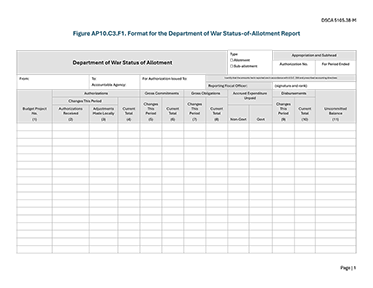
AP10.C3.5.1.3. Submit Monthly DoW Status-of-Allotment information, and associated reports of reconciliation, to DFAS by the 20th calendar day following the close of each accounting month. Use this information, with detailed supporting documentation, as the basis for the DFAS FMS Trust Fund reconciliation with Treasury.
AP10.C3.5.2. Allotments for Reimbursable Orders. For information on reimbursable orders, see Section AP10.C2.3.4.
AP10.C3.5.3. Fiscal Year-End Reporting Requirements.
AP10.C3.5.3.1. The DoW Components are required to submit a printed and certified, final, fiscal year (FY) consolidated OA request and DoW Status-of-Allotment information for direct cite funds to DFAS-SCA. Establish submission dates in accordance with special instructions issued by DFAS. The forms submitted may be manual forms or automated equivalents.
AP10.C3.5.3.2. The final OA request will have this certification: “I hereby certify that this report reflects FMS Obligational Authority as required by DSCA 5105.38-M, Section AP10.C2.3.4.1.”
AP10.C3.5.4. The final DoW Status-of-Allotment report must have this signed certification: “I hereby certify that the amounts shown in this report are correct. All known transactions meeting the criteria of 31 U.S.C. 1501(a) have been obligated and are so reported.”
AP10.C3.6.1. Reimbursement for Foreign Military Sales Administrative Expenses.
AP10.C3.6.1.1. Price Foreign Military Sales (FMS) administrative expenses in accordance with Section AP10.C6.5., and charge directly to the allotment received for actual FMS administrative expenses. DoW Status of Allotment reports must be submitted in the DoW standard format in Figure AP10.C3.F1. If the allotment is used as the basis for issuing reimbursable orders to appropriation accounts, a schedule showing the dollar value of orders released to each appropriation must be attached to the DoW Status-of-Allotment report. FMS administrative expenses may not be incurred in excess of the allotment, nor are the DoW Components authorized to incur obligations against appropriated fund operation accounts to finance FMS administrative budgets.
AP10.C3.6.1.2. Upon review of the budget requests submitted in response to its administrative budget call, DSCA will approve a single budget amount for each DoW Component and will issue an allotment providing funding for the approved budget. The recipient will prepare a DoW Status of Allotment report showing actual uses for administrative expense. Base the information on the organization designated in the DSCA budget call. Allotments for administrative expenses must be fully funded to cover obligations.
AP10.C3.6.1.3. Support DoW Status-of-Allotment reports for FMS administrative expenses with subsidiary allotment status reports of the executing organizations. Annotate subsidiary reports as “Subsidiary report-(name of the organization).”
AP10.C3.6.2. Control of Foreign Military Sales Administrative and Security Cooperation Organizations Budget Allotment Authority.
AP10.C3.6.2.1. Report the fiscal year (FY) identity of budget allotment authority, obligations, and disbursements for the current FY (CFY), and five preceding FYs, on the monthly DoW Status-of-Allotment reports for administrative expenses. Accounts will remain open for the liquidation and adjustment of valid obligations until the end of the canceled FY (five expired FYs and one canceling FY).
AP10.C3.6.2.2. All fund holders are required to maintain FY identity of obligations, disbursements, and budget allotment authority for the CFY and the five preceding FYs.
AP10.C3.6.2.3. Provided in Table AP10.C3.T1. is an example of FY identity using a CFY of 2024.
Table AP10.C3.T1. Example of Reporting Fiscal Year identity of budget allotment authority, obligations, and disbursements for the Current Fiscal Year
|
Fiscal Year |
Description |
|---|---|
|
Fiscal Year (FY) 2019 = expired FY |
At the end of FY 2024, and after completing the end-of-year reporting and closeout cycle, cancel all unliquidated obligations (ULOs). All amounts are withdrawn effective September 30, 2024. Following this action, FY 2019 cancels on October 1, 2024. |
|
FY 2020 = expired FY |
blank |
|
FY 2021 = expired FY |
blank |
|
FY 2022 = expired FY |
blank |
|
FY 2023 = expired FY |
blank |
|
FY 2024 = CFY |
Out-of-scope increase to prior FY obligations (FY 2019 and prior) will be charged against the CFY (FY 2024). The CFY becomes an expired FY on October 1, 2024. |
|
FY 2025 = Next FY |
October 1, 2024, FY 2025 begins. |
AP10.C3.6.3. Control of Foreign Military Sales Administrative and Security Cooperation Organization Prior Fiscal Year Obligational Authority.
AP10.C3.6.3.1. DSCA will not authorize increases to a prior year Obligational Authority (OA) to record upward adjustments for obligations that are the result of out-of-scope changes. Such changes constitute new obligations and are funded from the current year OA. Upward adjustments, which are the result of “within-scope” changes under the terms of the contract, are usually chargeable to the appropriate FY account against which the original obligation was charged. Charge all valid upward adjustments applicable to canceled years to the CFY.
AP10.C3.6.3.2. All fund holders will establish procedures to review and validate all ULOs for the CFY, and the preceding five FYs, on a monthly basis. If obligations are no longer valid, fund holders will ensure these amounts are deobligated and the appropriate funds returned to DSCA for withdrawal; see Section AP10.C3.6.5. Valid disbursements may be made from these expired accounts, up to the amount of the ULO balances for that year's obligation. Additional funding to cover these valid upward adjustments (within-scope price adjustments) may be requested from DSCA. This request should provide the following: original obligation amount; additional required funding authority needed; source or reason for additional obligation, including any subsidiary calculations or source; applicable supporting documentation; and point of contact.
AP10.C3.6.3.3. Deobligation of prior year funds, and the subsequent reobligation of these same funds in the current or one of the five preceding FYs, is not authorized. Expired funds may only be used for within-scope obligation adjustments until cancellation.
AP10.C3.6.4. Control of Unliquidated Balances.
AP10.C3.6.4.1. FMS Administrative and U.S. Military Group (MILGP) accounts remain available for liquidating valid obligations until the end of their fifth expired year; see the example in Section AP10.C3.6.2.3. No new obligations can be started for the CFY after September 30 of that FY.
AP10.C3.6.4.2. The monthly DoW Status-of-Allotment reports for administrative expenses, showing the Defense Finance and Accounting Service (DFAS) departmental accounting position, will present the current allocation and account balances (obligations and disbursements) for the end of that reporting month.
AP10.C3.6.4.3. See Section AP10.C3.6.5. for the procedure used when canceling funds at the end of the fifth year following their expiration and the process used when deobligations occur in the five preceding FYs.
AP10.C3.6.4.4. All fund holders will establish procedures to review and validate all ULOs for the CFY and the five preceding FYs.
AP10.C3.6.4.5. Reference Section AP10.C1.1.1.3. and Appendix 8 - Table AP8.T2. for additional information on Building Partner Capacity (BPC) programs and authorities, periods of availability of associated funding, and fund cancellation dates.
AP10.C3.6.5. Administration and Implementation of the Monthly and End-of-Year Closeout Guidance.
AP10.C3.6.5.1. All fund holders will review and use their respective monthly DoW Status-of-Allotment reports for administrative expenses, which present the DFAS departmental accounting position for that month. Use these reports to compare with the installation accounting records. If there are disbursement differences between the departmental and installation accounting records, use the departmental accounting records reconciled with Treasury cash to establish the withdrawal amount.
AP10.C3.6.5.2. DSCA will issue the annual end-of-year closeout guidance to all holders of FMS Administrative and MILGP funds.
AP10.C3.6.5.3. When the fifth expired year is canceled, the budget allotment authority amount will be decreased on September 30 to equal the departmental accounting disbursement amount that has been reconciled with Treasury.
AP10.C3.6.5.4. The fund holder will ensure that all obligations and disbursements are equal prior to year-end closeout for the canceling year account (the fifth year following funds expiration) and that no further disbursements are processed. The fund holders need to work closely with the DFAS departmental accounting offices at finalizing the amounts to be withdrawn for the canceling year (the fifth year following funds expiration).
AP10.C3.6.5.5. All fund holders will notify DSCA in writing when Budget Authority (BA) can be decreased on the CFY and the five preceding FYs. Upon receipt of a written request from the fund holder, DSCA will issue an FMS Administrative and MILGP Allocation document withdrawing the unobligated BA, citing the concurrence correspondence from the fund holder for the expired and canceling FYs. All records will be maintained with the FY BA documents.
AP10.C3.6.6. Defense Finance and Accounting Service Responsibilities for Expired and Canceled Accounts.
AP10.C3.6.6.1. Defense Finance and Accounting Service, Security Cooperation Accounting Directorate (DFAS-SCA) will adjust Expenditure Authority (EA) to agree with the DSCA allocation values for the expired and canceling FYs. All unobligated balances will be considered expired and not available for incurring new obligations. FMS Administrative and MILGP accounts remain available for liquidating valid obligations until the end of their fifth expired year.
AP10.C3.6.6.2. At the end of each FY, DFAS-SCA will update the canceling FY's obligated and disbursed balances for FMS and MILGP Administrative Fund accounting records and maintain related supporting documentation.
AP10.C3.6.6.3. DFAS-SCA will maintain memorandum records of the canceled obligations. Once closed, an account is no longer available for obligation. If it becomes necessary to pay an obligation, which otherwise would have been properly charged to the appropriation before it was canceled, the obligation should be charged to and paid from the applicable CFY FMS or MILGP account. Post these obligations against the CFY account when disbursed. Use memorandum records (or equivalent) to record the canceled “valid” obligations offline so that they may later be recognized as valid when disbursed and recorded against the applicable FMS or MILGP Administrative CFY account. For more information, see Department of War Financial Management Regulation (DoW FMR), DoW 7000.14-R, Volume 3, Chapter 10, “Accounting Requirements for Expired and Closed Accounts.”
AP10.C3.6.6.4. Once all BPC cases associated with the transportation account are closed, DFAS, in coordination with DSCA, will deposit all unliquidated balances into the Miscellaneous Receipts of the Treasury (11X3230). BPC Transportation accounts will close when all appropriations within the account have canceled.
AP10.C3.7.1. Objectives.
AP10.C3.7.1.1. This section establishes the budget execution requirements that are applicable to the FMS program.
AP10.C3.7.1.2. Specific objectives are to ensure that:
AP10.C3.7.1.2.1. Mandatory budget execution reports that accurately reflect data recorded in accounting records are submitted to Treasury in a timely manner;
AP10.C3.7.1.2.2. Unnecessary Foreign Military Sales (FMS) Obligational Authority (OA) is withdrawn officially from all organizations participating in the execution of FMS cases at the end of each fiscal year (FY); and
AP10.C3.7.1.2.3. FMS case records maintained by Implementing Agencies (IAs) are in agreement with Defense Finance and Accounting Service, Security Cooperation Accounting Directorate (DFAS-SCA) at the case-line level throughout the life of each FMS case.
AP10.C3.7.2. Responsibilities.
AP10.C3.7.2.1. DFAS must provide accounting data on FMS Trust Fund operations to the DoW Components.
AP10.C3.7.2.2. DSCA must monitor the FMS program and submission of required FMS Trust Fund Budget Execution reports in accordance with requirements outlined in Department of War Financial Management Regulation (DoW FMR), DoW 7000.14-R, Volume 6A, Chapter 2, Section 2, “Financial Reports Roles and Responsibilities.”
AP10.C3.7.2.3. IAs and the supporting DoW Components must:
AP10.C3.7.2.3.1. Conduct year-end reviews of the unobligated FMS reimbursable program to ensure unnecessary Budget Authority (BA) is identified and returned to the FMS Trust Fund;
AP10.C3.7.2.3.2. Ensure that the FMS reimbursable program is properly reported in appropriation or Defense Working Capital Fund (DWCF) budget execution reports;
AP10.C3.7.2.3.3. Submit financial Budget Execution reports accurately and timely in accordance with Section AP10.C3.8.;
AP10.C3.7.2.3.4. Reconcile IA FMS case records to DFAS-SCA case-line level accounting transactions on a periodic basis;
AP10.C3.7.2.3.5. Partner with Defense Finance and Accounting Service (DFAS) to resolve any variances or out-of-balance conditions in support of monthly FMS financial reporting; and
AP10.C3.7.2.3.6. Prepare Case Closure Certificates (See Figure AP7.C4.F4.) signifying IA completion of all actions necessary for DFAS-SCA to close the case as soon as possible after the case supply/services are complete, but no longer than 24 months after such occurrence for cases applicable to countries participating in Accelerated Case Closure Procedures (ACCP). See the Appendix 7, “Case Reconciliation and Closure Guide (RCG),” for the Case Closure Certificate format, Chapter 16, and Section AP10.C3.10.2. for case closure information. For case closure procedures required for non-ACCP, including Building Partner Capacity (BPC) program cases, refer to Section AP10.C3.10.2.
AP10.C3.8.1. Budget Execution Reports. Defense Finance and Accounting Service (DFAS) submits the following budget execution reports on Foreign Military Sales (FMS) Trust Fund operations:
AP10.C3.8.1.1. Monthly Standard Form 133 “Report on Budget Execution”, for 11X8242. For more information, see Department of War Financial Management Regulation (DoW FMR), DoW 7000.14-R, Volume 6A, Chapter 4, Section 4.0;
AP10.C3.8.1.2. Governmentwide Treasury Account Symbol Adjusted Trial Balance System. Fiscal Service discontinued use of the Fiscal Service Form 2108 and removed references to the form from current Fiscal Service guidance. Budget execution information previously provided on Fiscal Service Form 2108 is now available to Treasury through Governmentwide Treasury Account Symbol Adjusted Trial Balance System (GTAS). For more information, see DoW FMR, Volume 6A, Chapter 4; and Appropriate sections of the annual Chief Financial Officer (CFO) Financial Statements. For more information, see Section AP10.C3.8.2.
AP10.C3.8.2. Financial Statements. For financial statement guidance concerning the reporting of FMS amounts, see DoW FMR, Volume 6B, Chapter 2, “General Instructions for the Financial Statements” and DoW FMR, Volume 6B, Chapter 10, “Notes to the Financial Statements.” The Security Assistance reporting entity also provides GTAS submissions as a Significant Entity per DoW FMR, Volume 6A, Chapter 3, Section 3.4.2. “Significant Entities.”
AP10.C3.9.1. Fiscal Year-End.
AP10.C3.9.1.1. At the end of each fiscal year (FY), Implementing Agencies (IAs) should review the reimbursable Obligational Authority (OA) received to implement each Foreign Military Sales (FMS) case. The total amount of reimbursable Budget Authority (BA) received is on the OA request. The review serves as the basis to withdraw any unnecessary unobligated balances. Make the withdrawal by submitting a year
AP10.C3.9.1.2. Non-Expiring Accounts. At the close of each FY, retain reimbursable FMS OA in a performing DoW account only to the extent that:
AP10.C3.9.1.2.1. The amounts are required to cover certifiable obligations incurred by the performing account because of performance of the order;
AP10.C3.9.1.2.2. The amounts have been committed within a formal commitment accounting system, for example, to cover normal administrative lead time on the next contract escalation clauses; or
AP10.C3.9.1.2.3. The items have been delivered from inventory, or applicable DoW services have been performed (cash earned reimbursement). Withdraw any reimbursable FMS OA not required for these purposes from the performing accounts by September 30 each year. It is recognized that year-end reviews must be made prior to the last day of the FY. Therefore, the amount of OA retained may be somewhat greater than the goal. It is expected, however, that estimating procedures must be improved continually until unnecessary unobligated balances are eliminated.
AP10.C3.9.1.3. Expiring and Expired Accounts. By the close of each FY, show reimbursable FMS OA in an expiring account only to the extent that the amounts are earned reimbursements or are required to cover certifiable obligations incurred against the performing account. Withdraw any reimbursable FMS OA not required to cover obligations in the expiring account by September 30 each year. During the FY, transfer amounts required in expired accounts from the Trust Fund, as necessary, to cover upward obligation adjustments needed for within-scope changes to contracts or similar transactions.
AP10.C3.9.2. Reimbursement of Appropriations and Accounts.
AP10.C3.9.2.1. Reimburse DoW appropriations and fund accounts, or Miscellaneous Receipts Account 3041, “Recoveries Under the Foreign Military Sales Program, Army, Navy, Air Force, Defense,” upon delivery of items from inventory or performance of DoW services within 30 calendar days of the occurrence (i.e., date of shipment or performance) for:
AP10.C3.9.2.1.1. Items sold under Arms Export Control Act (AECA), Section 21 (22 U.S.C. 2761), or
AP10.C3.9.2.1.2. Procurement actions made under AECA, Section 22 (22 U.S.C. 2762), if direct cite procedures for financing applicable contracts are not used.
AP10.C3.9.2.2. The general rule applicable to the sale of DoW services is that the financing account current at the time of performance is credited with applicable BA and subsequent cash collections. The various cost elements that may be involved in the performance of an FMS order, and the appropriations that are to be reimbursed, are in Table AP10.C3.T2.
Table AP10.C3.T2. Cost Elements
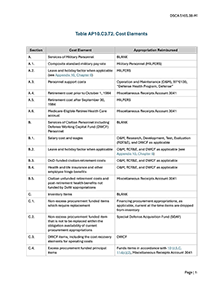
AP10.C3.9.2.2.1. When items are sold from inventory, the financing account current at the time items are dropped from inventory is credited with applicable BA and subsequent cash collections.
AP10.C3.9.2.2.2. When items not to be replaced (free or excess assets) are sold from inventory, those receipts are credited to the Special Defense Acquisition Fund (SDAF). For more information on SDAF, see Section C11.9. and Section AP10.C1.2.2.2.
AP10.C3.9.2.2.3. When appropriation or fund accounts are used to finance FMS procurements, the account current at the time the order is accepted is credited with BA and subsequent cash collections.
AP10.C3.9.3. Defense Department (DD) Form 2061, “Foreign Military Sales (FMS) Planning Directive,” or the Automated Equivalent (Planning Directive). Update the case Planning Directive as prescribed in Section AP10.C2.4. Update cost elements and financing accounts to ensure full recoupment of the costs prescribed in Appendix 10, Chapter 7 and to ensure timely identification of cost increases. The Planning Directive serves as the basis for preparing all OA requests during the life of the case.
AP10.C3.10.1. General. This section provides guidance on case reconciliation and closure for Foreign Military Sales (FMS) and Building Partner Capacity (BPC) cases. All proper charges and credits must be recorded against the applicable FMS or BPC case. Case closure does not stop the billing/reporting process, but results in a re-categorization of the case records from active status to inactive status to ensure accessibility for recording subsequent activity. For further guidance on the reconciliation and closure of FMS and BPC cases, to include closure checklists, see Section C15.7., Section C15-Legacy.7., Chapter 16, and Section AP7.C4.3.
AP10.C3.10.2. Case Closure.
AP10.C3.10.2.1. When all ordered items have been physically delivered and all ordered services performed (i.e., supply/services complete), or there is no activity on a blanket order case for 180 calendar days (and the purchaser agrees no further activity will occur), and all other conditions of the Letter of Offer and Acceptance (LOA) are fulfilled, an FMS or BPC case is a candidate for closure. At this time, the responsible IA must determine if there are any unresolved delivery issues, outstanding Supply Discrepancy Reports (SDRs), or litigation claims. Contracting officers must review any contracts that have not been financially closed to determine if significant financial adjustments of open contracts may occur. Cases can be closed under either Accelerated Case Closure Procedures (ACCP) or non-ACCP.
AP10.C3.10.2.1.1. Accelerated Case Closure Procedures. ACCP must be used only for those countries that explicitly elect such procedures. However, all countries that have cases financed with Military Assistance Program (MAP) Merger/Foreign Military Financing (FMF) (non-repayable) are mandatory participants in ACCP, unless specifically excluded by DSCA. Once selected by a country, ACCP must apply to all cases of that country and must govern any case that was opened (or closed) prior to the date of ACCP implementation, unless a specific arrangement between DSCA and the FMS purchaser is made as part of the implementation criteria. Under ACCP, case closure should be initiated within 24 months after the case is supply/services complete (SSC), to allow a country to initiate an SDR and allow the IA to reconcile the case. The applicable DoW Component must request DSCA approval to delay closure beyond 24 months.
AP10.C3.10.2.1.2. Non- Accelerated Case Closure Procedures. Under a non-ACCP case closure, all logistical and financial transactions must be processed before case closure can be initiated. BPC cases must utilize non ACCP.
AP10.C3.10.2.2. The case manager must ensure the actions outlined in Section AP10.C3.10.2.2.1. through Section AP1.C3.10.2.2.6. are taken.
AP10.C3.10.2.2.1. The IA-delivered value must agree with the delivered value recorded in the Defense Integrated Financial System (DIFS). If necessary to reconcile IA records, obtain historical transaction records from the DIFS database or equivalent online repositories.
AP10.C3.10.2.2.1.1. Accelerated Case Closure Procedures. If the case is being closed under ACCP, the difference between progress payments and liquidating deliveries, and the difference between total deliveries and total disbursements in DIFS, must equal the estimated Unliquidated Obligations (ULO) value established by the Implementing Agency (IA). The IA records must be in balance with each of these values; if not, the IA must submit applicable input to bring the records into balance before issuing a Case Closure Certificate.
AP10.C3.10.2.2.1.2. Non- Accelerated Case Closure Procedures. If the case is being closed under non-ACCP, progress payments must equal liquidating deliveries in DIFS. The IA records must be in balance with each of these values; if not, the IA must submit applicable input to bring the records into balance before issuing a Case Closure Certificate.
AP10.C3.10.2.2.2. Rectify all problem disbursements in accordance with Department of War Financial Management Regulation (DoW FMR), DoW 7000.14-R, Volume 3, Chapter 11, “Unmatched Disbursements, Negative Unliquidated Obligations, and In-Transit Disbursements.” A prerequisite for satisfactorily resolving problem disbursements is to validate the accuracy of the disbursed values. Use the authorities in DoW FMR, Volume 3, Chapter 11 to facilitate efficient reconciliation and closure actions. Additionally, Section AP10.C3.11. addresses the applicable write-off authority for FMS problem disbursements.
AP10.C3.10.2.2.3. Ensure the validity of all obligations in accordance with DoW FMR, Volume 3, Chapter 8. Many of those provisions address FMS-specific actions in this regard.
AP10.C3.10.2.2.4. Use the guidance in Section AP10.C3.10.2.2.4. through Section AP10.C3.10.2.2.4.2. for all cases without remaining ULOs.
AP10.C3.10.2.2.4.1. Accelerated Case Closure Procedures. If the case belongs to an ACCP country, the applicable DoW Component must submit a final Case Closure Certificate (see Appendix 7, Case Reconciliation and Closure Gude (RCG)) to Defense Finance and Accounting Service, Security Cooperation Accounting Directorate (DFAS-SCA) within 24 months after an FMS case is supply/services complete. If the IA determines that, due to reconciliation issues, a case under ACCP cannot be closed within 24 months of supply/services completion, then submit the case, along with identification of the problem or cause believed to prevent case closure, to DSCA for resolution.
AP10.C3.10.2.2.4.2. Non- Accelerated Case Closure Procedures. A SSC case for a Partner not participating in ACCP will not be submitted for closure until ULOs on accounting classification reference numbers (ACRNs) citing the case are resolved. No case under non-ACCP closure procedures can be interim closed; it must be marked final.
AP10.C3.10.2.2.5. Use guidance in Section AP10.C3.10.2.2.5.1. through Section AP10.C3.10.2.2.5.2. for FMS cases with remaining ULOs. BPC cases do not follow under guidance in Section AP10.C3.10.2.2.5.1. through Section AP10.C3.10.2.2.5.2.
AP10.C3.10.2.2.5.1. Accelerated Case Closure Procedures.
AP10.C3.10.2.2.5.1.1. The applicable IA must submit a Case Closure Certificate to DFAS-SCA within 24 months after an FMS case is SSC. Cases with a ULO of zero are final closed (there should be no more transactions of any kind on the case). Cases with a ULO greater than zero are interim closed (there could be additional disbursements on the case, but the purchaser has already paid the FMS Trust Fund enough to cover those disbursements). See Section AP10.C3.10.3. and the Appendix 7 (RCG).
AP10.C3.10.2.2.5.1.2. The applicable IA must determine and report the value of any remaining ULO relevant to that case. These amounts should be equal to those recorded in the applicable DoW accounting system.
AP10.C3.10.2.2.5.1.3. The applicable IA must request DSCA approval to delay interim closure if the estimated ULO is of significant value and is likely to be deobligated rather than disbursed. DSCA will then determine whether to approve the delay.
AP10.C3.10.2.2.5.1.4. DFAS-SCA must bill the applicable Partner using the DoW Component’s remaining ULO via normal billing procedures. The ULO is part of the case closure value.
AP10.C3.10.2.2.5.1.5. DFAS-SCA must record the estimated ULO value in a summary account entitled Case Closure Suspense Account (CCSA). At the same time, DFAS-SCA must record applicable charges and credits, by Partner and case, in subsidiary accounts, which total to the CCSA.
AP10.C3.10.2.2.5.1.6. When final costs are known and reported by the IA (i.e., liquidating the ULO), DFAS-SCA must record such amounts against the CCSA and subsidiary account by Partner and case.
AP10.C3.10.2.2.5.1.7. Upon receipt and payment of final bills, and reconciliation of the case, the IA must submit a final Case Closure Certificate.
AP10.C3.10.2.2.5.1.8. On a quarterly basis, DFAS-SCA must submit a status report on the CCSA and subsidiary accounts to the DSCA (Office of Business Operations, Financial Policy and Regional Execution Directorate, Financial Analysis and Compliance Division (OBO/FPRE/FAC)) and ACCP-participating FMS purchaser Partners.
AP10.C3.10.2.2.5.1.9. When a Partner’s CCSA has a negative balance of $100,000 or more for a period of six consecutive months, DSCA may instruct DFAS-SCA to bill the Partner for the entire balance owed. For example, if the Partner’s suspense account has negative balances of $100,000 on December 31, $250,000 on March 31, and $175,000 on June 30, DFAS-SCA will bill the Partner $175,000. Such billings will be made through the Partner’s omnibus quarterly billing statement and will cite all the FMS case(s) involved. DSCA should review the Partner’s CCSA periodically to determine if any refund is warranted.
AP10.C3.10.2.2.5.2. Non- Accelerated Case Closure Procedures. DoW Components must submit Case Closure Certificates to DFAS-SCA only after all applicable known costs have been recorded and no ULOs exist on ACRNs citing the case.
AP10.C3.10.2.2.6. At case closure, DFAS-SCA must use the submitted closure certificate/transaction in place of an LOA amendment or modification unless the case meets the criteria for an LOA amendment or modification specified in Section C6.7.
AP10.C3.10.3. Closure Certification.
AP10.C3.10.3.1. The Case Closure Certificate alerts DFAS-SCA to initiate actions needed to close a case. The IA must send certificates electronically to DFAS-SCA. If any reporting after the issuance of a Case Closure Certificate has caused variances between DIFS and the certified values, DFAS-SCA must notify the IA of actions required to enable closure processing to continue. When the IA and DFAS-SCA FMS case records are reconciled, DFAS-SCA must reclassify the case to an inactive status and provide a final statement of account to the FMS Partner for the final value of the case. Once a final statement has been sent for an FMS case, the case must be reclassified by the IA from active to inactive status. The IA then closes applicable case records.
AP10.C3.10.3.2. For additional information on post-closure activity for closed cases, refer to Chapter 15, Chapter 15-Legacy, Section C16.3.14, and Section C16.3.16.
AP10.C3.10.4. Billings After Case Closure.
AP10.C3.10.4.1. Any cases required to be reverted to implemented status must be approved by DSCA.
AP10.C3.10.4.2. The following requirements apply to all ACCP cases.
AP10.C3.10.4.2.1. The Dow Component will submit an interface transaction to DIFS, moving the case from final to interim closure status. After the status is changed, the IA will send an Expenditure Authority (EA) request to DFAS-SCA. DFAS-SCA will then move the cash from CCSA to the EA reserve account and record the disbursement against the country, case, and line.
AP10.C3.10.4.2.2. When post-closure disbursements exceed $100,000 (in either direction) because of a verified pricing adjustment, the applicable IA must submit a request to DSCA, with an information copy to DFAS-SCA, that the case be reopened. Upon receipt of DSCA approval to reopen the case, both the IA and DFAS records must be reclassified to implemented status. If the case is not reopened, then the disbursement must be processed against the CCSA.
AP10.C3.10.4.2.3. When all post-closure disbursements/credits have been reported and final costs determined, the Dow Component must certify the case for final status by using the Case Closure Certificate (see Appendix 7 (RCG)) and by reporting the transaction in DIFS.
AP10.C3.10.4.3. The following requirements apply to BPC cases referenced in Chapter 15 – Legacy and FMS cases closed under non ACCP.
AP10.C3.10.4.3.1. All cases must be reclassified to implemented status, except for those with a transaction adjustment of $200 or less. Such adjustments may be charged to the FMS Administrative Surcharge account. Otherwise, reestablish accounting records at the amounts recorded at the time the closure certification occurred. Reclassification to implemented status must occur in both the IA and DFAS-SCA records.
AP10.C3.10.4.3.2. All post-closure disbursements or credits must be recorded in an undistributed account until case records are reactivated.
AP10.C3.10.4.3.3. When post-closure activity results in exceeding the case value, a modification to the case is required.
AP10.C3.10.4.3.4. When cases are reactivated, the IA must request additional Obligational Authority (OA), commence reporting status of funds data, request EA, process disbursement/credit transactions, and report adjusted delivery information via the delivery transaction.
AP10.C3.10.4.3.5. For FMS cases, once the disbursement/credit and billing processes are complete, DFAS-SCA must bill the FMS Trust Fund purchaser. The IA must recertify the case for closure as specified in Section AP10.C3.10.3.
AP10.C3.10.4.3.6. For FMS or BPC cases where funds have been canceled, irrespective of funding source, DSCA will provide guidance on how to proceed and how invoices will be paid.
AP10.C3.10.5. Reopening Foreign Military Sales Cases. Normally, closed cases will not be reopened. If the FMS purchaser requests to reactivate a closed case, first determine if there is a case already implemented and available or if a new case should be developed. Opening a closed case (interim or final) is a last resort and requires DSCA approval. See Chapter 16, for additional information on reopening cases.
AP10.C3.10.6. Building Partner Capacity Funds Return.
AP10.C3.10.6.1. IAs must distinguish BPC cases, which are those resourced with U.S. appropriated funds available for obligation and expenditure only for a statutorily-directed time period, and FMS cases, which may be resourced in whole or part with the national funds of foreign governments that may remain available for obligation and expenditure for an indefinite period. U.S. appropriated funds expire, making them unavailable for obligation, at the end of their statutorily-defined period of availability. Once expired, unobligated balances in appropriated fund accounts remain available to liquidate obligations properly incurred before expiration (to include when those obligations are adjusted upward due to in-scope contract changes or otherwise) until these funds are canceled. Cancellation typically occurs at the end of the fifth fiscal year following expiration. See Section AP10.C3.6.4.5., Section AP10.C1.1.1.3.; and DoW FMR, Volume 3, Chapter 10, Section 3.2 and 3.3.
AP10.C3.10.6.2. For a BPC case, IAs must review, clearly identify any outstanding, unliquidated obligations on the BPC case, and adjust to the highest financial requirement by March 31 of the year of funds cancellation. To enable the return of funds to their parent account for DoW’s potential use of the funds against other obligations before cancellation, IAs must close the case and liquidate all outstanding obligations by July 31 of the year of funds cancellation. In the event IAs are unable to close cases prior to July 31, IAs must promptly use the Alternate Funds Return process as outlined in Section AP10.C3.10.6.2.1.
AP10.C3.10.6.2.1. The BPC Alternate Funds Return process requires the IA to draw down OA for undelivered orders, unpaid obligations, and/or uncollected reimbursements in the IA’s General Ledger (GL) system(s) and submit a DIFS Funds Return Memorandum to DFAS. See Chapters 15 and Chapter 15-Legacy for additional information on BPC case closure procedures.
An Implementing Agency (IA) that determines unresolved reconciliation issues exist for a case may write off those imbalances using write-off authority guidelines. The IA is responsible for providing all vouchers it prepares, citing the Foreign Military Sales (FMS) Administrative Surcharge account to the Defense Finance and Accounting Service, Security Cooperation Accounting Directorate (DFAS-SCA).
AP10.C3.11.1. Problem Disbursements. For problem disbursements (unmatched disbursements, negative unliquidated obligations, and in-transit disbursements) up to $2,500 per transaction, refer to Department of War Financial Management Regulation (DoW FMR), DoW 7000.14-R, Volume 3, Chapter 11 for an explanation of the problem disbursements policies. The DSCA (Office of Business Operations (OBO)) and DFAS-SCA are responsible for ensuring detailed procedures are issued to the FMS community. Problem disbursements greater than $2,500 should be brought to the attention of the DSCA (Office of Business Operations, Comptroller Directorate (OBO/CMP)) Comptroller for resolution, provided those problem disbursements have not exceeded the DoW FMR, Volume 3, Chapter 11 processing timelines. See Section C16.2.16.1 for additional information.
AP10.C3.11.2. Other Foreign Military Sales Financial Transactions. For all other types of FMS financial transactions, up to $200, charge the FMS Administrative Surcharge account for the amount required to affect prompt financial reconciliation as prescribed in the DSCA annual case review requirement in the Chapter 16. For write-off adjustments performed while readying a case for closure, DFAS-SCA will provide DSCA (Office of Business Operations, Financial Policy and Regional Execution Directorate, Financial Analysis and Compliance Division (OBO/FPRE/FAC)) with a quarterly summary of closure certificates received in which amounts have been charged in accordance with this paragraph. A comment must be included in the remarks/comments section of the Case Closure Certificate when these write-offs are used.
AP10.C3.12.1. Antideficiency Act Violations.
AP10.C3.12.1.1. For purposes of the Antideficiency Act (ADA), appropriated funds are not limited to those funds specifically appropriated by Congress to federal agencies from the general funds of the Treasury. Funds available to agencies are considered appropriated if made available for collection and expenditure pursuant to specific statutory authority, regardless of their source. In applying the ADA, the Foreign Military Sales (FMS) Trust Fund is considered to be, and will be, treated as appropriated funds. Therefore, the ADA applies to transactions involving the FMS Trust Fund.
AP10.C3.12.1.2. Types of Potential Violations. Potential violations may occur in FMS Trust Fund transactions when:
AP10.C3.12.1.2.1. Issuing Obligational Authority (OA) or awarding an FMS contract without a signed Letter of Offer and Acceptance (LOA);
AP10.C3.12.1.2.2. Obligating or expending FMS case funds for an unauthorized purpose, including purposes not provided for by law;
AP10.C3.12.1.2.3. Violating apportionments or indemnity clauses; or
AP10.C3.12.1.2.4. Incurring obligations on a Building Partner Capacity (BPC) case where the financing appropriation's period of availability to incur new obligations has expired. Additional information on potential violations of the ADA is in Department of War Financial Management Regulation (DoW FMR), DoW 7000.14-R, Volume 14, Chapter 2, “Antideficiency Act Violations.”
AP10.C3.12.1.3. Identifying and Reporting Potential Violations of the Antideficiency Act. Detailed guidance for identifying, investigating, and reporting violations under the ADA is in DoW FMR, Volume 14, Administrative Control of Funds and Antideficiency Act Violations.” Due to the complexities of provisions in the AECA, it is important to consult with appropriate legal counsel and comptroller officials on potential violations of the ADA for FMS.
AP10.C3.12.2. Adverse Financial Conditions.
AP10.C3.12.2.1. Other reportable events occur when FMS case records are out of balance, but these conditions do not necessarily meet the criteria of violations discussed in Section AP10.C3.12.1. These conditions are adverse financial conditions and occur when financial reports show that: OA exceeds case or line-item level values, commitments or obligations exceed OA at case or line-item level, total disbursements exceed obligations at case or line-item level, or Expenditure Authority (EA) is not requested prior to disbursement. Adverse financial conditions are reported using the same format used for ADA violations.
AP10.C3.12.2.2. Reporting Requirements for Adverse Financial Conditions.
AP10.C3.12.2.2.1. Defense Finance and Accounting Service, Security Cooperation Accounting Directorate (DFAS-SCA) has the responsibility for determining reportable conditions and notifying IAs of adverse conditions involving EA. DFAS-SCA must provide a monthly analysis report to the DoW Components identifying if disbursements are greater than EA at the country case-level, or if EA was requested, remained unused, and was not returned at the end of the month. The DoW Components must review the listings within 15 calendar days of receipt and provide DFAS-SCA an explanation of the discrepancy, the required corrective action, and when such action will be processed. This information will be shared with DSCA.
AP10.C3.12.2.2.2. DoW Components and IAs have the responsibility to resolve adverse conditions involving obligations or expenditures of funds in excess of approved authority at any level lower than case-level.
AP10.C3.12.2.3. Exceptions to Reporting Adverse Financial Conditions. Reports need not be submitted for within-scope cost increases in either of the following circumstances:
AP10.C3.12.2.3.1. Obligation(s) in excess of the “Total Estimated Cost” shown on the LOA occur, and a modification is prepared by the DoW Component and submitted to the purchaser through appropriate channels within 60 calendar days of the date of the transaction that resulted in the unfavorable financial condition; or
AP10.C3.12.2.3.2. Obligation(s) or expenditure(s) in excess of approved authority occur, the excess amount results from the posting of duplicate or erroneous obligation/expenditure transactions or the posting of obligations from inventory systems, and corrective action is taken within 60 calendar days of the transaction date. These conditions, however, could indicate weaknesses in internal controls, and administrative action may be required to improve systems design or to prevent recurrence.