
|
Section |
Title |
|---|---|
|
AP10.C2.1. |
|
|
AP10.C2.2. |
|
|
AP10.C2.3. |
|
|
AP10.C2.4. |
|
|
AP10.C2.5. |
AP10.C2.1.1. Purpose. The purpose of this chapter is to provide guidance on Foreign Military Sales (FMS) Trust Fund budget authority (BA), to include FMS Trust Fund obligational authority (OA) for implemented cases, the FMS administrative surcharge budget, and contract administration services (CAS) surcharge budget.
AP10.C2.1.2. Authoritative Guidance. The Arms Export Control Act (AECA) codified as Title 22, United States Code (U.S.C.) Chapter 39 (22 U.S.C. Chapter 39), provides the authority and general rules for FMS and commercial sales of defense articles and services. Additional specific authorities are in the applicable sections.
AP10.C2.2.1. Defense Security Cooperation Agency.
AP10.C2.2.1.1. DSCA prepares the annual budget request for the Foreign Military Sales (FMS) Trust Fund obligational and outlay authority to support the FMS Trust Fund program. DSCA reviews, approves, and distributes funding for the FMS administrative surcharge, U.S. Military Groups (MILGPs), Building Partnership Capacity (BPC), Special Defense Acquisition Fund (SDAF), and the FMS contract administration services (CAS) surcharge accounts.
AP10.C2.2.1.2. DSCA is responsible for establishing the annual Safety Level amount to be maintained in the FMS Trust Fund Administrative Surcharge account. The Safety Level amount will represent 18 months of operational funding based on current budget levels. DSCA will establish the Safety Level before the close of the fiscal year (FY) and forward the information to the Defense Finance and Accounting Service Security Cooperation Accounting Directorate (DFAS-SCA).
AP10.C2.2.1.2.1. The 18-month Safety Level is calculated using the amount that may be obligated for expenses pursuant to Arms Export Control Act (AECA) Section 21(e)(1)(A) (22 U.S.C. 2761(e)(1)(A)), noted in the “Foreign Military Financing Program” section of the annual Department of State (State), Foreign Operations, and Related Programs Appropriations Act for the upcoming FY. The monthly operating amount is calculated by dividing the amount by 12, and then multiplying that amount by 18. For detailed information on the calculation, refer to Section C9.15.
AP10.C2.2.1.2.2. Any changes requiring adjustment of the Safety Level computation methodology will be forwarded to the Office of the Under Secretary of War (Comptroller) (OUSW(C)) for review and approval. See Section AP10.C3.4.8.6. for more information on the periodic review and analysis of surcharge accounts.
AP10.C2.2.2. Implementing Agency and Performing Agency.
AP10.C2.2.2.1. Each implementing and performing agency that prepares data for Letters of Offer and Acceptance (LOAs) must ensure that:
AP10.C2.2.2.1.1. Department of Defense (DD) Form 2060, FMS Obligational Authority (OA), (or automated equivalent) is created to initiate performance of the case and support Component budget estimates, and
AP10.C2.2.2.1.2. Sufficient, anticipated appropriation or fund reimbursable authority is included in the DoW budget.
AP10.C2.2.2.2. IAs are responsible for fulfilling FMS Trust Fund orders using these financing techniques:
AP10.C2.2.2.2.1. Issuance and acceptance of reimbursable orders into a financing appropriation or Defense Working Capital Fund (DWCF) account,
AP10.C2.2.2.2.2. Issuance of allotments of the FMS Trust Fund to performing DoW Components, or
AP10.C2.2.2.2.3. Authorization to use the FMS Trust Fund (11X8242, “Advances, Foreign Military Sales, Funds Appropriated to the President”) directly.
AP10.C2.2.2.3. IAs must submit FMS administrative and CAS budget requests annually.
AP10.C2.2.3. Defense Finance and Accounting Service, Security Cooperation Accounting Directorate. DFAS SCA must obtain cash advances from FMS Trust Fund purchasers to liquidate obligations resulting from the use of OA created by the FMS Trust Fund program.
AP10.C2.3.1. General.
AP10.C2.3.1.1. The DoW Budget Authority (BA) is the United States’ legal financial authority, provided by law, that empowers government agencies to spend federal funds. BA allows DoW to enter into obligations that will result in immediate or future outlays from Federal Government accounts. For Security Cooperation (SC), exercising BA begins with the implementation of the applicable Letter of Offer and Acceptance (LOA) document. Prior to exercising the BA, the Implementing Agency (IA) must prepare and process five forms (or automated equivalents) as applicable:
AP10.C2.3.1.2. The implementation of the LOA will occur only after the purchaser has forwarded a signed copy to the IA, with any required initial deposit received by Defense Finance and Accounting Service, Security Cooperation Accounting Directorate (DFAS-SCA). Once implemented, IAs will ensure that OA is properly recorded in their accounting system of record. This authority must take place prior to a government agency or department spending money from the budget.
AP10.C2.3.1.3. BA requests must be limited to:
AP10.C2.3.1.3.1. The total case value for approved LOAs, Amendments, and processed Modifications; or
AP10.C2.3.1.3.2. The amount expected to be obligated in the current fiscal year (FY).
AP10.C2.3.1.4. At the end of each FY, DFAS-SCA reduces unused BA or Obligational Authority (OA). Following the year-end accounting closing entries, reversal entries restore BA values for the new FY.
AP10.C2.3.1.5. BA for Foreign Military Sales (FMS) case lines, with the exception of contingency and Small Case Management Lines (SCML), is distributed to IAs. BA for the below-the-line surcharges (FMS administrative surcharge and packing, crating, handling, and transportation (PCH&T)) are not distributed to IAs.
AP10.C2.3.2. Source Documents.
AP10.C2.3.2.1. LOA. The LOA is the basic source document for an FMS case. The LOA does not in itself create BA in either the FMS Trust Fund or in a DoW appropriation or fund account; however, it is required for establishing BA. See Figure C5.F8. for a sample LOA; instructions for preparing LOAs are contained in Figure C5.F11.
AP10.C2.3.2.2. Amendment to an Letter of Offer and Acceptance. An Amendment is designed to obtain FMS Trust Fund purchaser acceptance of a change in LOA scope when the original purpose of a case line or note changes. Amendments are used to alter the original LOA and provide the basis to change FMS Trust Fund BA, when applicable. See Section AP10.C7.3.6. for additional information on determining scope of work changes to associated contracts. See Figure AP10.C2.F2. for a sample Amendment; instructions for preparing an Amendment are in Section C6.7.
AP10.C2.3.2.3. Modification to an Letter of Offer and Acceptance. A Modification is a notification document to alert FMS Trust Fund purchasers of within-scope cost increases, cost decreases, or other minor changes to the program. Modifications are used to alter the original LOA and provide the basis to change FMS Trust Fund BA, when applicable. See Section AP10.C7.3.6. for additional information on determining scope of work changes to associated contracts. See Figure C6.F5. for a sample Modification; instructions for preparing a Modification are in Section C6.7.
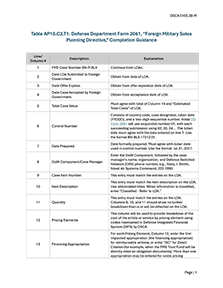
AP10.C2.3.3. FMS Planning Directive (DD 2061). The installation preparing the LOA data for the IA prepares and maintains a Planning Directive. See Figure AP10.C2.F1. for a sample DD Form 2061; instructions for completing the DD Form 2061 are in Table AP10.C2.T1. The DD Form 2061, or the automated equivalent, is a working paper that serves three major purposes:
Figure AP10.C2.F1. Sample Foreign Military Sales Planning Directive
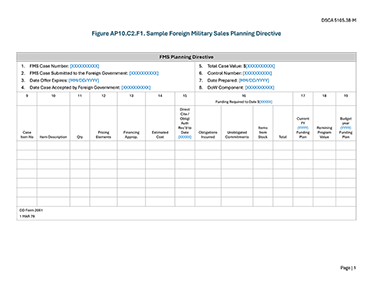
Table AP10.C2.T1. Defense Department Form 2061, “Foreign Military Sales Planning Directive,” Completion Guidance
AP10.C2.3.3.1.1. It provides identification of the cost elements included in prices reflected on the LOA and helps assure the case is priced in accordance with DoW pricing policies in Appendix 10, Chapter 6;
AP10.C2.3.3.1.2. It provides a time-phased plan for execution of the case upon FMS purchaser acceptance and implementation; and
AP10.C2.3.3.1.3. It identifies the appropriations or funds that will be used to finance the LOA.
AP10.C2.3.3.2. Obligational Authority Request. An OA Request is prepared based on the Planning Directive.
AP10.C2.3.3.2.1. Part A is prepared at the FMS case-line level and is the basis for line-level control of OA. Part B identifies the appropriations or funds that have been or will be used to finance the lines reflected in Part A.
AP10.C2.3.3.2.2. The OA Request may be prepared for an individual case or for multiple cases.
AP10.C2.3.3.2.3. The OA Request is also used to convey the FMS Contract Administration Services (CAS) surcharge OA (see Section AP10.C2.5.).
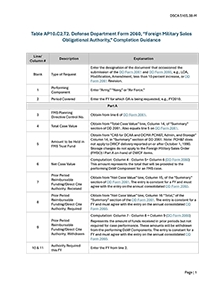
AP10.C2.3.3.2.4. See the following link for a DD Form 2060; instructions for completing the form are in Table AP10.C2.T2.
Table AP10.C2.T2. Defense Department Form 2060, “Foreign Military Sales Obligational Authority,” Completion Guidance
AP10.C2.3.4.1. Establishment of Foreign Military Sales Trust Fund Obligational Authority. To establish OA, FMS Trust Fund purchasers must return all accepted LOAs, Amendments, and processed Modifications to the IA. IAs will create and submit an automated OA request through the Defense Integrated Financial System (DIFS). Upon successful processing in DIFS, the IA will receive an automated acknowledgement of receipt and approval of the OA request.
AP10.C2.3.4.2. Trust Fund Direct Citation. The OA Request must be used to request commitment/OA for direct citation of the FMS Trust Fund. The OA Request is used as a control device, and commitments/obligations must be limited to the dollar value of the approved OA Request.
AP10.C2.3.5. Recognition of Foreign Military Sales Reimbursable Obligational Authority in DoW Appropriation or Fund Accounts.
AP10.C2.3.5.1. Trust Fund Orders for Reimbursable Orders.
AP10.C2.3.5.1.1. The LOA, Amendment, or Modification does not represent a reimbursable order to the performing DoW Components. The approved OA Request is the reimbursable order. The OA Request includes the reimbursable portion of the order that may be credited to appropriations by a DoW Component for each line within a case for a FY. The OA amount for each line within a case cannot be exceeded. Reporting violations of this administrative limitation will follow the guidance in Appendix 10, Chapter 3 and Department of War Financial Management Regulation (DoW FMR), DoW 7000.14-R, Volume 14.
AP10.C2.3.5.1.2. The applicable DoW appropriation or fund accounting system must maintain an audit trail between the applicable OA Request and the appropriation or fund accounting records. Performance within the financing appropriation or fund account will be controlled in accordance with the accounting system established for that particular appropriation or fund account. Appropriation or DWCF bills for earned reimbursements must be processed in accordance with DoW FMR, Volume 11A and DoW FMR, Volume 11B.
AP10.C2.3.5.1.3. The FMS case management system is not intended to track the financial status, or obligation, while reimbursable performance is in process. The status of specific purchaser requisitions can be obtained through logistical system inquiries. Applicable logistics status reports are provided to case managers and FMS purchasers, and are not to be confused with financial status reports.
AP10.C2.3.5.1.4. DoW Components that are not IAs, but support the FMS program in response to IA work requests, must carefully review applicable work requests to determine the financing source. If the financing source is an IA appropriation account, the request must be recorded and processed as an internal DoW order. If the recipient is a sub-allotment holder, the required allotment status report must be provided to the allotment holder and consolidated into the DoW Status-of-Allotment report to DFAS, as discussed in Appendix 10, Chapter 3.
AP10.C2.3.5.2. Apportionment for Reimbursable Orders.
AP10.C2.3.5.2.1. When authority to accept reimbursable orders is subject to apportionment, obligations on a reimbursable program may not exceed the apportioned amounts of anticipated reimbursement. Reimbursable OA may be recognized up to the apportioned amount to the extent the FMS Trust Fund purchaser has advanced necessary cash under Section AP10.C3.3.3.1., or has orders charged to appropriated funds. Reimbursable orders in excess of apportionment are not available for obligation; an additional apportionment of anticipated reimbursable orders needs to be requested and received through the reapportionment process.
AP10.C2.3.5.2.2. Apportionments and reapportionments for reimbursable programs must be requested by appropriation account and FY. An appropriation that is available for obligation for more than one year requires an apportionment for anticipated reimbursable orders in the first year of availability. That apportionment must be reduced to the value of orders actually received in the first year. In the subsequent years of availability, a reapportionment for anticipated reimbursable orders is required to accept the purchaser’s orders that fund within-scope price increases. The reapportionment request for anticipated reimbursable orders in the final year of availability is especially critical because any unused amounts in the reapportionment are automatically available for acceptance of additional reimbursable orders necessary to fund within-scope price increases after the appropriation has lapsed.
AP10.C2.3.5.2.3. Receipt of an apportionment, or reapportionment for anticipated reimbursable orders, does not constitute authority to incur obligations. The actual purchaser’s orders must be received and recorded in appropriation accounting records before applicable BA may be used.
AP10.C2.3.6. Contract Authority.
AP10.C2.3.6.1. Contract authority is the statutory authority to incur obligations with liquidation of obligations dependent on a future act, such as receipt of an appropriation. Implemented FMS documents, along with the OA Request, create contract authority. New contract authority reported in the Standard Form (SF) 133 “Report on Budget Execution”, is the value of FMS cases accepted for performance during the current FY for which OA has been approved in accordance with the requirements of Section AP10.C3.3.
AP10.C2.3.6.2. Funds appropriated by Congress for defense purposes cannot be used to liquidate obligations resulting from the use of FMS contract authority, unless specifically allowed in appropriation acts or supplemental funding bills. FMS purchaser cash deposits liquidate these obligations and unfunded contract authority. Below departmental level, contract authority loses its unfunded identity and is treated in the same way as other budgetary resources available for obligation. See Arms Export Control Act, Section 22 (22 U.S.C.2762) for more information on procurement for cash sales.
AP10.C2.3.6.3. Procurements for FMS purchasers are accomplished by citing the FMS Trust Fund in applicable documents. Accordingly, accounting for commitments, obligations, and accrued expenditures in the FMS Trust Fund is accomplished as a direct fund cite.
AP10.C2.3.7. Budget Authority for Foreign Military Sales Administrative Expenses. The cumulative BA available in the current FY is composed of actual collections for FMS administrative expenses (including the FMS administrative charges and logistics support charges), less any prior allotments of such amounts and the amount to be reserved for future administrative expenses (i.e., the Safety Level). In no event should the annual allotment be higher than the limitation imposed in the annual Department of State, Foreign Operations, and Related Programs Appropriations Acts, unless otherwise approved through the process required by law.
AP10.C2.3.8. BA for Cooperative Logistics Supply Support Arrangements (CLSSAs). Proper recognition and phasing of BA resulting from LOAs written to implement CLSSAs create unique challenges (DoD Instruction (DoDI) 2000.20 “Cooperative Logistics Supply Support Arrangements”). Under these arrangements, the purchaser provides for the purchase and sustainment of spare and repair parts in DoW inventory. Once these increments are established, the purchaser is provided supply support with the same responsiveness as is provided to DoW military units within the same Force Activity Designator (FAD). The applicable LOAs have three distinct financial subdivisions.
AP10.C2.3.8.1. Foreign Military Sales Order I.
AP10.C2.3.8.1.1. Foreign Military Sales Order I, Part A. Foreign Military Sales Order (FMSO) I, Part A represents the on-hand inventory level required in the Continental United States (CONUS) to support FMS requisitions to replenish in-country stocks. Normally, the on-hand level represents five months of demand. The cash necessary to establish on-hand inventory accompanies the accepted LOA.
AP10.C2.3.8.1.2. FMSO I, Part B results in recognition of the contract authority necessary to award contracts for pipeline resupply to support FMS purchaser demands.
AP10.C2.3.8.1.2.1. The purchaser’s requisition is filled from on-hand inventory acquired under FMSO I, Part A. The inventory is then replaced by a delivery of a due-in from a contractor. Purchaser payments under FMSO II (the foreign purchaser's anticipated yearly consumption under CLSSA) provide the cash necessary to pay the contractor and establish new contract authority to award a contract for additional items, thus maintaining quantities in the pipeline.
AP10.C2.3.8.1.2.2. Because cash received from FMSO II is used to pay for due-ins, the purchaser is not required to deposit cash in support of FMSO I, Part B. However, billings against the FMSO I, Part B are required if FMSO II demands are below expected levels. FMSO I, Part B normally represents 12 months of demand or the procurement lead-time, whichever is greater.
AP10.C2.3.8.1.3. Budget Authority. The FMSO I case exists for the duration of the CLSSA and is modified only if the quantity of the end items to be supported changes or FMSO consumption patterns differ from expectations. The reimbursable BA resulting from acceptance of the FMSO I is credited to financing appropriations current at the time the contracts are awarded to increase on-hand and on-order quantities.
AP10.C2.3.8.2. Foreign Military Sales Order II. FMSO II is the consumption case. FMSO II does not create BA for re-procurement until applicable requisitions are received (earned reimbursements) and purchaser cash is deposited in the financing appropriation account (collected). Upon shipment and collection, additional BA is recognized to maintain the pipeline created by FMSO I, Part B. FMSO II BA is credited to appropriations current at the time material is released from inventory in response to FMSO II requisitions.
AP10.C2.4.1. General. Planning Directives and Obligational Authority (OA) Requests are required for all new cases that have been submitted to Foreign Military Sales (FMS) Trust Fund purchasers for acceptance and for all cases in the process of implementation. The Planning Directive and OA Request must initially be developed when the Letter of Offer and Acceptance (LOA) data is prepared. The OA Request must be included with the LOA package. The IA must retain the Planning Directive as backup for the LOA package.
AP10.C2.4.1.1. The Planning Directive reflects detailed pricing elements, planned financing appropriations (or direct citation), the amount of OA required for the current year, and an estimate of OA for the budget year. The initial Planning Directive may contain abbreviated financial analysis data. However, as execution begins, the Planning Directive must be expanded to encompass all required cost elements and data.
AP10.C2.4.1.2. Activities furnishing articles or services to fulfill case requirements must provide the case manager the necessary data to accomplish his or her responsibilities. The case manager must ensure that all applicable charges for the proportionate recoupment of nonrecurring research, development, and production costs (see Appendix 10, Chapter 6) are included in the LOA package and identified for reimbursement to the Special Defense Acquisition Fund (SDAF) in the OA Request.
AP10.C2.4.1.3. Planning Directives and OA Requests must be prepared for each case and must also be prepared:
AP10.C2.4.1.3.1. In support of requests for Amendments and Modifications reflecting financial impact;
AP10.C2.4.1.3.2. In support of price changes of less than 10 percent of the estimated cost of articles and services (utilizing the most recently approved document);
AP10.C2.4.1.3.3. In support of variations of more than $100,000 between reimbursable accounts or between direct cite and reimbursable accounts discovered subsequent to case implementation;
AP10.C2.4.1.3.4. In support of changes in current year OA requirements within the net case value as reflected on the most recently approved Planning Directive and OA Request; and
AP10.C2.4.1.3.5. As necessary, to ensure adequate OA is available in the budget year before commencement of that year.
AP10.C2.4.2. Preparation of Planning Directives and OA Requests. Guidance for completing a Planning Directive using DD Form 2061 is in Table AP10.C2.T1. Guidance for completing an OA Request using DD Form 2060 is in Table AP10.C2.T2. All Planning Directives and OA Requests are cumulative. Therefore, case managers must maintain an audit trail that will relate each to its predecessor.
AP10.C2.4.2.1. To ensure control over the flow of documentation, the case manager must assign and maintain a system of control numbers. The control numbers are composed of the FMS Trust Fund purchaser country code, case designator, Julian date, and serial number (e.g., BN-BLX-08181 08).
AP10.C2.4.2.2. All amounts on Planning Directives and OA Requests must be in U.S. currency.
AP10.C2.4.2.3. Case managers must scrutinize financial performance on a continuing basis to ensure the availability of sufficient OA for both the current FY and case completion.
AP10.C2.4.2.4. Each case manager preparing the year-end OA Request must identify the OA requirements through the end of the upcoming fiscal year (FY). If the sum of the budget-year, current-year, and prior-year requirements exceed the case value, then the case manager must initiate action for the processing of a case Amendment or Modification, as appropriate.
AP10.C2.4.2.5. The various pricing elements and related appropriations and funds required to prepare Planning Directives and OA Requests are maintained in Defense Integrated Financial System (DIFS) by DSCA.
AP10.C2.5.1. Foreign Military Sales Contract Administration Services Surcharge Budget. DoW Components will develop and submit an annual Foreign Military Sales (FMS) Contract Administration Services (CAS) Budget request to the DSCA Comptroller by August 10 of each year. These estimates must support only FMS CAS-related efforts as outlined in the Federal Acquisition Regulation (FAR) Part 31 and the Defense Federal Acquisition Regulation Supplement (DFARS), Subpart 225.7303. As such, these estimates cannot include FMS CAS-related efforts that are not charged in whole or in part under Arms Export Control Act (AECA), Section 21 (22 U.S.C. 2761). This includes individual reciprocal countries’ agreements processed by the Under Secretary of War for Research and Engineering (USW(R&E)) and Under Secretary of War for Acquisition and Sustainment (USW(A&S)); CAS waivers for North Atlantic Treaty Organization (NATO) and NATO Cooperative Projects; CAS waivers applicable to other special projects; and FMS CAS work excluded by specific Public Laws. For more information concerning items excluded from FMS CAS Budget estimates, see Appendix 10, Chapter 6, Chapter 7, and Section C9.6.
AP10.C2.5.1.1. The FMS CAS Budget request must specify the amount of anticipated FMS CAS work that will be performed and needs to be reimbursed for that particular fiscal year (FY). An Obligational Authority (OA) Request must accompany the budget request with anticipated FMS CAS costs, to include the projected unfunded civilian retirement (UCR) costs and associated salary and retirement costs for military personnel performing full-time FMS CAS. The DoW reimbursable rates are computed annually (see Department of War Financial Management Regulation (DoW FMR), DoW 7000.14-R, Volume 11A, Chapter 6) and approved and released by OUSW(C) (see the Department of Defense FY 2026 Reimbursable Rates webpage).
AP10.C2.5.1.2. The OA Request must reflect the total amount of reimbursements that are expected to be performed for that fiscal year (FY) and list all appropriations and reflect the estimated amount for each appropriation. The sum of the amounts reflected for each appropriation must equal the requested total and the FMS CAS Budget. The UCR costs are computed on the basic pay only, excluding overtime (see 5 U.S.C. 8331).
AP10.C2.5.1.3. The Defense Contract Management Agency (DCMA) Continental United States (CONUS) FMS CAS Budget estimates must be based on a DCMA-established annual command rate as explained in Section AP10.C7.7.2.3.4. In addition to the budget estimates, DCMA must provide a copy of the Command Rate Report and the Quarterly Functional Workforce Analysis worksheet.
AP10.C2.5.1.4. The DCMA Overseas FMS CAS-Budget estimates must be based on actual costs for employees.
AP10.C2.5.1.4.1. Such estimates will include all other costs (e.g., equipment, vehicles, or computers) in addition to salaries that are associated with CAS-employees. Budget presentation of employee’s cost must be based upon all effort.
AP10.C2.5.1.4.2. Follow the Funded Environmental and Morale Leave (FEML) funding guidance issued by the Office of the Under Secretary of War for Personnel and Readiness(OUSW (P&R)), DoD Instruction (DoDI) 1327.06, “Leave and Liberty Policy and Procedures.” Employees who are provided Environmental and Morale Leave (EML) travel as assistance-in-kind (AIK) by the host government may not also travel on FMS CAS-funded FEML in the same year. Under no circumstances may the combination of FMS CAS-funded FEML and AIK-EML exceed one trip per year. The travel on AIK tickets must not be augmented with further tickets or travel that is FMS CAS-funded.
AP10.C2.5.1.4.3. The estimates for the part-time employees will include only actual work performed (costs relating to salaries), UCR rate computed on salaries, and overseas temporary duty costs.
AP10.C2.5.2. Foreign Military Sales Contract Administration Services Obligational Authority Requests. Before FMS CAS surcharge costs may be incurred, the DoW Component must establish a reimbursable order in the financing appropriation that will initially pay the actual cost of such services. The OA Request must list the appropriations and anticipated reimbursements to each appropriation.
AP10.C2.5.2.1. The initial approved OA Request must represent the reimbursable order to perform FMS CAS work on FMS cases. If it is suspected that the OA Request is no longer valid, and the OA amount needs either to be increased or decreased, then an updated OA Request must be forwarded with a cover letter to the DSCA (Office of Business Operations, Comptroller Directorate (OBO/CMP)) explaining the need for the OA change.
AP10.C2.5.2.2. At year-end, the annual OA Request must be updated to reflect the September 30 end-of-year obligated position. New obligations are not authorized after September 30 of the closing FY.
AP10.C2.5.2.2.1. The “Final FMS OA” documents must show the actual cost incurred by each appropriation, including the UCR costs and Medicare-Eligible Retiree Healthcare accruals that are deposited in Miscellaneous Receipts Account 3041 (see 5 U.S.C. 8331(3) and Office of Management and Budget Circular A-11, Section 20.5), the military pay accounts for military personnel costs associated with salary, the Defense Health Program account (97*0130) for military personnel and their dependents medical healthcare costs, and retirement for full-time FMS CAS employees. The U.S. Treasury accounting symbols are listed in the “Federal Account Symbols and Titles: The FAST Book.”
AP10.C2.5.2.2.2. This “Final FMS OA” is the basis for withdrawing OA for all unobligated balances that were recorded under each appropriation for that FY. Prior to the close out of a particular FY and during the subsequent FYs, joint financial reviews will be conducted between the billing agency and DSCA. All adjustments or revisions will be submitted within 30 days following the completion of the review.
AP10.C2.5.2.2.3. CONUS FMS OA documents should be forwarded to DSCA on or before December 14 of that year. Overseas “Final FMS OA” documents must be forwarded to DSCA when all costs have been reimbursed and all associated disbursements have been processed.
AP10.C2.5.2.3. Revenues to fund FMS CAS expenses are prescribed in Section AP10.C3.4.5.1.4. The methods for reimbursing the DoW Components for performing FMS CAS are prescribed in Section AP10.C7.7.2.1. and Section AP10.C7.7.2.2.
AP10.C2.5.2.4. DoW Components that purchase equipment, vehicles, computers, and other items using the FMS CAS Surcharge Account must establish disposal guidance to ensure compliance with DoW FMR, Volume 11A, Chapter 5, to ensure that all funds resulting from the sale or disposal of this equipment are returned to the FMS Trust Fund.