
|
Section |
Title |
|---|---|
|
AP10.C6.1. |
|
|
AP10.C6.2. |
|
|
AP10.C6.3. |
Estimating Prices and Billed Values for a Letter of Offer and Acceptance. |
|
AP10.C6.4. |
|
|
AP10.C6.5. |
|
|
AP10.C6.6. |
|
|
AP10.C6.7. |
|
|
AP10.C6.8. |
|
|
AP10.C6.9. |
Storage, Repair, or modification of Purchaser-Owned Material. |
|
AP10.C6.10. |
Use or Expansion of Department of War Facilities and Equipment. |
|
AP10.C6.11. |
|
|
AP10.C6.12. |
|
|
AP10.C6.13. |
|
|
AP10.C6.14. |
|
|
AP10.C6.15. |
|
|
AP10.C6.16. |
|
|
AP10.C6.17. |
|
|
AP10.C6.18. |
|
|
AP10.C6.19. |
|
|
AP10.C6.20. |
|
|
AP10.C6.21. |
|
|
AP10.C6.22. |
|
|
AP10.C6.23. |
|
|
AP10.C6.24. |
|
|
AP10.C6.25. |
AP10.C6.1.1. Purpose. The purpose of this chapter is to establish a pricing policy for articles, services, and training and to ensure the DoW Components engaged in Security Cooperation (SC) uniformly and consistently apply pricing methodologies that recoup current period costs and a reasonable contribution to nonrecurring Research, Development, Test, and Evaluation (RDT&E) and production costs. Nonrecurring RDT&E and production costs represent historical decisions to expend RDT&E funds to develop new equipment or to purchase assets or facilities. Foreign Military Sales (FMS) customers and Building Partner Capacity (BPC) partner nations benefit from the investment decision, although it is based entirely on DoW requirements when they purchase related equipment or when the use of the assets and facilities is necessary to provide ordered services or to deliver ordered material.
AP10.C6.1.2. Authoritative Guidance. The Arms Export Control Act (AECA) codified as Title 22, United States Code (U.S.C.) Chapter 39 (22 U.S.C. Chapter 39) and the Foreign Assistance Act (FAA), as amended, codified as 22 U.S.C. Chapter 32 (22 U.S.C. Chapter 32) provide the authority and general rules for FMS pricing policy.
AP10.C6.2.1. Price Establishment. The DoW Components that sell defense articles or services under the authority of the Arms Export Control Act (AECA)and/or the Foreign Assistance Act (FAA)must:
AP10.C6.2.1.1. Ensure defense articles and services provided to Foreign Military Sales (FMS) purchasers are priced in accordance with the policies established in this chapter; and
AP10.C6.2.1.2. Establish a single selling price for defense articles and services. A single selling price includes the additional charges for nonrecurring Research, Development, Test, and Evaluation (RDT&E) and production costs, costs for recurring procurement support efforts, transportation costs when the use of DoW transportation is approved, and other applicable surcharges.
AP10.C6.2.2. Price Information. The Department of War Components must:
AP10.C6.2.2.1. Ensure each price estimate provided to a FMS purchaser is a reasonable approximation of the final price. However, the fact that an estimate is not consistent with the final cost accumulation does not negate the requirement to establish a final price (actual cost) in accordance with this chapter;
AP10.C6.2.2.2. Provide detailed price and cost information upon request by the FMS purchaser. Proprietary cost and pricing data must not be disclosed unless there is prior authorization from the contractor concerned;
AP10.C6.2.2.3. Present prices of defense articles and services to FMS purchasers and DoW Components in the format of FMS Letters of Offer and Acceptance (LOAs) or BPC pseudo-LOAs (unless otherwise specified, references to an LOA in this chapter apply to both types of documents). Surcharges prescribed in this chapter are subject to change without prior approval of the purchaser. The administrative surcharge applicable to each line on the LOA is to be specified in a note in each LOA document. The LOA must be used unless a waiver is obtained from the Director, Defense Security Cooperation Agency (DSCA), to use a suitable substitute instrument. Any substitute instrument must contain the same cost elements as those identified on the LOA; and
AP10.C6.2.2.4. Directly cite the FMS Trust Fund (11X8242) purchaser(s) subaccount(s) on contractual documents for new procurements initiated as a result of accepted and implemented FMS LOAs. When funds are provided by another Implementing Agency (IA), when possible, coordinate to directly cite the FMS Trust Fund (11X8242) purchaser(s) subaccount(s) on contractual documents for new procurements.
AP10.C6.2.3. Transportation. The DoW Components must ensure that the transportation of material, other than Defense Working Capital Fund (DWCF) material, sold to FMS purchasers is accomplished through the use of Collect Commercial Bills of Lading (CCBL) to the maximum extent possible. When transportation is accomplished through the use of Government Bills of Lading (GBLs), including DWCF material, the GBL must be annotated to show that Interstate Commerce Act, Section 10721 (49 U.S.C. 10721) is not applicable and that normal commercial rates must be billed to the USG for the shipment. Refer to the Section C7.6. and Section C15.3.11.1.2.1. and Section C15-Legacy.3.11.1.2.1. for guidance on the use of the Defense Transportation System (DTS) in support of FMS and BPC cases.
AP10.C6.2.4. Case Management.
AP10.C6.2.4.1. The DoW Components must assign a case manager to each active FMS case. The case manager is responsible for the total financial and logistical aspects of the case including:
AP10.C6.2.4.1.1. Prescribed pricing policies are followed;
AP10.C6.2.4.1.2. Delivery reports have been submitted to the Defense Finance and Accounting Service, Security Cooperation Accounting Directorate (DFAS-SCA); and
AP10.C6.2.4.1.3. Reconciliation of the FMS case financially and logistically throughout the life of the FMS case has occurred, and not less than annually:
AP10.C6.2.4.1.3.1. On the anniversary of each major case, and/or
AP10.C6.2.4.1.3.2. In preparation for a review with the FMS purchaser.
AP10.C6.2.4.2. The case manager’s authority to direct other supporting activities must be commensurate with the responsibilities in Section AP10.C6.2.4.1.1. through Section AP10.C6.2.4.1.3. Refer to Chapter C2 for additional discussion on case management responsibilities.
AP10.C6.2.5. Buy Back. The DoW Component must ensure that the USG “buy back” of items from foreign governments initially sold under FMS programs is conducted in accordance with procurement rules involving the obligation of DoW appropriations. Monies due as a result of such procurement may be paid by the DoW Payment Activity into the FMS Trust Fund in accordance with the foreign government’s instructions (e.g., applied to a case or a cash refund). The FMS purchaser's "buy back" holding account is used as an audit trail for the transaction. A direct exchange is permitted for a reparable item of the same type under certain circumstances (see Section AP10.C6.15.2.2.2. through Section AP10.C6.15.2.2.3.).
FMS pricing policy for an LOA stipulates how costs are determined when the FMS purchaser is billed and establishes how to develop a price estimate. An essential difference between the billed price and the estimated price on an offer is the degree of firmness associated with each pricing method. Arms Export Control Act (AECA), Chapter 7 (22 U.S.C. 2751) states that sales are approved only when they are consistent with the foreign policy interest of the United States (U.S.) and the purpose and principles of the United Nations (UN) Charter.
AP10.C6.3.1. Pricing Requirements.
AP10.C6.3.1.1. Defense Articles and Services from Stock. AECA, Section 21(a)(1) (22 U.S.C. 2761(a)(1)) The President may sell defense articles and defense services from the stocks of the Department of Defense and the Coast Guard to any eligible country or international organization if such country or international organization agrees to pay in U.S. dollars for:
AP10.C6.3.1.1.1. Defense articles not intended to be replaced at the time of such agreement is entered into, not less than the actual value.
AP10.C6.3.1.1.2. Defense articles intended to be replaced at the time of such agreement is entered into, the estimated cost of replacement of such article, including the contract or production costs less any depreciation in the value of such article; or production costs less any depreciation in the value of such article.
AP10.C6.3.1.1.3. Defense services, for the full cost to the USG of furnishing such service, except in the case of training sold to a purchaser under the terms in Section AP8.C6.21.1. In this latter case, only those additional costs that are incurred in furnishing such assistance must be recovered.
AP10.C6.3.1.2. Charges Applicable to the Sale of Defense Articles or Services. AECA, Section 21(e)(1) (22 U.S.C. 2761(e)(1)) states that the selling price must include appropriate charges for:
AP10.C6.3.1.2.1. Administrative services, calculated on an average percentage basis to recover the full estimated costs (excluding a pro rata share of fixed base operations costs) of administration of sales made to all purchasers of such defense articles and services as specified in AECA, Section 43(b) (22 U.S.C. 2792(b)) and AECA, Section 43(c) (22 U.S.C. 2792(c)).
AP10.C6.3.1.2.2. A proportionate amount of any nonrecurring costs (NC) of Research and Development (R&D) and production of major defense equipment (MDE), except for equipment wholly paid for either from U.S. military assistance funds under 22 U.S.C. 2311(a)(3), or from U.S. credit funds made available on a non-repayable basis under AECA, Section 23 (22 U.S.C. 2763); and
AP10.C6.3.1.2.3. The recovery of ordinary inventory losses associated with the sale of defense articles that are being stored at the expense of the purchaser of such articles.
AP10.C6.3.1.3. Price of New Procurement. AECA, Section 22 (22 U.S.C. 2762) requires eligible countries or international organizations to pay the full amount of the contract and any damages and costs that may accrue due to the cancellation of such contracts (termination liability) when the USG enters into a contract for a new procurement on their behalf. Payment to the USG by the foreign country or international organization must be in U.S. dollars.
AP10.C6.3.1.4. Price of Design and Construction Services. AECA, Section 29 (22 U.S.C. 2769) requires that foreign countries or international organizations pay the full cost of design and construction services and any damages and costs that may accrue due to the cancellation of such contracts when the USG enters into a contract for design and construction services on their behalf.
AP10.C6.3.2. Letter of Offer and Acceptance Values.
AP10.C6.3.2.1. On the Letter of Offer and Acceptance (LOA), the estimated price is to be a reasonable approximation of the amount that will ultimately be billed, including the Office of the Under Secretary of War (Comptroller) (OUSW(C)) inflation indices and other factors. Amounts to be placed on the LOA, except unit price, will be rounded to the next whole dollar. LOAs are written either as a defined order, blanket order, or as a Cooperative Logistics Supply Support Arrangement (CLSSA). Pricing for each type of LOA requires special treatment. Moreover, an LOA may involve lines that are defined order or blanket order, while CLSSA cases have no other lines. An LOA must include only prices for defense articles and services sold to FMS purchasers and must not be adjusted for any reason other than authorized by this section (such as for inflation or for contingencies).
AP10.C6.3.2.2. Defined Order Letters of Offer and Acceptance. Defined Order LOAs are for specified defense articles or services and are usually written for the acquisition of systems. Orders are normally placed by the Implementing Agency (IA) following LOA implementation.
AP10.C6.3.2.2.1. Cost Estimates. IAs involved in procuring such systems should have available estimates of the expected costs as the basis for developing the FMS price. These estimates, however, must be validated for the configuration to be delivered. Additional charges detailed in other sections of this chapter must also be applied. When developing estimates for weapon systems in different configurations than those for which IA estimates are available, the IA should obtain contractor estimates for the different configurations.
AP10.C6.3.2.2.2. Inflation. When a price estimate must be inflated for delivery of a weapon system several years in the future, OUSW(C)-published inflation indices must be used. If other price inflation or alternate OUSW(C)-published factors apply, those factors must be documented in case files and justified to OUSW(C) for approval before finalizing LOAs.
AP10.C6.3.2.3. Blanket Order Letters of Offer and Acceptance. Blanket Order LOAs are for categories of defense articles or services with no definitive listing of items or quantities to be provided.
AP10.C6.3.2.3.1. Cost Estimates.
AP10.C6.3.2.3.1.1. For hardware support items, the price developed may be based on either a computer listing of specified parts or a percentage of the cost of the major system to be supported. In other instances, the price on the LOA may simply be a dollar value line to enable the purchaser to requisition those items up to the dollar ceiling in the Letter of Request (LOR). In the latter case, the amount written into the LOA can rely in part on the estimated activity in the country’s program.
AP10.C6.3.2.3.1.2. In developing a price for LOA purposes where a blanket order is involved, the source of supply might not be known. In this case, certain assumptions must be made. For example, in writing a blanket order case for spare parts for an aircraft, an agency may have to make assumptions about the source and value of items in order to estimate various pricing elements. This allows the analyst to apply the appropriate costs and charges. At the time of the billing for delivery of an item charged to the case, the appropriate surcharges must be applied by Defense Finance and Accounting Service, Security Cooperation Accounting Directorate (DFAS-SCA) in accordance with Appendix 10, Chapter 7 “Billing and Reimbursement.” Agencies that have developed an ordering history for certain countries or weapon systems may be able to develop a ratio for items using procurement data and items from stock that enable a more precise application of surcharges for the estimate.
AP10.C6.3.2.3.2. Inflation. When developing a price for items to be delivered beyond the period for which pricing data is available, it will be necessary to apply inflation factors as in defined order cases.
AP10.C6.3.2.4. Cooperative Logistics Supply Support Arrangement. CLSSA LOAs are designed to provide responsive and continuous supply support at the depot level for U.S.-made military material possessed by foreign countries and international organizations. CLSSAs are normally the most effective means for providing common repair parts and secondary item support for equipment of U.S. origin that is in allied and friendly country’s inventories. Pricing for CLSSA LOAs must be estimated per Section AP10.C6.8.
AP10.C6.3.3. Billing Values. On the Department of Defense (DD) Form 645, FMS Billing Statement, or automated equivalent, the price, at the point in time when actual costs are known and reported to DFAS-SCA, should be firm and exact (the exception being “E” (Estimated) price code transactions). The billed cost (except when a rounded dollar indicator code is utilized) is detailed in dollars and cents.
Accessorial costs represent certain expenses incidental to issues, sales, and transfers of material that may or may not be included in the standard price or contract cost of material. The various types of accessorial costs that may be applicable to FMS shipments include packing, crating, and handling (PC&H); transportation; port loading and unloading; and staging.
AP10.C6.4.1. Packing, Crating and Handling.
AP10.C6.4.1.1. Packing, Crating, and Handling (PC&H) includes the costs incurred at DoW facilities for labor, materials, or services in removing requisitioned articles from storage locations, preparing them for shipment from the storage or distribution points, and processing necessary material release confirmation documents.
AP10.C6.4.1.2. PC&H costs will be based on the original acquisition value of material sold from DoW inventories to recover the cost, except for Defense Working Capital Fund (DWCF) items delivered after October 1, 1990, since DWCF standard pricing already includes PC&H. PC&H will not be assessed on articles shipped directly from the manufacturer since no in-house DoW labor, materials, or services are involved. Actual costs should be used when known. If actual costs are not available or are not cost effective to obtain, a surcharge rate can be used. Prescribed PC&H rates are:
AP10.C6.4.1.2.1. A PC&H rate of 3.5 percent is added to the original acquisition value of material with a unit price of $50,000 or less (see Table C9.T4); and
AP10.C6.4.1.2.2. An additional charge added at a rate equal to 1 percent of that portion of the original acquisition value of material with a unit price over $50,000 (see Table C9.T4).
AP10.C6.4.1.3. The PC&H charge for service/maintenance cases is applied to the acquisition cost of the item(s) sold or serviced, not the cost of the service. The rate(s) in Section AP10.C6.4.1.2.1. and Section AP10.C6.4.1.2.2. apply.
AP10.C6.4.1.4. For items, PC&H is computed on the original acquisition value and not the reduced value. Actual costs should be used when known.
AP10.C6.4.1.5. For pricing blanket order lines on Letters of Offer and Acceptance (LOAs), use 3.5 percent on the line value since the unit price is unknown.
AP10.C6.4.2. Transportation.
AP10.C6.4.2.1. Transportation costs include DoW-supplied or DoW financed transportation (land, air, inland and coastwise waterways) within and outside the U.S. (OCONUS), and overseas transportation by vessel or air. This includes parcel post via surface or air.
AP10.C6.4.2.2. Non-Defense Working Capital Fund. The transportation of FMS material must be on Collect Commercial Bills of Lading (CCBLs) to the maximum extent possible. When transportation is accomplished using a Government Bill of Lading (GBL), it must show that 49 U.S.C. 10721 is not applicable and that normal commercial rates must be billed to the USG for the shipment. Shipping activities must clearly identify the material as DWCF or non-DWCF to ensure the appropriate fund cite is issued for inland Continental United States (CONUS) transportation.
AP10.C6.4.2.3. Defense Working Capital Fund. Effective October 1, 1990, DWCF standard pricing includes transportation costs within CONUS. If the first destination transportation is accomplished through GBLs, it must contain the DWCF fund cite, and show that 49 U.S.C. 10721 is not applicable and that normal commercial rates must be billed to the USG for the shipment. Shipping activities must clearly identify the material as DWCF or non-DWCF to ensure the appropriate fund cite is issued for inland CONUS transportation.
AP10.C6.4.2.4. Pricing Transportation. Price transportation on LOAs as follows.
AP10.C6.4.2.4.1. Above-the-Line Transportation Services. When Foreign Military Sales (FMS) purchasers use the Defense Transportation System (DTS), an estimated amount is placed above the line to pay for transportation services that are not appropriate to be funded with below-the-line estimates. Examples of these transportation services include premium transportation such as Special Assignment Airlift Mission (SAAM) flights, securing a vessel for a one time only shipment, staging cost for consolidating shipments, Radio-Frequency Identification (RFID) tagging and tracking devices, special security (guards hired to escort the shipment), and other unique requirements.
AP10.C6.4.2.4.2. Below-the-Line Transportation Services. When FMS purchasers use DTS, a Delivery Term Code (DTC) percentage is applied to the line to compute an estimated amount for these costs on the LOA. DTC percentages are based on the mode of transportation provided (e.g., port-to-port, depot-to-in-country destination) and the rate area where articles are being delivered. For more information on DTC percentages, see Chapter 7. Pursuant to DSCA Policy Memorandum 20-47, “Department of Defense Appropriated Building Partner Capacity (BPC) Accounting Interim Solution,” dated September 29, 2020, effective fiscal year (FY) 2021, all new BPC cases funded with Title 10, U.S.C. authority must not include any indirect, or below-the-line, charges. All indirect charges are excluded from these cases and will be paid for through a separate program-wide support case or funded via a Funding Authorization Document (FAD) coordinated through the applicable supporting entity.
AP10.C6.4.2.4.3. Exception. The DoW Components must apply estimated actual totals contained in the Appendix 2, Transportation Cost Look-Up Tables, to estimate transportation costs for items normally shipped in DTS (e.g., sensitive/hazardous end items) when costs using standard transportation percentages are significantly different from actual charges.
AP10.C6.4.2.4.4. Items. For items, transportation is computed on the original acquisition value and not the reduced value, except when accountability for excess items has been transferred to “Property Disposal.” The provisions of the Department of Defense Manual (DoDM) 4160.21, Volume 3, “Defense Materiel Disposition: Reutilization, Transfer, and Sale of Property,” must apply. The use of actual costs, when known, is highly encouraged.
AP10.C6.4.3. Port Loading and Unloading Costs. Port loading and unloading costs include DoW-supplied or DoW-financed labor, materials, or services for loading, unloading, and handling at ports of embarkation (POE) or ports of debarkation (POD).
AP10.C6.4.4. Staging.
AP10.C6.4.4.1. The actual costs of staging must be recovered as part of an above-the-line service charge. Such charges must not be duplicative of any other accessorial cost.
AP10.C6.4.4.2. Costs for the staging of material in CONUS DoW (non-DWCF owned/operated) facilities are additional to DTS costs, and a 3 percent staging charge is applicable, if DSCA has authorized below-the-line recoupment of staging.
AP10.C6.4.4.3. DWCF activities must bill actual costs incurred as an above-the-line service.
AP10.C6.4.4.4. When non-excess material is supplied for DoW storage points located Outside the Continental United States (OCONUS), the applicable rates must be charged as a prepositioning cost.
An administrative surcharge must be added to all Foreign Military Sales (FMS) cases (unless waived pursuant to legal authority, see Section AP10.C6.13.) to recover DoW expenses. Table C9.T4. gives further guidance on the current FMS administrative surcharges and how they are applied.
AP10.C6.5.1. Prescribed Standard Foreign Military Sales Administrative Surcharge.
AP10.C6.5.1.1. Foreign Military Sales Administrative Surcharge. The applicable Foreign Military Sales (FMS) administrative surcharge is dependent upon variables associated with the Letter of Offer and Acceptance (LOA). For cost increases within the scope of the LOA, modifications retain the FMS administrative surcharge rates associated with the lines modified. With respect to contracts issued in support of an LOA, a within-scope change is a unilateral change to the general scope of the contract, subject to the applicable changes clause. A within-scope change to the contract includes but is not limited to, cost growth, or an equitable price adjustment such as cost overruns, a Period of Performance (PoP) extension granting the contractor additional time to complete the deliverables specified in the existing Statement of Work, or a change in PoP due to excusable delays beyond the control of the contractor and without the fault or negligence of the contractor. A change in scope occurs when there is a material change to the product or service from the requirements of the original purpose of a case line or note changes. A material change to a supporting contract to an LOA can include changes that exceed the scope of the original contract by adding new work through an increase to the total estimated cost of the contract as a result of increases or changes to the specification (form, fit, function/type of work), increases in quantity, increase in the number of hours worked/deliverable services, or an increase to the time of performance/extending the PoP. DSCA will determine within-scope and scope changes for USG-provided goods and services. DSCA will coordinate and consult with the cognizant contracting officer to determine within-scope and scope changes for contractor-provided goods and services. See Section C6.7. for additional guidance on Amendments and Modifications. When an amendment adds a new line to an existing FMS case, or changes the scope of the LOA, the FMS administrative surcharge rate in effect at that time is applied. The following FMS administrative surcharge rates are applicable for LOA standard cases/lines and for the periods shown.
AP10.C6.5.1.1.1. Effective June 1, 2018. A uniform 3.2 percent FMS administrative surcharge is effective for all new LOA lines accepted by the purchaser on or after June 1, 2018.
AP10.C6.5.1.1.2. November 1, 2012 - May 31, 2018. A uniform 3.5 percent FMS administrative surcharge was used for all new LOA lines accepted by the purchaser during this period.
AP10.C6.5.1.1.3. August 1, 2006 - October 31, 2012. A uniform 3.8 percent FMS administrative surcharge rate was used for all new LOA lines accepted by the purchaser during this period. Program Management Lines were no longer applicable to new cases accepted on or after this date. USG services, over or above those covered by the FMS administrative surcharge, were provided on well-defined line items. All cases accepted on or after August 1, 2006 through October 31, 2012, collected a minimum charge to ensure sufficient funds to prepare and implement each case by including small case management lines (SCML). The FMS administrative surcharge rate is not applied against the SCML. This application was suspended for cases accepted, implemented, or decreased on or after July 3, 2012. Refer to the Section C9.4.7. for specific information concerning the application of the SCML.
AP10.C6.5.1.1.4. June 1, 1999 - July 31, 2006. A uniform 2.5 percent FMS administrative surcharge rate was used for standard LOA lines implemented during this period. See Section AP10.C6.5.1.3. for nonstandard lines.
AP10.C6.5.1.1.5. October 1, 1977 - May 31, 1999. A uniform 3 percent FMS administrative surcharge rate was used for standard LOA lines implemented during this period. See Section AP10.C6.5.1.3. for nonstandard lines.
AP10.C6.5.1.1.6. March 10, 1977 - September 30, 1977. A uniform 2 percent FMS administrative surcharge rate was effective for LOAs signed by the Implementing Agency (IA) during this period.
AP10.C6.5.1.1.7. January 29, 1970 - March 9, 1977. A 2 percent FMS administrative surcharge rate was applied during this period, unless the supplying Military Department (MILDEP) determined that the rate was either insufficient or in excess of actual administrative expenses, for any single FMS case. The use of actual FMS case administrative expenses was authorized.
AP10.C6.5.1.2. Supply Support Arrangements. An FMS administrative surcharge of 5 percent must be added to the basic sales price of the initial on-hand portion of CLSSA. See Section AP10.C6.8.3. and Table C9.T4.
AP10.C6.5.1.3. Foreign Military Sales Administrative Surcharges for Nonstandard Articles and Services. For case lines accepted prior to August 1, 2006, an FMS administrative surcharge rate of 5 percent must be added to the basic sales price of LOA lines for nonstandard articles and services. However, the standard rate in effect must be applied under the following circumstances:
AP10.C6.5.1.3.1. A contractor is designated as the source of supply in lieu of a DoW Component performing additional work for the nonstandard articles and services, or
AP10.C6.5.1.3.2. A case/program management line is included in the LOA that specifically recovers costs associated with the tasks performed in support of the sale of nonstandard articles or services.
AP10.C6.5.2. Department of War Component Administrative Expenses.
AP10.C6.5.2.1. Administrative services cost calculations (as identified in Section AP10.C6.3.1.) of component Security Assistance (SA) direct and indirect costs must include a pro rata share of manpower and contractor-provided support costs for SA administrative functions. The DoW Component administrative support costs must not include costs prescribed in Appendix 10 “Security Cooperation Financial Management Regulations” as above-the-line costs, nor should the costs include DoW mission costs. See Section C9.4. for case-related manpower functions and appropriate funding sources.
AP10.C6.5.2.2. The personnel portion of actual administrative expenses must include a pro rata share of those personnel performing and supporting SA duties. This same measure applies to contractor-provided support for SA administrative functions. These functions may be indirect (e.g., support across multiple purchasers/cases) or direct (e.g., support to a specific case or program).
AP10.C6.5.2.3. DoW organizations that provide general administrative support to SA programs must recoup the full cost (excluding a pro rata share of fixed base operations costs) to provide such support.
AP10.C6.5.3. Foreign Military Sales Administrative Surcharge on Cases Closed at Reduced or No Value.
AP10.C6.5.3.1. For any case that is closed, the USG will retain funds to pay for estimated administrative costs associated with the case, even if no articles or services have been delivered ($0 delivered value). The minimum, nonrefundable amount will be the value when combining the SCML (if applicable) and the FMS administrative surcharge value; one-half of the FMS administrative surcharge estimated on the case; or the standard FMS administrative surcharge percentage of the expended value, whichever is greater. See Section C6.8.
AP10.C6.5.3.2. DSCA (Office of Business Operations (OBO)) may approve reductions to the minimum nonrefundable amount when it can be clearly shown that the actual values of administrative costs on the case are less than the minimum nonrefundable amount, or if the case is canceled for the convenience of the USG.
AP10.C6.5.3.3. Case Managers wishing to request that a case be closed at $0 articles and/or services value, must contact DSCA (OBO)for approval. The DSCA (OBO) reply is sent to the Case Manager and Defense Finance and Accounting Service, Security Cooperation Accounting Directorate (DFAS-SCA).
AP10.C6.5.3.4. Cases canceled for the convenience of the USG may not incur an administrative cancellation fee but require the amount of the FMS administrative surcharge assessed to be approved by DSCA (OBO).
AP10.C6.5.3.5. For cases with an ordered value greater than or equal to $25,000,000 and closing at $0 delivered articles and/or service value, the IA will submit a recommended, nonrefundable FMS administrative surcharge amount to DSCA (OBO) for approval.
AP10.C6.5.4. Waived Foreign Military Sales Administrative Surcharge.
AP10.C6.5.4.1. General. Normally, the amount of the FMS administrative surcharge that has been waived or reduced for a particular FMS case, pursuant to statute, must be reimbursed to the FMS administrative surcharge account. For such reimbursements, generally the IA (which is the proponent of the case on which the charge has been waived) must obligate its current available appropriations for the full amount being waived when the case is implemented. DFAS-SCA calculates the amount of the earned FMS administrative surcharge on cases with waived administrative surcharge and submits quarterly billings to the appropriate IA.
AP10.C6.5.4.2. Funds Control. The LOA package for cases with waived FMS administrative surcharge must cite the authority, dollar amount waived, and obligating document number in a case note. The IA must include a copy of the certified document committing the funds as part of the LOA coordination package. See Department of War Financial Management Regulation (DoW FMR), DoW 7000.14-R, Volume 14 “Administrative Control of Funds and Antideficiency Act Violations,” for guidance on the administrative control of appropriations.
AP10.C6.6.1. Logistics Support Charge (LSC) was applicable to material and services identified on the Military Articles and Services List (MASL), excluding Defense Working Capital Fund (DWCF) material. LSC was assessed at 3.1 percent of the articles and services reported delivered on or after April 1, 1987 and prior to October 1, 2007. Table C9.T4. explains the elimination of the LSC and how to treat prior year LSC charges.
AP10.C6.7.1. Level of Service.
AP10.C6.7.1.1. Foreign Military Sales Administrative Surcharge Funded Manpower. There is a certain level of routine support provided to an Foreign Military Sales (FMS) customer in each case. Costs associated with this workload are captured via the assessed FMS administrative surcharge.
AP10.C6.7.1.2. Letter of Offer and Acceptance Funded Manpower. An IA may determine there are additional services directly related to the defense articles or services being provided, that are over or above the routine level of support generally provided to an FMS customer. These costs may be included on an FMS case as an above-the-line cost at the request of the FMS purchaser, or by the USG, based on the analysis of what will be required to successfully implement and execute the requested program/case. An auditable methodology must be used to document all costs included on these lines.
AP10.C6.7.1.3. Department of War Component Operating Funds. In accordance with Office of the Under Secretary of War (Comptroller) (OUSW(C)) Memo, “Budget Policy on use of DoW Component Operating Funds in Support of Foreign Security Forces,” Military Departments (MILDEPS) have the responsibility to develop, maintain, and institutionalize the capabilities of Service members and DoW Expeditionary Civilian personnel to support DoW efforts to organize, train, equip, and advise foreign military forces and relevant supporting institutions. DoW Components are to budget in their operating accounts all costs for DoW military and civilian personnel in Afghanistan, Iraq, and other countries, as well as reach back support, encompassed by DoW Assistance Appropriations.
AP10.C6.7.1.3.1. Costs include but are not limited to: military pay, special pay, transportation, pre-deployment training and training in theater, forward base operating costs, life support, communications, vehicle maintenance, program management, and contracts for linguists, logistics, security, and infrastructure needed to support such DoW personnel in country.
AP10.C6.7.1.3.2. Where the MILDEP has discretion, as a matter of budget policy, the following activities will be budgeted and paid from DoW Assistance Appropriations and not budgeted or paid from DoW Component operating accounts:
AP10.C6.7.1.3.2.1. In circumstances where DSCA provides services pursuant to the Economy Act (31 U.S.C. 1535) to the organization designated by the Secretary of War (SECWAR) or Deputy Secretary of War (DEPSECWAR) to have management responsibility for the DoW Assistance Appropriation (Managing Organization), amounts from such DoW Assistance Appropriation will be used to reimburse DSCA for its administrative expenses in providing the ordered services;
AP10.C6.7.1.3.2.2. In circumstances where the Multi-National Aviation Special Project Office (MASPO) provides services pursuant to the Economy Act (31 U.S.C. 1535) to the Managing Organization, amounts from such DoW Assistance Appropriation will be used to reimburse MASPO for the actual costs of the procurement, sustainment, and technical support services;
AP10.C6.7.1.3.2.3. In circumstances where the U.S. Army Corps of Engineers (USACE) provides services to the Managing Organization, amounts from such DoW Assistance Appropriation will be used to reimburse USACE for its project design, contract preparation and award, and supervision and administration expenses in providing the ordered services;
AP10.C6.7.1.3.2.4. In circumstances where an organization funded by a Defense Working Capital Fund (DWCF) provides supplies or services pursuant to 10 U.S.C. 2208 to the Managing Organization, amounts from such DoW Assistance Appropriation will be used to pay the working capital funded organization for the costs of providing the ordered supplies or services;
AP10.C6.7.1.3.2.5. In circumstances where the Managing Organization arranges for a member of an eligible foreign security force to receive education or training at a U.S. Service school, amounts from such DoW Assistance Appropriation will be used to reimburse the Service school at the lowest rate charged to other foreign countries; and
AP10.C6.7.1.3.2.6. In circumstances where the Managing Organization arranges for a member of an eligible foreign security force to attend a U.S. Service Academy, amounts from such DoW Assistance Appropriation will be used to reimburse the U.S. Service Academy at the lowest rate charged to other foreign countries, unless reimbursement for the cost of attendance is waived pursuant to 10 U.S.C. 347(a)(6)(B)
AP10.C6.7.2. Cost Allocation. DoW Components must ensure that each type of cost is allocated only once and only on one basis to an FMS case. Additional discussion on consistency in allocating costs incurred for the same purpose is contained in Appendix 10, Chapter 3 “Accounting.” Care must be taken to ensure against “double charging” for the same costs. The FMS Case-Related Manpower Functions and Funding Source Manpower Matrix (Table C9.T2A.) describes in detail the manpower functions that may be funded on FMS cases and the funding source for those related costs.
AP10.C6.8.1. Cooperative Logistics Supply Support Arrangement Management.
AP10.C6.8.1.1. Department of Defense Instruction (DoDI) 2010.06, “Materiel Interoperability and Standardization with Allies and Coalition Partners,” and the Section C5.5.3.3. prescribe the policies and criteria for establishing Cooperative Logistics Supply Support Agreements (CLSSAs). CLSSAs provide for the execution of Foreign Military Sales Orders (FMSO) covering stock, consumption, and storage. Two Foreign Military Sales (FMS) cases are required for supply support arrangements, an FMSO I case and an FMSO II case. Both cases must be executed in order for FMS requirements to be anticipated and to be satisfied on an equal footing with U.S. requirements.
AP10.C6.8.1.2. Foreign Military Sales Order I.
AP10.C6.8.1.2.1. The FMSO I case is subdivided into two parts: Part A represents the on hand portion of the inventory (normally 5 months), and Part B represents an on-order dependable undertaking (normally a 12-month period). In unusual circumstances, it may be determined that the 5-month on-hand and 12-month on-order levels are inappropriate for the particular equipment being supported. In these circumstances, the on-hand and on-order requirements may be adjusted to more realistically reflect DoW on-hand and on-order levels for the items being supported; a renegotiation of the CLSSA may be necessary. The office that developed the CLSSA must retain documentation in support of such determinations.
AP10.C6.8.1.2.2. For new FMSO I cases accepted on or after September 20, 2005, the on hand portion of the inventory list will be 30 percent of the total investment/equity list. For FMSO I cases accepted prior to September 20, 2005, the on-hand portion of the inventory list will remain at 5/17 of the total investment/equity list.
AP10.C6.8.1.3. Foreign Military Sales Order II. The FMSO II case represents the foreign purchaser’s anticipated yearly consumption under CLSSA.
AP10.C6.8.1.4. Cash Requirements.
AP10.C6.8.1.4.1. Cash paid on acceptance of the FMSO I should equal the Part A on-hand portion of the inventory and administrative surcharge. The cash required to liquidate obligations incurred with suppliers for the on-order portion is the cash paid by the purchaser in connection with the FMSO II case and, in turn, creates a new order received and recreates obligational authority (OA) back to the FMSO I.
AP10.C6.8.1.4.2. If the amount of progress payments required by the IA varies by more than 10 percent of the Part A value, the DoW Component must:
AP10.C6.8.1.4.2.1. Amend the case to bring the Part A value in line with the DoW Component progress payment requirement; or
AP10.C6.8.1.4.2.2. Request additional progress payments to equal the Part A value.
AP10.C6.8.1.4.3. Cash to cover requisitions is paid in advance of each quarter covered by the case. The cycle of obligation, acquisition, requisition, issuance, and payment can be summarized as follows:
AP10.C6.8.1.4.3.1. The FMSO I, Parts A and B, grant the DoW Components OA up to the case amount;
AP10.C6.8.1.4.3.2. The cash provided under the FMSO I, Part A, finances the on-hand inventory;
AP10.C6.8.1.4.3.3. Requisitions made by the purchaser are filled from the on-hand inventory;
AP10.C6.8.1.4.3.4. Replenishment of on-hand inventory is made from contracts awarded under OA granted by the FMSO I, Part B;
AP10.C6.8.1.4.3.5. Payments to contractors are made from funds provided in accordance with the FMSO II terms; and
AP10.C6.8.1.4.3.6. Liquidation of obligations by payment to contractors in effect recreates OA granted by the FMSO I, Part B, and the cycle commences again.
AP10.C6.8.1.5. Obligation Authority.
AP10.C6.8.1.5.1. The entire amount of the FMSO I case represents OA. Normally, no cash billings are required against the FMSO I, Part B, unless the CLSSA is either partly or wholly terminated. The FMSO II case provides OA only to the extent purchaser orders are received. Thus, proper working of the FMSO I and II should result in a constant 12 months of OA in the applicable appropriation or fund account, never more or less, after the on-hand inventory of the FMSO I, Part A, has been acquired.
AP10.C6.8.1.5.2. The cash and OA derived from the FMSO I and FMSO II are to be transferred to the commodity command or supply agency that is expected to provide supply support to the foreign country. This command or supply agency must use such cash and OA to increase stock and on-order quantities in anticipation of requisitions from the country that entered into the CLSSA.
AP10.C6.8.1.6. Both parts of the FMSO I provide OA equal to its value in the DoW Component activity giving the supply support to the purchaser.
AP10.C6.8.2. General Pricing. Use the pricing requirements in Section AP10.C6.15.2.2. to price CLSSA cases.
AP10.C6.8.3. Foreign Military Sales Administrative Surcharge.
AP10.C6.8.3.1. Foreign Military Sales Order I (Part A). A one-time nonrefundable, administrative surcharge of 5 percent must be charged on the on-hand portion (Part A) of the FMSO I case. For amendments that decrease the value of the on-hand portion (Part A), there must be no adjustment made to the administrative surcharge. However, for amendments that increase the value of the on-hand portion (Part A), the 5 percent nonrefundable administrative surcharge must be charged on the total value of the increase. The following is an example of the administrative fee computation:
Table AP10.C6.T1. Foreign Military Sales Order I Administrative Fee Computation Example
|
Document |
Revised On-Hand Material Value |
Increase or (Decrease) to Previous On-Hand Material Value |
5 percent Admin Fee Charge on Increase |
Admin Fee Accrued Expenditures |
|---|---|---|---|---|
|
Basic LOA |
3000000 |
3000000 |
150000 |
150000 |
|
Amend 1 |
4000000 |
1000000 |
50000 |
200000 |
|
Amend 2 |
2000000 |
-2000000 |
N/A (Decrease) |
200000 |
|
Amend 3 |
3000000 |
1000000 |
50000 |
250000 |
|
Amend 4 |
5000000 |
2000000 |
100000 |
350000 |
|
Amend 5 |
4000000 |
-1000000 |
N/A (Decrease) |
350000 |
AP10.C6.8.3.2. Foreign Military Sales Order I (Part B). No administrative surcharge will be charged on the on-order portion (Part B) of the FMSO I case. The current administrative surcharge (3.2 percent) must be charged on requisitions processed under FMSO II cases. If an FMSO I agreement is terminated, the current administrative surcharge must be charged for the inventory over and above the on-hand portion of the case. There must be no additional surcharge on the on-hand portion of the case since the purchaser has made advance payment of the administrative charges applicable to this portion of the case.
AP10.C6.8.4. Storage Costs. There is no annual inventory maintenance and storage charge for Defense Working Capital Fund (DWCF) items for CLSSAs, as the DWCF standard (stabilized) price recoups all costs. For non-DWCF items, storage fees must be charged, on the value of stored assets, based on the on-hand portion of the FMSO I. The annual storage fee is 1.5 percent. For cases not remaining open for a full year, a fee of 0.125 percent per month must be charged (Table C9.T4.).
AP10.C6.8.5. Normal Operating Inventory Loss. The standard prices paid by the foreign government for the stock level of DWCF items already include a surcharge for estimated normal operating losses in storage.
AP10.C6.8.6. Unusual Inventory Loss. Stock losses due to enemy action, major disaster, or other casualty from a natural phenomenon must be assessed against the foreign government in an amount proportionate to the ratio that the value of its stock case bears to the total value of stocks in storage.
AP10.C6.8.7. Obsolete Material.
AP10.C6.8.7.1. Obsolete or Excess to the U.S. If an item becomes obsolete or excess to the U.S. but not to the foreign government, the U.S. may request the foreign government to withdraw its undelivered quantity of the item. Additional quantities may be offered to the foreign government at fair value prices (see Section AP10.C6.15.3.1. through Section AP10.C6.15.3.3.).
AP10.C6.8.7.2. Obsolete or Excess to the Foreign Government. If items become obsolete or excess to the requirements of the foreign government but not to the U.S., the foreign government may request the U.S. to consider cancellation of its order and to apply its equity in the undelivered quantity to subsequent orders for other items. If cancellation is not agreed to, arrangements must be made for the U.S. to dispose of the material and credit the net proceeds to the foreign government. If the U.S. has a need for the material, credit the stock level for the return of the material to U.S. stocks in accordance with departmental procedures.
AP10.C6.8.7.3. Obsolete or Excess to the U.S. and Foreign Government. If items become obsolete or excess to the requirements of both the U.S. and the foreign government, arrangements must be made for the U.S. to dispose of the material, and the proportional share of the net proceeds of sale must be credited to the foreign government.
AP10.C6.8.8. Purchaser Equity. CLSSAs are written in terms of an absolute dollar amount of support to be provided under the arrangement. A listing of the specific items required to support the weapon system is not developed. Under this "dollar value" concept, the FMS purchaser's equity must remain valued at the cash deposited for the FMSO I. Upon termination, a review must be made of the foreign country’s demand data for specific items. When demand data results in the procurement of stock above the DoW-approved retention levels, the foreign country must be informed that applicable stocks owned by that country must be drawn down or that a settlement agreeable to both parties must be reached.
AP10.C6.9.1. Storage.
AP10.C6.9.1.1. Costs applicable to the storage of purchaser-owned articles include the functions of receiving, care and preservation, set assembly and related activities, and overhead operations (such as re-warehousing, maintenance of operating equipment, physical inventories, and cleaning areas).
AP10.C6.9.1.2. Storage charges are applicable to the non- Defense Working Capital Fund (DWCF), on-hand portion of Foreign Military Sales Order (FMSO) I cases, cases on which DoW is ready to deliver applicable items, but the purchaser has requested to delay delivery, and cases on which DoW cannot deliver due to legal or policy restrictions.
AP10.C6.9.1.3. Charges commence 15 days following the date of availability (there is no annual inventory maintenance and storage charge for DWCF items for Cooperative Logistics Supply Support Agreements (CLSSAs), as the DWCF standard (stabilized) price recoups all costs).
AP10.C6.9.1.4. A uniform DoW annual rate of 1.5 percent or 0.125 percent of the average monthly value of purchaser-owned material will be charged to applicable Foreign Military Sales (FMS) cases to recover an activity’s storage cost unless a separate charge is negotiated with the storage facility.
AP10.C6.9.1.5. A separate line on the Letter of Offer and Acceptance (LOA) should capture the storage-related costs. If this line did not previously exist, it can be added via an LOA modification.
AP10.C6.9.2. Repair or Modification.
AP10.C6.9.2.1. When a foreign government requests the repair and/or modification of items from non-DWCF activities, the actual or estimated cost of the work will be priced on a job order basis or through the contract procurement process. An illustration of price computation is in Figure AP10.C6.F1.
Figure AP10.C6.F1. Price Computation Example: Overhaul of Purchaser-Owned Material1
|
Assumptions: |
|
|
Civilian Direct Labor Hours |
500 |
|
Direct labor hourly rate (employee salary and pro rata overhead) |
$36.72 |
|
Unfunded Civilian Retirement (UCR) Rate FY 2018 |
6.8% |
|
Army Military Labor Hours (E-7) |
100 |
|
Foreign Purchaser paid for inbound and outbound transportation |
|
|
Computation: |
|
|
Direct material consumed or incorporated (does not include purchaser-owned material) |
$1,000.00 |
|
Direct civilian labor cost recouped (including unpacking and Packing, Crating, and Handling (PC&H)) (500 × $36.72) |
$18,360.00 |
|
Unfunded Civilian Rate costs ($18,360 × 6.8%) |
$1,248.48 |
|
Military Composite Standard Pay Reimbursement (104,429 × .00056) × 100 Transportation 1 |
+ |
|
Foreign Military Sales (FMS) Selling Price2 |
$26,456.50 |
|
Notes:
|
|
AP10.C6.9.2.2. Labor costs will be computed in accordance with Section AP10.C6.20.
AP10.C6.9.2.3. Materials and supplies obtained from the military supply system stocks will be priced in accordance with Section AP10.C6.15.
AP10.C6.9.2.4. Materials, supplies, or services obtained directly from contractors will be priced in accordance with Section AP10.C6.16.
AP10.C6.9.2.5. Transportation and related costs incurred in the movement of the materials and supplies used during repair and/or modification must be priced in accordance with Section AP10.C6.4.2. See Section AP10.C6.4.2.2. for treatment of DWCF material.
AP10.C6.9.2.6. Indirect labor, materials, and contractual services will be priced in accordance with the guidance in this section and allocated to job orders.
AP10.C6.9.2.7. Appropriate incoming and outgoing transportation costs related to FMS equipment or material processed by repair or overhaul facilities will be paid by the FMS purchaser. If the repair facility ships the repaired item to the purchaser, then the transportation costs must be charged to the FMS case.
AP10.C6.9.3. Foreign Military Sales Administrative Surcharge. The FMS administrative surcharge must be applied to all direct and indirect costs billed in connection with storage, repair, and/or modification.
AP10.C6.9.4. Special Instructions Applicable to Defense Working Capital Fund Activities. DWCF activities must charge approved DoW stabilized rates and prices for defense articles and services in support of FMS cases. Material funded by DWCF, including depot-level reparables, must be priced at the standard (stabilized) price in effect at the time the item is dropped from inventory or at the net/exchange price, if applicable, for a direct exchange transaction. The standard (stabilized) price or rate charged to FMS purchasers of DWCF activities for defense articles and services must be adjusted to include an amount for unfunded civilian retirement (UCR) and post-retirement health benefits costs in accordance with Section AP10.C6.20.5.
All costs of construction, or expansion of facilities, desired by and for the exclusive use of the foreign government must be financed and funded by the foreign government. Charges by the USG for labor, material, or services must be reimbursed in accordance with the provisions of Section AP10.C6.15. and Section AP10.C6.20. Any expansion of facilities or equipment required for DoW use, which may also be available for Foreign Military Sales (FMS), must be funded through the normal DoW budget process.
AP10.C6.10.1. Reimbursement of Proportionate Share. In addition to the costs identified in Section AP10.C6.10., a proportionate share of operating costs must be reimbursed.
AP10.C6.10.2. Work at Department of War Test Facilities and Laboratories. Case and line managers must inform performing activities when work requested at DoW test facilities and laboratories involves Foreign Military Sales (FMS). Work is priced to ensure full reimbursement of direct, indirect, and overhead costs to the test facility or laboratory for the FMS effort.
AP10.C6.10.3. Embedded Computer Software Facilities.
AP10.C6.10.3.1. Embedded Computer Software Facilities (ECS) support is normally supplied through a services case (or line) of a system sale. A requirement for a new facility, or augmentation of an existing facility, that is funded by the FMS purchaser is incidental to the service. Regardless of the costs charged to an FMS purchaser for the use or augmentation of a facility, DoW owns and operates the facility.
AP10.C6.10.3.2. Software support may be supplied by a separate facility dedicated to FMS or from a facility supporting both DoW and FMS programs. The FMS purchaser pays a prorated share of the total software support costs.
When specific agreements or arrangements are made for the joint use of USG facilities (e.g., sharing of storage spaces or dedicated training facilities), a pro rata share of the operating cost financed by operating appropriations must be charged to the foreign purchaser.
AP10.C6.11.1. Joint Use of Office or Storage Space.
AP10.C6.11.1.1. When jointly used storage or office space is involved, the pro rata share of operating costs must be determined based on space assigned to the foreign government compared to the total space available for assignment.
AP10.C6.11.1.2. Operating costs must include, but are not necessarily limited to, the cost of maintenance and upkeep of the facilities, including access roads, security, communications, utilities, and rent if the USG must make rental payments under lease agreements.
AP10.C6.11.2. Joint Use of Satellites. When jointly used satellites are involved, the launch cost must be allocated to each participant based on pre-launch negotiations that consider the expected benefits accruing to each participant. Recurring operating costs must be prorated based on the time each participant actually uses the satellite.
AP10.C6.12.1. Periodic Review. Rates that may be developed to recoup accessorial costs and surcharges (see Section AP10.C6.4., Section AP10.C6.5., and Section AP10.C6.16.3.1.) are subject to periodic review. Office of the Under Secretary of War (Comptroller) (OUSW(C)) should notify the applicable DoW Components when such reviews are being conducted and request the DoW Components’ participation.
AP10.C6.12.2. Rate Revision. No charges, or surcharges based on a percentage rate, may be made to recover any element of cost unless the charge or percentage charge is expressly prescribed in Appendix 10, or the charge based on the percentage rate is proposed in writing to and is approved by OUSW(C). Whenever a DoW Component believes a prescribed rate should be revised, it should submit its request with supporting data to OUSW(C), through the DoW Component Senior Financial Manager and DSCA (Office of Business Operations (OBO)). DSCA (OBO) will conduct its assessment of the request and provide either its endorsement of or objection to OUSW(C). Sufficient data must accompany the request to enable evaluation of the merits of the proposed revision.
A cost recoupment waiver is the exercise of legal authority to partially or totally waive the recoupment of incurred costs. A cost recoupment waiver is not an exception to the pricing policy.
AP10.C6.13.1. Waiver of Nonrecurring CostRecoupment Charges.
AP10.C6.13.1.1. Arms Export Control Act (AECA), Section 21(e)(2)(A) (22 U.S.C. 2761(e)(2)(A)) authorizes the President to reduce or waive the Nonrecurring Cost(NC) recoupment charge or charges, which would otherwise be considered appropriate under AECA, Section 21(e)(1)(B) (22 U.S.C. 2761(e)(1)(B))) for particular sales that would, if made, significantly advance USG interest in North Atlantic Treaty Organization (NATO) standardization; standardization with the Armed Forces of Japan, Australia, the Republic of Korea, Israel, or New Zealand, in furtherance of the mutual defense treaties between the U.S. and those countries; or foreign procurement in the U.S. under coproduction agreements.
AP10.C6.13.1.2. AECA, Section 21(e)(2)(B) (22 U.S.C. 2761(e)(2)(B)) authorizes the President to waive NC recoupment charges for a particular sale if it is determined that:
AP10.C6.13.1.2.1. Imposition of the charge or charges likely would result in the loss of the sale; or
AP10.C6.13.1.2.2. The waiver of the charge or charges for MDE would result in savings to the U.S. that substantially offset the revenue due to this waiver.
AP10.C6.13.1.3. AECA, Section 21(e)(2)(C) (22 U.S.C. 2761(a)(2)(C)) gives the President the authority to waive, for particular sales of MDE, any increase in a charge or charges previously considered appropriate under AECA, Section 21(e)(1)(B) (22 U.S.C. 2761(e)(1)(B)). This authority is given if the increase results from a correction of an estimate (reasonable when made) of the production quantity base that was used for calculating the charge or charges for purposes of such paragraph.
AP10.C6.13.1.4. The authority to waive NC recoupment charges has been delegated to the Director, DSCA. All waiver requests must be coordinated with Offce of the Undersecretary of War for Research and Engineering (OUSW(R&E)), Offce of the Undersecretary of War for Acquisition and Sustainment (OUSW(A&S)), and OUSD(C).
AP10.C6.13.2. Special Waiver Authority for NATO Airborne Warning and Control System. Notwithstanding Section AP10.C6.5.4.1., 10 U.S.C. 2350e authorizes the Secretary of War (SECWAR) in carrying out the NATO Airborne Warning and Control System (AWACS) program to:
AP10.C6.13.2.1. Waive reimbursement for the costs of the following functions performed by personnel other than personnel employed in the U.S. Air Force AWACS program office:
- Auditing;
- Quality assurance;
- Codification;
- Inspection;
- Contract administration;
- Acceptance testing;
- Certification services; and
- Planning, programming, and management services.
AP10.C6.13.2.2. Waive any surcharge for administrative services otherwise chargeable; and
AP10.C6.13.2.3. Assume contingent liability for:
AP10.C6.13.2.3.1. Any program losses resulting from the gross negligence of any contracting officer of the U.S.;
AP10.C6.13.2.3.2. Identifiable taxes, customs duties, and other charges levied within the U.S. on the program; and
AP10.C6.13.2.3.3. The U.S. share of unfunded termination liability.
AP10.C6.13.3. Waiver of Contract Administration Services and Cataloging Services.
AP10.C6.13.3.1. AECA, Section 21(h) (22 U.S.C. 2761(h)) authorizes the President to provide (without charge) quality assurance, inspection, Contract Administration Services (CAS), contract audit defense services, cataloging data, and cataloging services. AECA, Section 21(h) (22 U.S.C. 2761(h)) applies to:
AP10.C6.13.3.1.1. Any contract or subcontract for defense articles, defense services, or design and construction services entered into after October 29, 1979, under Foreign Military Sales (FMS) or direct commercial sales (DCS) on behalf of a foreign government that is a member of North Atlantic Treaty Organization (NATO) or the Governments of Australia, New Zealand, Japan, the Republic of Korea, or Israel. The authority applies only if the foreign government provides these services in accordance with an agreement on a reciprocal basis, without charge, to the USG;
AP10.C6.13.3.1.2. Any contract or subcontract for defense articles, defense services, or design and construction services pursuant to the NATO Security Investment Program (NSIP). The authority applies only in accordance with a reciprocal agreement under which the foreign governments participating in the NSIP provide such services, without charge, in connection with similar contracts or subcontracts; and
AP10.C6.13.3.1.3. Cataloging data and cataloging services provided to NATO, to any member government of NATO, or to the Governments of the Republic of Korea, Australia, New Zealand, Japan, or Israel, if that organization, member government, or the Governments of the Republic of Korea, Australia, New Zealand, Japan, or Israel provide such data and services without charge to the U.S. in accordance with a reciprocal agreement.
AP10.C6.13.3.2. The authority to negotiate and conclude these reciprocal agreements has been delegated to Office of the Under Secretary of War for Acquisition & Sustainment (OUSD(A&S)). Upon approval of the agreement, OUSD(A&S) will provide a copy of that agreement to DSCA.
AP10.C6.13.3.3. When a waiver is approved, the cost of Contract Administration Services (CAS) in support of the applicable effort must be funded by a DoW appropriation. Billings for such actual costs must not be submitted against the FMS Trust Fund. The waiver under each agreement applies only to new FMS Letters of Offer and Acceptance (LOAs) with implementation dates (as recorded in the Defense Security Assistance Management System (DSAMS)) on or after the effective date of the reciprocal agreement.
AP10.C6.13.3.4. Countries with CAS waivers are listed in the Table C9.T5., Table C9.T6., and Table C9.T7. DSCA (Office of Business Operations (OBO)) is responsible for updating and maintaining the CAS waiver tables.
AP10.C6.13.4. Special Waiver Authority for North Atlantic Treaty Organization Cooperative Projects.
AP10.C6.13.4.1. AECA, Section 27(e)(1) (22 USC 2767(e)(1)) stipulates that the President may reduce or waive the charge or charges in connection with cooperative projects or agreements entered into under the authority of that section. The charges that may be reduced or waived are those that are otherwise considered appropriate under 22 U.S.C. § 2761(e) (see subparagraph 13.1.2) for sales of defense articles and services from stocks or new procurements when the other participants agree to waive or reduce such charges.
AP10.C6.13.4.2. Waiver authority of the President under AECA, Section 27 (22 U.S.C. 2767) has been delegated to the Director, DSCA.
AP10.C6.13.4.3. Administrative surcharges must not be increased on other sales made under AECA, Section 27 (22 U.S.C. 2767) in order to compensate for any cost waivers that are granted pursuant to AECA, Section 27(d) (22 U.S.C. 2767(d)). Funds received pursuant to such other sales must not be available to reimburse the costs incurred by the USG for which waiver or reduction is approved by the President under AECA, Section 27 (22 U.S.C. 2767).
AP10.C6.13.5. Exclusion of the Cost of Military Pay and Entitlements for Defense Services Funded by the Military Assistance Program or Non-Repayable Foreign Military Financing.
AP10.C6.13.5.1. 22 U.S.C. 2311(a)(3) permits the exclusion of salaries of members of the Armed Forces (other than Coast Guard) if the sales case for defense articles, services (including training), or for design and construction services is totally financed by Military Assistance Program (MAP) Merger or by non repayable Foreign Military Financing (FMF).
AP10.C6.13.5.2. For cases with LOAs exclusively citing MAP Merger funds and/or non-repayable FMF or BPC and Foreign Security Forces (FSF) cases, which are funded with DoW or Department of State (State) appropriated funds, services provided under AECA, Section 21 (22 U.S.C. 2761), AECA, Section 22 (22 U.S.C. 2762), AECA, Section 29 (22 U.S.C. 2769), or AECA, Section 30 (22 U.S.C. 2770) must be priced to exclude military pay and entitlements (including retired pay accrual). Examples of DoW and Satte appropriated funds are: Pakistan Counterinsurgency Fund (PCF), Pakistan Counterinsurgency Capability Fund (PCCF), Coalition Readiness Support Program (CRSP), FSF: authority to build capacity under 10 U.S.C. 333, Counter-Islamic State in Iraq and Syria, Counter-Islamic State of Iraq and the Levant Train and Equip Fund (CTEF), Afghanistan Security Forces Fund (ASFF), and Iraq Train and Equip Fund (ITEF).
AP10.C6.13.5.2.1. The exclusion of military pay and entitlements in pricing applies when services are performed regardless of the date of the LOA. For MAP Merger, this pricing applies to services provided after September 30, 1985; for non-repayable FMF, this pricing applies to services provided after September 30, 1989.
AP10.C6.13.5.2.2. Any subsequent amendment or modification that reduces MAP Merger or non-repayable FMF funding below 100 percent requires re-pricing to add military pay and entitlements to the entire case.
AP10.C6.13.5.3. A separate price for DWCF goods and services must not be established to exclude military pay and entitlements when the case is fully funded by MAP Merger, is a non-repayable FMF, or is a BPC case.
AP10.C6.13.6. Exchange of Unit Training and Related Support.
AP10.C6.13.6.1. AECA, Section 30a (22 U.S.C. 2770a) authorizes the reciprocal unit exchange of training and related support between the U.S. and a friendly foreign country or an international organization. This authority applies only to established military units, not to ad hoc units or individual members of units. Department of Defense Directive (DoDD) 5530.03, “International Agreements,” provides that unit exchanges must only be arranged as part of an international agreement.
AP10.C6.13.6.2. As outlined in Chapter 10, each country should pay its students Travel and Living Allowance (TLA). In addition, exchanges can be made on either an individual to individual or unit-to-unit basis.
AP10.C6.13.6.3. Reciprocal unit exchanges or related support arrangements must use the following pricing guidelines.
AP10.C6.13.6.3.1. The Military Department (MILDEP) official with the delegated authority to negotiate agreements must perform a price analysis based on prior experience and/or current supporting data. The price determined for the unit exchange of training or related support must be fair and reasonable. If a pricing determination cannot be made, the training may not be performed and the related support may not be exchanged.
AP10.C6.13.6.3.2. Reciprocal unit exchanges of any training or related support by the U.S. are subject to the applicable pricing provisions contained throughout this section. The estimated cost of the reciprocal unit exchange to be provided, and the value of the unit to be received, must be computed and documented by the MILDEPS designated resource management function. The documented estimated cost is the basis for reporting costs incurred and for reimbursement purposes in the event, exchanges are not reciprocated.
AP10.C6.13.6.4. Compensation for the acquisition or transfer of a unit exchange of training and related support must be accomplished through either of the following methods.
AP10.C6.13.6.4.1. Reciprocal Exchange. Training or related support that is to be exchanged requires a written determination by the approving U.S. organization that the reciprocal unit exchange of training or related support has a substantially comparable value. Comparable value received is the sum of those monetary and nonmonetary values that comprise the total exchange value. Methodologies depicting comparable value, both monetary and nonmonetary, must be retained and available for audit purposes.
AP10.C6.13.6.4.2. Reimbursable. Payments for training and related support are to be in the currency of the supplying nation and must be provided in the event reciprocity is not achieved within 12 months from the date the training began.
AP10.C6.13.6.5. The servicing accounting and finance office must take the following actions when reciprocal training or related support is not provided or not received.
AP10.C6.13.6.5.1. Actions to be Taken When the U.S. Does Not Provide Reciprocal Training or Related Support. When the U.S. does not provide reciprocal training and related support within 12 months after such training or support begins, the exchange transaction must be converted to a reimbursable transaction and an obligation must be recorded. The obligation must be recorded against the appropriation current at the time the determination is made that reciprocal training will not be provided or 12 months from the date the training began, whichever occurs first. The resulting accounts payable is to be paid 30 days from the date established. The accompanying documentation must fully explain the reasons for not providing reciprocal training or related support during the preceding 12 months.
AP10.C6.13.6.5.2. Actions to be Taken When the U.S. Does Not Receive Reciprocal Training or Related Support. When the U.S. does not receive reciprocal training or related support within 12 months after such training or support begins for a foreign country, the exchange transaction must be converted to an accounts receivable. The accounts receivable must be established against miscellaneous receipt account 3210, “General Fund Proprietary Receipts, Defense Military, Not Otherwise Classified.” See Department of War Financial Management Regulation (DoW FMR), DoW 7000.14-R, Volume 16, Chapter 6 “Debt Owed to the Department of Defense (DoD) by Foreign Entities,” for procedures for billing foreign countries.
AP10.C6.13.7. Special Authorities. In accordance with the administration of the European Air Defense Agreements, the Secretary of Defense is authorized under the International Security and Development Cooperation Act of 1985, Section 132 (see AECA, Section 2767(e) (22 U.S.C. 2767(e)))to:
AP10.C6.13.7.1. Waive any surcharge for administrative services otherwise chargeable under AECA, Section 2767(e)(1)(A) (22 U.S.C. 2767(e)(1)(A)), and
AP10.C6.13.7.2. Waive any charge not otherwise waived for services associated with contract administration for the sale (under the AECA) of Patriot Air Defense Missile Fire units to the Federal Republic of Germany contemplated in the agreements.
AP10.C6.13.8. Fair Pricing. Under AECA, Section 21 (22 U.S.C. 2761) and AECA, Section 42(e) (22 U.S.C. 2792), the recoupment of NC is not required for FMS cases wholly funded with MAP Merger or non-repayable FMF, BPC, or FSF cases that are funded with DoW or State appropriated funds. Effective with delivery reports after December 1, 1989, Defense Finance and Accounting Service (DFAS) no longer applies asset use charges to FMS transactions. When such asset use expenses are included in, or are a part of, the standard prices/stabilized rates charged for defense articles and services, a separate price must not be established for sales from or services furnished by DoW Components in connection with FMS cases. In addition, military salaries and the unfunded costs of civilian retirement and other benefits are not included in the FMS administrative account.
AP10.C6.14.1. An exception to prescribed pricing policies refers to approval of an alternative method of identifying applicable cost(s). Requests for exceptions to the policies prescribed herein, or waivers of DoW costs for which DSCA is not delegated as the waiver authority, must be submitted to Office of the Under Secretary of War (Comptroller) (OUSW(C)), through the DoW Component Senior Financial Manager, and DSCA (Office of Business Operations (OBO)) (Note: A cost recoupment waiver is not an exception to pricing policy). DSCA (OBO) will conduct its assessment of the request and provide either endorsement or objections to OUSW(C). Sufficient data must accompany the request to enable OUSW(C) to evaluate the merits of the proposed deviation.
AP10.C6.15.1. General. Arms Export Control Act (AECA), Section 21 (22 U.S.C. 2761) authorizes the sale of defense articles from stock to eligible foreign governments and international organizations. These sales include all sales of items from DoW inventories, whether delivered from storage or from procurements that were initiated to maintain adequate DoW inventory levels. Procurements specifically for Foreign Military Sales (FMS) requirements (excluding Cooperative Logistics Supply Support Agreements (CLSSAs)) may not be considered a sale from stock. Procurements initiated to replace stocks sold from DoW inventories are not FMS new procurements.
AP10.C6.15.2. Sale of Defense Articles.
AP10.C6.15.2.1. Sale Price of Non-Excess Defense Articles. Non-excess defense articles are assets within the approved force acquisition objective and approved force retention stock of all DoW Components. Also included in the non-excess category are articles procured in anticipation of military assistance or sales requirements as a result of CLSSAs, or pursuant to a military assistance or sales order. The selling price must be determined when the item is dropped from inventory or the Letter of Offer and Acceptance (LOA) is prepared if a firm price is determined in accordance with the provisions of Section AP10.C6.15.4.
AP10.C6.15.2.2. Sale of Defense Working Capital Fund Articles.
AP10.C6.15.2.2.1. The selling price of Defense Working Capital Fund (DWCF) articles to FMS purchasers must be determined at the time the article is dropped from inventory. The standard price charged to FMS purchasers for DWCF articles must be adjusted to include an amount for unfunded civilian retirement and post-retirement health benefits costs (see Section AP10.C6.20.5.). See Department of War Financial Management Regulation (DoW FMR), DoW 7000.14-R, Volume 2B, Chapter 9 “Defense Working Capital Fund Budget Justification Analysis,” DoW, FMR, Volume 11A, Chapter 1 “General Reimbursement,” and DoW FMR, Volume 11B, Chapter 11 “Reimbursements and Revenue Recognition - Defense Working Capital Funds” for additional information.
AP10.C6.15.2.2.2. If a purchaser returns a reparable DWCF item for repair or replacement, the overhaul service must be priced in accordance with Section AP10.C6.9.2. The price of the replacement/exchange item would be the exchange price or net price (standard price less credit) basis adjusted for the unfunded retirement and benefits.
AP10.C6.15.2.2.3. As an invested participant, a CLSSA purchaser may return a fully serviceable, reparable item to the appropriate DWCF activity for credit, when the item is within the activity's approved acquisition objective. The credit will only be issued after the item is received and inspected at the activity. Funds credited may be paid by the DoW disbursing office into the FMS Trust Fund in accordance with the instruction of the foreign purchaser or DSCA.
AP10.C6.15.2.2.4. Prior to October 1, 2001, petroleum, oil, and lubricants (POL) were priced at standard (stabilized) prices. Effective October 1, 2001, the selling price of POL is the replacement cost of the POL, during the period of the sale, plus associated overhead. See DoW FMR, Volume 11A, Chapter 1 and DoW FMR, Volume 11B, Section 12 for additional information on overhead.
AP10.C6.15.2.3. Sale of Non- Defense Working Capital Fund Articles. The pricing and treatment of reimbursements of non DWCF articles sold are dependent upon whether the item(s) being sold require replacement. An illustration of the price computation is in Figure AP10.C10.F2.
Figure AP10.C6.F2. Price Computation Example: Non-Excess Procurement Funded Item from Stock
|
Assumptions: |
|
|
Market Value |
None Available |
|
Most Recent Acquisition Price |
$50,000.00 |
|
New Contract Price |
$100,000.00 |
|
Modification Costs |
$5,000.00 |
|
Nonrecurring Cost (NC) Recoupment Charge, Appendix 1 |
$2,000.00 |
|
Prorated overhaul costs before sale date (see Figure AP10.C6.F3.) |
$5,203.20 |
|
Service Life |
10 Years |
|
Age at transfer |
6 Years |
|
Remaining Service Life |
4 Years |
|
Computation: |
|
|
Not to Be Replaced |
|
|
Adjusted Price: ($50,000+$5,000) × (4/10)1 |
31/422,000.00 |
|
Adjusted NC recoupment: $2,000 × (4/10)2,3 |
800.00 |
|
Prorated overhaul costs before sale date (see Figure AP10.C6.F3.)4 |
+ 5,203.20 |
|
Foreign Military Sales (FMS) Selling Price5,6,7 |
$28,003.20 |
|
To Be Replaced |
|
|
Adjusted Price: $100,000 × (4/10)8 |
$40,000.00 |
|
Adjusted NC recoupment: $2,000 × (4/10)2,3 |
+ 800.00 |
|
FMS Selling Price5,6,7 |
$40,800.00 |
|
Notes:
|
|
AP10.C6.15.2.3.1. Item Not to be Replaced. If, at the time an agreement for sale of defense article under AECA, Section 21 (22 U.S.C. 2761) was entered into, the Implementing Agency (IA) does not intend to replace the defense article being sold, then the price charged to the purchaser will be the actual value of the defense article being sold, which is DoW's acquisition cost of the item being sold, less any depreciation.
AP10.C6.15.2.3.1.1. The price of the item must be the most recent actual procurement cost of the series and model being sold, plus the cost of any modifications or improvements incorporated after production and the applicable NC recoupment charge.
AP10.C6.15.2.3.1.2. Reductions to the sale price may be made when there is an actual difference in utility or desirability among units of issue of an item due to age or condition.
AP10.C6.15.2.3.1.3. The cost of the last major overhaul or outfitting accomplished before the sale date is added to the calculated price and is not reduced for age or condition. The overhaul costs will be prorated over the interval between the last actual overhaul and the next scheduled overhaul (see Figure AP10.C6.F3.).
Figure AP10.C6.F3. Price Computation Example: Overhaul Costs Previously Incurred for a Procurement Funded Item Sold to Foreign Military Sales Purchasers
|
Assume the following:
|
AP10.C6.15.2.3.1.3.1. If a future overhaul is not scheduled, the cost of the previous overhaul will be prorated over the normal average interval between overhauls.
AP10.C6.15.2.3.1.3.2. If an overhaul schedule is not available, the most appropriate time span for that series and model should be used.
AP10.C6.15.2.3.1.3.3. In the case where actual costs are not available for the last overhaul, a reasonable estimate from the facility normally performing overhauls for the type of item to be sold may be used.
AP10.C6.15.2.3.1.3.4. In the case where a maintenance schedule has not been established, a period of at least five years should be used.
AP10.C6.15.2.3.1.3.5. A request for waiver of the overhaul cost may be submitted to Office of the Under Secretary of War (Comptroller) (OUSW(C)) in accordance with Section AP10.C6.13.
AP10.C6.15.2.3.1.4. In the case of a naval vessel that is 20 or more years old, and 3,000 tons or less, AECA. Section 21(a)(2) (22 U.S.C. 2761(a)(2)) provides that the actual value is not less than the greater of the scrap value or the fair value (including conversion costs) as determined by the Secretary of Defense. See Figure AP10.C6.F4. for an example of the price computation for a ship that is greater than 3,000 tons.
Figure AP10.C6.F4. Price Computation Example: Sale of Ship (Greater than 3,000 Tons or More Than 20 Years Old) Not to be Replaced
|
Assumptions: |
|
|
Acquisition Value |
$22,500,000.00 |
|
Condition Code |
10% |
|
Nonrecurring Cost (NC) |
$500,000.00 |
|
Prorated overhaul costs before sale date |
$1,500,000.00 |
|
Scrap Value |
$1,000,000.00 |
|
Fair Value (Acquisition Value × Federal Condition Code Rate) ($22,500,000 × 10%) |
$2,250,000.00 |
|
Computation: |
|
|
Greater of Scrap or Fair Value1 |
$2,250,000.00 |
|
Adjusted NC Recoupment (10% × $500,000)1 |
$50,000.00 |
|
Prorated overhaul costs2 |
+$1,500,000.00 |
|
Foreign Military Sales (FMS) Selling Price3 |
$3,800,000.00 |
|
Notes:
|
|
AP10.C6.15.2.3.1.5. The proceeds from sales of defense articles sold without intent to replace that are paid with national funds of the FMS purchaser must be deposited into the Special Defense Acquisition Fund (SDAF). (See Appendix 8 - Special Defense Acquisition Fund.) The proceeds from sales of defense articles sold without intent to replace that consist of U.S. grant assistance, including funds for Building Partner Capacity programs and activities, must be deposited into the U.S. Treasury as miscellaneous receipts, per 31 U.S.C. 3302(b).
AP10.C6.15.2.3.2. Item to be Replaced. If, at the time an agreement for sale of a defense article under AECA, Section 21 (22 U.S.C. 2761) is entered into, the IA intends to replace the defense article being sold with any defense article to address a loss of capability or readiness from such sale, then the amount charged to the purchaser for the cost of replacement article must be one of the below:
AP10.C6.15.2.3.2.1. The estimated amount to replace the article sold with the identical type, model, and series of defense article, less any depreciation of the article sold;
AP10.C6.15.2.3.2.2. When replacement with an article described in Section AP10.C6.15.2.3.2.1. will not meet IA requirements, the estimated amount necessary to replace the article sold with a newer model, modified version, or variant that serves as a functional equivalent to the defense article that is being sold, less any depreciation of the article sold.
AP10.C6.15.2.3.2.3. When no replacement article described in either Section AP10.C6.15.2.3.2.1. or Section AP10.C6.15.2.3.2.2. is obtainable, the amount equal to the last acquisition cost of the article sold, less any depreciation of such article.
AP10.C6.15.2.3.2.4. The proceeds of defense articles sold with intent to replace must be deposited into the current procurement account necessary to facilitate the IA' s replacement of the article (see Appendix 10, Chapter 4).
AP10.C6.15.2.3.2.5. Like Items. For the purposes of this guidance, a newer model, modified version, or variant of a defense article sold is that article's "functional equivalent" if it allows the IA to meet the same operational objectives as the article sold under similar constraints or limitations (e.g., Air Intercept Missile (AIM)-9M replaced with AIM-9X). When the desired replacement article is designed to accomplish a particular operational objective in an advanced or fundamentally different way ( e.g., a guided missile vs. an unguided missile), or to accomplish distinct operational objectives beyond those made possible by the article sold ( e.g., aircraft capable of vertical take-off and landing vs. horizontal only), the desired article will not be considered a functional equivalent. In cases where IAs intend to acquire such an article as a replacement for an article sold under AECA, Section 21 (22 U.S.C. 2761), the amount charged to the purchaser must still comply with the pricing parameters detailed in Section AP10.C6.15.2.3.2.1. through Section AP10.C6.15.2.3.2.3.
AP10.C6.15.2.3.2.5.1. Some improvements to an IA's stock may result from FMS priced in accordance with this guidance. However, FMS under AECA, Section 21 (22 U.S.C. 2761) must not be used as a tool to upgrade an IA's stock at the expense of an FMS purchaser and in a manner that takes undue advantage of such purchaser. When replacement sales under AECA, Section 21 (22 U.S.C. 2761) may result in a price to the purchaser that is substantially higher than the actual value of the article sold, IAs and leaders administering FMS will ensure that the purchaser is fully aware of this cost-value differential and clearly desires to proceed with a transaction despite such differential prior to entering into any binding FMS agreement ( e.g., a Letter of Offer and Acceptance). In such cases, FMS purchasers should understand that the price reflects the requirement for the U.S. Government to minimize readiness impacts to the DoW when executing the FMS program, and that the purchaser may realize greater value by choosing to forego an FMS purchase from DoW stock and seeking to obtain the desired articles through other means.
AP10.C6.15.2.3.2.5.2. When it is imperative that stock be replaced through accelerated procurements, and normal pricing policies will not adequately recoup replacement costs, an exception to DoW pricing policies must be requested from the OUSW(C). Section AP10.C6.14. specifies guidance on exception requests. Normally, the exception would be to add a replacement factor or delay final pricing until the contract for replacement items is financially complete.
AP10.C6.15.2.3.2.6. Dissimilar or Modified Items. Congress authorizes the replacement of material using proceeds from sales of dissimilar or modified items. The replacement item must be a later series, a modified version of the same basic model (e.g., sale of a C-130A aircraft and the purchase of a C-130E aircraft), or an acceptable substitute item (e.g., sale of an M-48 tank and the purchase of an M-60 tank). The purchase of upgrading or a modification kit is not considered a replacement even though the upgrade or modification would result in an end item similar to the items that are being acquired. In this situation, an item of material sold will require replacement to compensate DoW inventories for the resultant loss of capability or readiness. The replacement must be shown under the direct budget program and reprogramming action taken prior to replacement. The obligations to replace the assets will be recognized and accounted for as direct obligations, rather than as reimbursements to annual procurement appropriations.
AP10.C6.15.2.4. Sale of Munitions. Munitions that are serviceable retain their full value and should not be depreciated in accordance with standard depreciation timetables. For the purposes of this guidance, "munitions" has the meaning established in 10 U.S.C. 101(f)(4). Notwithstanding this definition, provisions in this manual that restrict sales of specific categories of munitions under the FMS program ( e.g., Section C4.5.) remain applicable.
AP10.C6.15.3. Excess Defense Articles.
AP10.C6.15.3.1. Excess defense articles are assets in excess of the Approved Force Acquisition Objective and Approved Force Retention Stock of all the DoW Components (see Section AP10.C6.15.2. for additional discussion). Excess defense articles must be sold in an "as is" condition. The cost of repairing, rehabilitating, or modifying such articles must be computed in accordance with Section AP10.C6.9.2.
AP10.C6.15.3.2. Excess articles may be sold at reduced prices to recognize depreciation for the age and condition of the article. Packing, Crating, and Handling (PC&H) and Transportation (PCH&T) is computed on the original acquisition value and not on the reduced price. The level of effort for the PCH&T is not less for an article that is considered excess; therefore, the expenses for the PCH&T do not decrease and must be recovered in total from purchasers. This policy applies to procurement appropriations and DWCF. An illustration of the price computation for Non-DWCF is in Figure AP10.C6.F5.
Figure AP10.C6.F5. Price Computation Example: Excess Procurement (Non- Defense Working Capital Fund) Funded Item from Stock/Inventory
|
Assumptions: |
|
|
Acquisition Value1 |
$50,000.00 |
|
Federal Condition Code |
30% |
|
Nonrecurring Cost (NC) Recoupment Charge |
$2,000.00 |
|
Prorated overhaul costs before sale date |
$5,203.20 |
|
Market Value |
$10,000.00 |
|
Scrap Value |
$5,000.00 |
|
Fair Value (Acquisition Value * Federal Condition Code Rate) |
$15,000.00 |
|
Computation: |
|
|
Greater of Market, Scrap, or Fair Value |
$15,000.00 |
|
Adjusted NC Recoupment (30% × $2,000)2 |
$600.00 |
|
Prorated overhaul costs before sale date (see Figure AP10.C6.F3.)3 |
+ $5,203.20 |
|
Foreign Military Sales (FMS) Selling Price4 |
$20,803.20 |
|
Notes:
|
|
AP10.C6.15.3.3. The selling price of excess articles, exclusive of repair or modification costs, must be the highest of:
AP10.C6.15.3.3.1. Its market value for which the applicable Nonrecurring Cost (NC)recoupment charge must be assumed to be included (market value is the price at which bona fide sales have been consummated for products of like kind, quality, and quantity);
AP10.C6.15.3.3.2. Its scrap value plus NC recoupment charge and the last major overhaul costs incurred (scrap value is the amount that would be expected to be obtained from selling the asset at the end of its useful life); or
AP10.C6.15.3.3.3. Its fair value, plus NC recoupment charge and prorated major overhaul costs (fair value is the price for which an item can be bought or sold in an arm’s length transaction between unrelated parties).
AP10.C6.15.3.4. The fair value is computed using the fair value rates associated with the Federal Condition Code of the asset multiplied by the established inventory price. See Table AP10.C6. T2. If the IA proposes the price of the material to be less than the 5 percent minimum threshold indicated in Table AP10.C6.T2. or proposes to waive the overhaul costs, a detailed justification must be sent to the DSCA (Office of Business Operations (OBO)) in accordance with Section AP10.C6.13. If DSCA endorses the IA proposal, it will forward that package to OUSW(C) for final approval.
Table AP10.C6.T2. Federal Condition Code
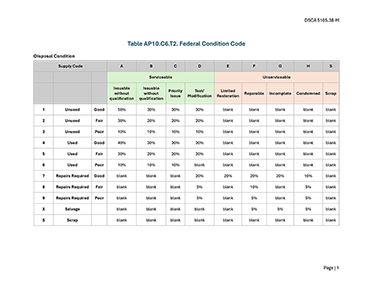
AP10.C6.15.3.5. The overhaul costs will be prorated over the interval between the most recent prior overhaul and the next scheduled overhaul. If a future overhaul is not scheduled, the cost of the last overhaul will be prorated over the normal average interval between overhauls. In the case where actual costs are not available for the last overhaul, a reasonable estimate from the facility normally performing overhauls for the type of item to be sold may be used. In the case where a maintenance schedule has not been established, a period of at least five years should be used. An example of computing these costs is illustrated in Figure AP10.C6.F3.
AP10.C6.15.3.6. When accountability for excess items has been transferred to "Property Disposal," the provisions of the Department of Defense Manual (DoDM) 4160.21, Volume 3 “Defense Materiel Disposition: Reutilization, Transfer, and Sale of Property” must apply. This manual provides specific guidance for the disposition of amounts realized from the sale of such equipment. Defense Logistics Agency (DLA) Disposition Services will calculate PC&H based on the original acquisition value of assets sold or transferred.
AP10.C6.15.3.7. A request for an exception to the established pricing policy of excess material for FMS will be submitted in accordance with Section AP10.C6.14. and must address the following:
AP10.C6.15.3.7.1. Whether the item has been screened for potential sale to purchasers and whether there is any existing purchaser interest at the price determined in accordance with the established pricing policy;
AP10.C6.15.3.7.2. Whether the alternative proposed price is equal to or greater than the scrap value plus the established recoupment charge for DoW NC;
AP10.C6.15.3.7.3. Whether demilitarization costs will be incurred by DoW if the item is sold and, if so, the estimated amount of such demilitarization costs;
AP10.C6.15.3.7.4. What the price to repair the item would be and its percentage of the original acquisition cost of the item; and
AP10.C6.15.3.7.5. Whether the proposed sale has any other economic or political benefit to DoW and/or the USG.
AP10.C6.15.4. Quotation of Firm Prices.
AP10.C6.15.4.1. The DoW Components are authorized to quote firm prices for items to be sold from stock and for in-house services to be furnished, pursuant to 22 U.S.C. 2761. Such prices are not subject to further adjustment, provided the purchaser accepts the LOA before the expiration date. A firm price may be quoted only for:
AP10.C6.15.4.1.1. An actual or estimated replacement price for a procurement-funded end item, including ammunition, or major items to be sold from inventory as authorized in Section AP10.C6.15.2.3.2., when the price is based on budgetary data or contractor quotation;
AP10.C6.15.4.1.2. A price for procurement-funded or major item developed under provisions of Section AP10.C6.15.2.3.1. and Section AP10.C6.15.3. and
AP10.C6.15.4.1.3. Training tuition rates (only for current year). Refer to Section AP10.C6.21. for additional information on rates for training of international students.
AP10.C6.15.4.2. The reason for quoting firm prices is to minimize difficulties that might arise should prices undergo several revisions due to budgetary decisions made subsequent to the country’s acceptance of LOAs. Firm prices may be quoted only after careful and coordinated development of such pricing data. LOAs (other than for training) that specify firm pricing must be coordinated, at a minimum, with the OUSW(C), the Offices of the Assistant Secretaries of the Military Departments (MILDEPS) (Financial Management and Comptroller), and DSCA.
AP10.C6.15.4.3. All LOAs authorized to be on a firm price basis must include a note that specifies that the pricing data presented is firm (except for changes authorized in Section AP10.C6.22.5.) and will not be changed, provided the country accepts the LOA before its offer expiration date.
AP10.C6.15.5. Charges for Nonrecurring Costs.
AP10.C6.15.5.1. Non-USG purchasers must pay a fair price, determined in accordance with Department of Defense Directive (DoDD) 2140.02 “Recoupment of Nonrecurring Costs (NCs) on Sales of U.S. Items,” for the value of DoW nonrecurring investment in the development and production of Major Defense Equipment (MDE), as required by law, unless an NC recoupment charge waiver has been approved by the Director, DSCA. For FMS, an NC recoupment charge is applicable to all MDEs. MDE is any item of Significant Military Equipment (SME) listed on the U.S. Munitions List (USML) having a DoW nonrecurring Research, Development, Test, and Evaluation (RDT&E) cost accumulation of $50 million or a total DoW production cost of more than $200 million. A listing of MDE with associated NC charges can be found in the Appendix 1. The NC recoupment charge is not applicable to Building Partner Capacity (BPC) cases.
AP10.C6.15.5.2. Cost Pool Methodology.
AP10.C6.15.5.2.1. A cost pool methodology is used to determine the pro rata share of NC to be recouped. The NC recoupment charge computation (nonrecurring RDT&E and nonrecurring production cost pools divided by estimated benefiting units) is submitted to the Director, DSCA for approval. The NC recoupment computation must be supported with an MDE calculation worksheet, illustrated in Figure AP10.C6.F6., Figure AP10.C6.F7., and Figure AP10.C6.F8. The Director, DSCA will review each DoW Component’s calculations and publish the approved charge in the Appendix 1.
Figure AP10.C6.F6. Recoupment of Nonrecurring Costs on Major Defense Equipment Example: Base Level
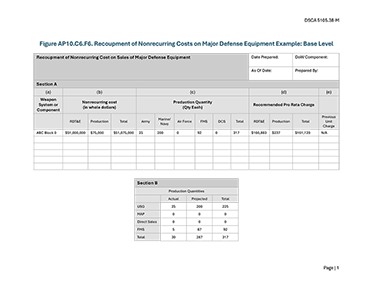
Figure AP10.C6.F7. Recoupment of Nonrecurring Costs on Major Defense Equipment Example: Two-Level
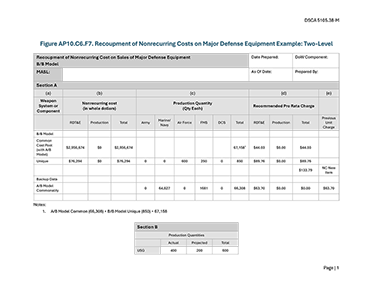
Figure AP10.C6.F8. Recoupment of Nonrecurring Costs on Major Defense Equipment Example: Multi-Level
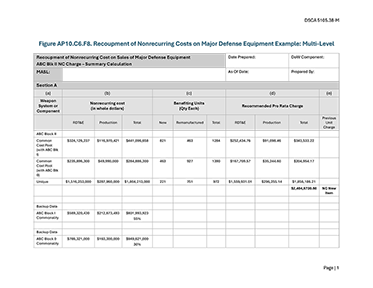
AP10.C6.15.5.2.2. Each DoW Component must establish a system to accumulate cost pools, recognize when a cost pool meets recoupment thresholds, and calculate an NC recoupment charge for items releasable to foreign countries and international organizations when FMS sales are anticipated. The NC recoupment charge must be based upon information recorded in DoW accounting records or DoW budget justification documents. If adequate documentation is unavailable, the DoW Component will calculate the pro rata NC at 5 percent of the last known DoW acquisition cost.
AP10.C6.15.5.3. Nonrecurring Research, Development, Test and Evaluation Cost Pool.
AP10.C6.15.5.3.1. The nonrecurring RDT&E cost pool includes costs funded by RDT&E appropriations to develop or improve the product or technology under consideration. The costs to be included in the nonrecurring RDT&E investment cost pool must be determined on the budget and accounting classifications established for RDT&E appropriations in DoW FMR, Volume 2A “Budget Formulation and Presentation.” DoW FMR, Volume 2B, Chapter 5 “Research, Development, Test, and Evaluation Appropriations” establishes the following RDT&E categories:
AP10.C6.15.5.3.1.1. Budget Activity 1, Basic Research;
AP10.C6.15.5.3.1.2. Budget Activity 2, Applied Research;
AP10.C6.15.5.3.1.3. Budget Activity 3, Advanced Technology Development (ATD). ATD is sometimes further broken down into budget activities 3A (strictly research efforts that involve the production of breadboards or brass boards to model all or part of a design) and 3B (applied to projects to produce a prototype, which although not suitable for fielding, is closer to representation of an end item for military application);
AP10.C6.15.5.3.1.4. Budget Activity 4, Advanced Component Development and Prototypes;
AP10.C6.15.5.3.1.5. Budget Activity 5, System Development and Demonstration;
AP10.C6.15.5.3.1.6. Budget Activity 6, RDT&E Management Support; and
AP10.C6.15.5.3.1.7. Budget Activity 7, Operational System Development.
AP10.C6.15.5.3.2. Costs in budget activities 3B, 4, 5, 6, and 7 are subject to recoupment and must be included in the nonrecurring RDT&E cost pools upon which the pro rata charge is calculated. The costs incurred for nonrecurring RDT&E in budget activities 1, 2, and 3A may not be included in the nonrecurring RDT&E cost pool.
AP10.C6.15.5.3.3. All applicable NC efforts, including in-house or multiple contractors, must be included in the nonrecurring RDT&E cost pool; the source of the NC effort to develop a product is not relevant to the calculation of the NC recoupment charge. The costs of improvement programs that are designed to continuously improve the safety, reliability, availability, and maintainability of an end item, or major component, over the projected life of the item will be shared equitably by all users of the item.
AP10.C6.15.5.3.3.1. Normally, each user will pay a share of the total annual cost through a Component Improvement Program (CIP) or comparable program. All users are expected to participate in such a program.
AP10.C6.15.5.3.3.2. The cost-sharing calculation will be established at the time the nonrecurring RDT&E cost pool is established and the NC recoupment charge is approved. First, the total life of the item will be projected, and then the point in time when half of all projected deliveries to non-DoW purchasers will occur will be estimated. Using actual cost data and data from historical files for similar CIP or comparable programs, the total U.S. investment costs over the life of the program will be estimated. The amount of U.S. investment projected to be incurred up to the previously determined point of half of the deliveries to non-DoW purchasers will be included in the weapon system nonrecurring RDT&E cost pool.
AP10.C6.15.5.3.3.3. The annual cost of operating the CIP or comparable program will be shared in proportion to the number of items in the possession of each user. This will ensure that the remaining costs of operating the CIP, or comparable program, will be shared equally by all users of the item.
AP10.C6.15.5.4. Nonrecurring Production Cost Pool. The costs to be included in the nonrecurring production cost pool are those financed by, or to be financed in the future by, procurement or operations and maintenance appropriations that benefit current and future production runs. DoDD 2140.02 “Recoupment of Nonrecurring Costs (NCs) on Sales of U.S. Items,” stipulates that the pool must capture such costs as preproduction, special tooling, special testing equipment, production engineering, product improvement, destructive testing and product model production, and testing and evaluation. Other costs may be included if they benefit both current and future production runs. Descriptions of the major categories of costs to be accumulated in this NC pool are as follows.
AP10.C6.15.5.4.1. Production Cost. Preproduction cost refers to the cost of such activities as tooling manufacture and tryout (i.e., jigs, dies, and fixtures) and the implementation of layout plans. A lump sum payment for license costs is part of the preproduction cost. See Section AP10.C6.15.5.4.8. for more information on license costs.
AP10.C6.15.5.4.2. Special Tooling Cost. Special tooling cost refers to the costs of all jigs, dies, fixtures, molds, patterns, taps, gauges, other equipment and manufacturing aids, and replacement thereof, that are of such a specialized nature that substantial modifications or alteration of their use is limited to the development of production of particular supplies or parts, or the performance of particular services. The term includes all components of such items, but does not include:
AP10.C6.15.5.4.2.1. Material;
AP10.C6.15.5.4.2.2. Special testing equipment; or
AP10.C6.15.5.4.2.3. Building and non-serviceable structures (except foundations and similar improvements necessary for the installation of special tooling), general or special machine tools, or similar capital items.
AP10.C6.15.5.4.3. Special Test Equipment Cost. Special test equipment cost refers to the cost funded by procurement appropriations for either single or multipurpose integrated test units engineered, designed, fabricated, or modified to accomplish special-purpose testing in the performance of the contract. Such testing units comprise electrical, electronic, hydraulic, pneumatic, mechanical, or other items or assemblies of equipment that are mechanically, electrically, or electronically interconnected so as to become a new functional entity, causing the individual item or items to become interdependent and essential in the performance of special test equipment procured with RDT&E appropriations.
AP10.C6.15.5.4.4. Developmental Production Engineering Cost. Developmental production engineering cost includes the cost of product design improvement intended to enhance the producibility of an item; examination of available manufacturing processes to determine the need for new techniques (and their development, if necessary); the optimum marshalling of resources for efficient manufacturing (such as optimum lot size, scheduling, production control, production line design and balancing, and plant layout); and tool design and detailed manufacturing planning. Although a continuing activity, most of this effort is rightfully considered a nonrecurring production cost.
AP10.C6.15.5.4.5. Product Improvement Cost. Product improvement programs may be accomplished by contractors as an engineering change proposal, modification work order, or an in-house project. Categories listed below are to be included in the end item nonrecurring production cost pool, even though a participating product improvement program has been established that prorates the annual cost of the program based upon worldwide asset position (both U.S. and foreign-owned end items). The DoW cost of the category listed in Section AP10.C6.15.5.4.5.6. must be recovered as part of the selling price of a new model item if the item is MDE. Product improvement is subdivided into six distinct types of effort:
- Safety;
- Cost reduction;
- Reliability, availability, and maintainability;
- Deficiency corrections;
- Compatibility standardization, and simplification; and
- New or improved operational capability.
AP10.C6.15.5.4.6. Destructive Testing Cost. Destructive testing is a technique for performing tests on a component, assembly, or end item. It involves the testing of an article beyond its design limits (and ultimately its destruction), or the actual consumption of the article to determine if it is performing to design specifications.
AP10.C6.15.5.4.7. Pilot Model Testing Cost. Pilot model testing includes the following efforts:
AP10.C6.15.5.4.7.1. Qualification testing is a very severe testing to determine if a product will do what it is designed to do. It usually involves the testing of a product to the limits of its performance. It is often destructive and the test articles are not intended to be used operationally in the future; and
AP10.C6.15.5.4.7.2. First article testing performed to evaluate a new manufacturer’s ability to produce a specified design (could be the new manufacturer’s design or that of another manufacturer). It is normally more stringent and costly than routine acceptance testing, but less stringent and costly (and less destructive) than qualification testing.
AP10.C6.15.5.4.8. License Cost. License cost refers to the cost of the license DoW obtains to allow competitive awards for the production of an item when its design is owned by a contractor. In effect, DoW buys the rights to allow other contractors to produce an item for DoW purposes through the payment of royalties or a lump sum fee. These royalties are customarily on a per item basis and should be charged as recurring production costs. The lump sum fee is a nonrecurring production cost.
AP10.C6.15.5.5. Components for United States Government Use Only. In computing NC pools for items to be sold under FMS, NC of major components that are restricted to USG use must not be included. For example, the costs of nuclear devices and features, countermeasure devices and features, security devices (black boxes), carrier-peculiar adaptations, and special fuel tank devices must be excluded. Estimates may be used if accounting records do not identify associated costs.
AP10.C6.15.5.6. Benefiting Units.
AP10.C6.15.5.6.1. Benefiting units is the number of items that must be included in all known or projected DoW production quantities and must be determined as follows.
AP10.C6.15.5.6.1.1. The production quantities of end items required by DoW must be obtained from either Selected Acquisition Reports or the Future Years Defense Program Procurement Annex.
AP10.C6.15.5.6.1.2. The production quantities of end items to be procured for foreign countries or international organizations under Security Assistance (SA) programs must be obtained from DoW Component SA plans.
AP10.C6.15.5.6.1.3. If end item data is not available from any of these sources, then the developing command must estimate the total number of end items to be produced.
AP10.C6.15.5.6.1.4. The production quantities of systems components that meet the investment threshold must be derived from the number of end items to be produced. For example, if 100 aircraft must be produced (assume one engine for each aircraft) and spare part support requires 150 engines, the production quantity of engines is 250.
AP10.C6.15.5.6.2. In the event of a disagreement on the production quantity and sales projections, the Director, DSCA must make the final determination in coordination with OUSW(C), the Office of the Under Secretary of War for Acquisition & Sustainment (OUSW(A&S) and the Office of the Under Secretary of War for Research and Engineering (OUSW(R&E)) of the production estimates to be used for determining the NC recoupment charge.
AP10.C6.15.5.7. Nonrecurring Cost Charge Revisions. A revision may be submitted at any time by a DoW Component. It is mandatory that a modification to the NC recoupment charge be submitted when a significant change occurs.
AP10.C6.15.5.7.1. Price Reduction. When the price is reduced because of age, condition, or supply status (excess), the same percentage reduction must be made to the pro rata share of NC.
AP10.C6.15.5.7.2. Biennial Review. DoDD 2140.02 requires a biennial review of approved MDE charges to determine if there has been a significant change in factors or assumptions used to compute the currently approved recoupment for a model. A significant change occurs when:
AP10.C6.15.5.7.2.1. A new calculation shows a change of 30 percent of the current system NC charge for an MDE item;
AP10.C6.15.5.7.2.2. The NC unit charge increases or decreases by $50,000 or more; or
AP10.C6.15.5.7.2.3. The potential for a $5 million change in recoupment exists.
AP10.C6.15.5.7.3. Model Change. When a model change occurs, the NC recoupment charge must be recalculated. That portion of the NC that benefits only one model must be allocated only to that model. That portion of the NC that benefits old and new models must be prorated between cost pools related to the old and new model items. The commonality between old and new models may be determined either on the basis of the ratio of old model parts in the new item or on some other common acceptable basis for allocation of costs between the models (e.g., engineering analysis or technology analysis, as appropriate). Sample calculations are illustrated in Figure AP10.C6.F6. through Figure AP10.C6.F8.
AP10.C6.15.5.8. Nonrecurring Costs Charge Recoupment. The approved pro rata charge must be recouped unless a waiver is authorized. When NC recoupment is applicable, the price on an LOA must include the specific recoupment charge. In instances where the initial rate has not yet been approved, DoW Components must provide an estimated rate based on the most accurate information available to the DoW Component. The LOA must be modified to specify the subsequently approved rate and only that approved rate is to be billed. When a recoupment charge is revised, the previous value is retained in the Appendix 1. Subsequent revisions to the pro rata charge must be applied to new LOAs and must not be applied retroactively. An exception to this rule of application is not authorized.
AP10.C6.15.5.9. Reporting Nonrecurring Costs Recoupment Collections. NC Recoupment Collections must be reported.
AP10.C6.15.5.9.1. Funds collected for NC recoupment charges must be disposed of in accordance with Section AP10.C3.9.2.
AP10.C6.15.5.9.2. DoW Components must provide a quarterly report on the status of NC recoupment collections. The report must be forwarded to the Assistant Director, DSCA (OBO) within 45 days following the close of each fiscal quarter.
AP10.C6.15.5.9.3. DoW components must maintain records of anticipated and actual NC recoupment collections.
AP10.C6.15.5.10. Waivers.
AP10.C6.15.5.10.1. The Director, DSCA has been delegated the authority to waive NC recoupment charges on FMS sales in accordance with Section AP10.C6.13.1., DSCA must issue, in writing, any approvals granted for waivers of the NC recoupment charge that otherwise would be collected under FMS. DSCA must forward a notification of each approved waiver to the applicable DoW Component.
AP10.C6.15.5.10.2. The decision on any waiver requires the concurrence of OUSW(C), OUSW(A&S), and OUSW(R&E). If an issue concerning the waiver request cannot be resolved, the Director, DSCA must submit an official waiver request to the Deputy Secretary of War (DEPSECWAR) for final determination. That request to the DEPSECWAR must be coordinated with OUSW(C), OUSW(A&S), and OUSW(R&E).
AP10.C6.15.5.10.3. Articles delivered after November 30, 1989, under FMS cases fully financed with Military Assistance Program (MAP) Merger funds and/or non-repayable Foreign Military Financing (FMF) funds, must be priced to exclude the NC recoupment charge, in accordance with AECA, Section 21(e)(1)(B) (22 U.S.C. 2761(e)(1)(B)).
AP10.C6.15.5.11. Special Research, Development, Test and Evaluation and Nonrecurring Production Costs
AP10.C6.15.5.11.1. DoDD 2140.02 requires the purchaser to pay for “special” RDT&E and nonrecurring production costs that are incurred for the benefit of a particular FMS purchaser. Documentation must be maintained to show that the FMS purchaser requested the feature for its own benefit. For purposes of this paragraph, a “special” feature or unique requirement includes, but is not limited to, features that DoW initially may not have adopted or purchased due to the non-availability of funds, lack of authorization from the Congress, or lack of an approved DoW requirement, but subsequently adopts or purchases when otherwise authorized.
AP10.C6.15.5.11.2. DoDD 2140.02 stipulates that the USG must not be charged a recoupment charge for “special” RDT&E and nonrecurring production costs even if the USG also adopts those features for its own use, or provides equipment with such features under a U.S. grant, aid, or similar program. This provision applies without regard to whether the adoption of such features by DoW occurs before, during, or after the full development of the feature.
AP10.C6.15.5.11.3. DoDD 2140.02 permits the recoupment of "special" RDT&E and nonrecurring production costs incurred by FMS purchasers or participants of a coproduction, co-development, and cooperative development, or cooperative production program.
AP10.C6.15.5.11.3.1. Recoupment is allowable only if such "special" costs exceed $50 million for each FMS purchaser, or if the “special” costs of participants of a cooperative agreement exceed $50 million in aggregate.
AP10.C6.15.5.11.3.2. The "special" recoupment charge is determined by the DoW Component as a result of the distribution of the total costs divided by the total production, which is the same methodology used for determining the DoW NC recoupment charge.
AP10.C6.15.5.11.3.3. The reimbursements may be collected by the Department from other purchasers or participants on behalf of the purchaser or cooperative participant incurring the “special” costs. Unless otherwise authorized by the Under Secretary of War (USW), Policy, reimbursements must not be collected after 10 years have passed since the date the original FMS customer accepted the FMS LOA that included the special NC charges. IAs should coordinate with DSCA to obtain approval.
AP10.C6.15.5.12. Defense Contract Audit Agency. The Director, Defense Contract Audit Agency (DCAA) must ensure that any evaluation of a contractor accounting system includes an analysis of the internal controls established to ensure compliance with the requirement to pay NC recoupment charges for sales made prior to October 7, 1992. If DCAA audit work (e.g., on a bid proposal or claim for incurred costs) discloses contractor noncompliance with the requirement to pay an NC recoupment charge, an audit report must be issued promptly to the cognizant DoW contracting officer, with a copy of the report submitted to OUSW(C), Defense Finance and Accounting Service, Security Cooperation Accounting Directorate (DFAS-SCA), and DSCA (OBO).
AP10.C6.15.6. Returns. In accordance with 22 U.S.C. 2761(m), returns may be accepted if the defense article was previously supplied under the U.S.C., is not SME, and is in full functioning condition without need of repair or rehabilitation. DoW must have a funded requirement, including FMS requirements, for the defense article. The purchaser must not be reimbursed directly; the purchaser's FMS Trust Fund account must be credited to reflect the transaction, using DoW appropriations or other purchaser funds, dependent on the buyer.
Defense articles procured for cash sales to an eligible foreign government or international agency for direct delivery, pursuant to Arms Export Control Act (AECA), Section 22 (22 U.S.C. 2762), must be priced to recover the full contract cost to DoW, including DoW recurring contract support costs and applicable DoW surcharges. Costs may be revised for increases in labor and materials, or for other changes in production and procurement costs. The purchaser is obligated to pay any damages or costs that may accrue from the purchaser’s cancellation of the contract (termination liability). Applicable surcharges must be added to the contract cost and included in billings for incurred costs. An illustration of the price computation is in Figure AP10.C6.F9.
Figure AP10.C6.F9. Price Computation Example: New Procurement
|
Contract Price (20 items) |
$1,000,000.00 |
|
Nonrecurring Cost (NC) ($2,500 each × 20 items) |
50,000.00 |
|
Contract Administration Services (CAS) ($1,000,000 × 0.015) |
15,000.00 |
|
Government Furnished Material (GFM) |
25,000.00 |
|
Packing, Crating, and Handling (PC&H) GFM (3.5%)1 |
875.00 |
|
Transportation of GFM from Depot to Contractor Plant1 |
+938.00 |
|
Foreign Military Sales (FMS) Selling Price (20 items)2 |
$1,091,813.00 |
|
FMS Unit Selling Price2 ($1,091,813/20) |
$54,590.65 |
|
Notes:
|
|
AP10.C6.16.1. Cost Principles.
AP10.C6.16.1.1. DoW articles must be priced based on the same cost principles used in pricing DoW contracts covering items for DoW use. Recognition must be given to other reasonable, allowable, and allocable contractor costs and risks as permitted in the Federal Acquisition Regulation (FAR) and Defense Federal Acquisition Regulation Supplement (DFARS), unless the purchase is wholly funded through non-repayable Foreign Military Financing (FMF) funds.
AP10.C6.16.1.2. When insufficient funds are available in the Foreign Military Sales (FMS) Trust Fund account of a foreign government to meet current cash requirements, DSCA must initiate, through the responsible DoW Component contracting officer, appropriate contractual actions that will balance current cash requirements with available funds, unless the provisions of AECA, Section 22(b) (22 U.S.C. 2762(b)) are involved. This condition should not occur without notification to the FMS purchaser. See Department of War Financial Management Regulation (DoW FMR), DoW 7000.14-R, Volume 16 for information on debt owed to the DoW by foreign entities.
AP10.C6.16.1.3. The $250,000 expense/investment threshold stated in DoW FMR, Volume 2A, Chapter 1 does not apply to investment items funded by expense appropriations in support of BPC programs.
AP10.C6.16.2. Nonrecurring Research, Development, Test and Evaluation and Nonrecurring Production Costs. The price must include recovery of nonrecurring RDT&E costs and nonrecurring production costs as specified in Department of Defense Directive (DoDD) 2140.02 “Recoupment of Nonrecurring Costs (NCs) on Sales of U.S. Items.” Section AP10.C6.15.5. contains further discussion of these costs.
AP10.C6.16.3. Contract Administration Services Surcharge Costs Incurred in Support of New Procurements for Foreign Military Sales.
AP10.C6.16.3.1. Contract Administration Services Surcharge. Defense Finance and Accounting Service, Security Cooperation Accounting Directorate (DFAS-SCA) recovers the cost of Contract Administration Services (CAS) by applying a percentage surcharge to the delivery transactions reflecting disbursements to contractors for FMS procurements on which applicable CAS have not been waived. The surcharge amounts collected are deposited to an account maintained by DFAS-SCA and used to reimburse the DoW Components for CAS performed. The following surcharges in Table AP10.C6.T3. are prescribed for DFAS-SCA application to disbursement with reimbursable codes, specific delivery source codes, and price code “N”:
Table AP10.C6.T3. Contract Administration Services Surcharges
|
Foreign Military Sales Contract Administration Services Component |
For Letters of Offer and Acceptance Implemented Before October 1, 2002 |
For Letters of Offer and Acceptance Implemented October 1, 2002 - November 30, 2014 |
For Letters of Offer and Acceptance Implemented December 1, 2014 - January 31, 2020 |
For Letters of Offer and Acceptance Implemented on or After February 1, 2020 |
|---|---|---|---|---|
|
Contract Administration/Management |
0.50% |
0.65% |
0.50% |
0.45% |
|
Quality Assurance and Inspection |
0.50% |
0.65% |
0.50% |
0.45% |
|
Contract Audit |
0.50% |
0.20% |
0.20% |
0.10% |
|
Subtotal: Continental United States (CONUS) Foreign Military Sales (FMS) Contract Administration Services (CAS) |
1.50% |
1.50% |
1.20% |
1.00% |
|
Outside of the Continental United States (OCONUS) |
Previously included above |
0.20% |
0.20% |
0.20% |
|
Total: CONUS + OCONUS FMS CAS |
1.50% |
1.70% |
1.40% |
1.20% |
AP10.C6.16.3.2. Contract Administrative Surcharge Waivers. CAS is subject to waiver in whole or in part under AECA, Section 21(h) (22 U.S.C. 2761(h)). See Section AP10.C6.13.3. for more information on CAS waivers. A listing of waived programs is included in the Chapter 9. CAS waivers apply only to those cost elements approved for the entire Letter of Offer and Acceptance (LOA), not only to a specific line/sub-line. CAS waivers are case based and apply to new cases implemented on or after the approved waiver date. They are not retroactive nor applied to amendments on cases implemented prior to the waiver. The waived CAS element must be charged to DoW appropriations. DFAS and DSCA must reject billings to the FMS Trust Fund CAS Surcharge Account for charges that were waived.
AP10.C6.16.4. Contract Administration Services Surcharge Costs Incurred in Support of Foreign Country Commercial Contracts. DoW support of commercial contracts awarded by foreign countries and international organizations represents an FMS sale of services. The Defense Contract Management Agency (DCMA) is responsible for performing this function. The hours expended in support of these commercial contracts must be accumulated and billed at an FMS contract administrative hourly labor rate published each fiscal year (FY) by Office of the Under Secretary of War (Comptroller) (OUSW(C)). For the current rate, see the OUSW(C) Department of Defense FY 2026 Reimbursable Rates webpage.
AP10.C6.16.5. Costs for Government-Furnished Material.
AP10.C6.16.5.1. Supplied From Inventory. All Government-Furnished Material (GFM) supplied from inventory must be billed to the FMS case as "work in process" when the GFM is shipped from a depot to a contractor (see Appendix 10, Chapter 7) The billing price must be the same as a direct sale to an FMS purchaser, plus applicable accessorial costs.
AP10.C6.16.5.2. Supplied From a Contractor. All GFM supplied from another contractor must be billed to the FMS case as "work-in-process" when payments are made to the contractor supplying the GFM. GFM should be shipped via a Collect Commercial Bills of Lading (CCBL) or prepaid by the supplying contractor. Contracts with contractors supplying GFM should directly cite the FMS Trust Fund as the financing source to the maximum extent possible.
AP10.C6.16.5.3. Precious Metal. When precious metals recovered under the precious metals recovery program are provided as GFM to a contractor, the material must be valued at the market price on the date it is supplied to the contractor. Market price must be determined from any authoritative publication.
AP10.C6.16.6. Other Department of War-Funded Services in Support of Foreign Military Sales Procurements.
AP10.C6.16.6.1. The cost of DoW-provided or DoW-funded engineering services that are required to solve problems encountered during a production run must be allocated to FMS purchasers based on the number of items that are in the production run.
AP10.C6.16.6.2. If components are procured for an FMS purchaser and assembled by DoW personnel, assembly labor costs must be assessed in accordance with Section AP10.C6.20.
AP10.C6.16.6.3. If a contractor is designated as the source of supply for nonstandard items to be procured for FMS purchasers, the contract price for the applicable items will normally include the additional cost(s) incurred to research and procure the nonstandard items. Any reasonable method of allocating these additional costs is acceptable. The test of the reasonableness of the contractor’s costing allocation would be acceptance of the method by Defense Contract Audit Agency (DCAA).
AP10.C6.16.7. Customization Costs. The cost of deviations from USG configuration and special technical data desired by a foreign government must be included as a charge to that foreign government.
AP10.C6.16.8. Items to be Replaced by Later Production (Diversions). When new production and procurement items are diverted from Military Department (MILDEP) delivery schedules, and will be replaced by later production, these items must be priced at the current production cost or the replacement production cost, whichever is higher.
AP10.C6.16.9. Production by a Foreign Government. When a portion of the production quantity is to be produced by the purchasing foreign government, costs must be computed separately in accordance with cost methods established by the foreign government and accepted by the USG.
AP10.C6.16.10. Recoupment of Interest Penalties Due to Prompt Payment Act.
AP10.C6.16.10.1. The FMS Trust Fund must pay or reimburse any prompt payment interest penalty payments that are incurred (Title 5, Code of Federal Regulation (CFR), Part 1315 (5 CFR 1315), “Prompt Payment”). Vouchers for interest penalties incurred on FMS procurements must cite the same line of accounting supplied by DFAS-SCA prior to the beginning of each FY. If, at the time of occurrence, the appropriate fund cite is unknown, contact DFAS-SCA. DFAS-SCA has assigned a unique accountable station number for each Service or Component for the purposes of accounting for prompt payment interest penalty reporting.
AP10.C6.16.10.2. Within 30 days after the end of each quarter, each assigned DFAS-SCA accountable station must submit the FMS Prompt Payment Act Report to DSCA. This report contains three sections reflecting the interest penalties paid by the number of transactions, the dollar amount, and a reason code.
AP10.C6.16.10.3. Each assigned DFAS-SCA accountable station must submit an FY end-of-year report annually. Since the fourth quarter report is an aggregate of the entire FY, the quarterly report also serves as the annual requirement. This report is due to DSCA 45 days after the end of the FY.
AP10.C6.16.11. Price Codes. The DoW Components will make every effort to obtain the final price for contract-supplied items within 180 days of reported delivery. However, the use of estimated price codes is approved for reporting the deliveries of major end items if an actual price code is not available within 30 days after the date of shipment. Moreover, the use of estimated price codes is mandatory for reporting the deliveries of major end items if an actual price code is not available within 90 days after the date of shipment.
AP10.C6.17.1. Defense articles are leased to a foreign country or international organization under the authority of Arms Export Control Act (AECA), Section 61 (22 U.S.C. 2796). Inspection, restoration, maintenance, accessorial costs, or other support costs incurred in connection with the lease must be priced in accordance with this section and included on a separate Letter of Offer and Acceptance (LOA). Lease charges must apply except for cooperative Research & Development (R&D) projects, military exercises, communications, and/or electronics interface projects. Reimbursement of the lease charge for any defense article that has passed 75 percent of its normal service life may be waived if it is determined that doing so is important to the national security interest of the U.S. This waiver authority has been delegated to the Director, DSCA or in the absence of the Director, the Deputy Director.
AP10.C6.17.2. Pricing of Leased Defense Articles.
AP10.C6.17.2.1. The amount to be charged for the lease of defense articles is the depreciation incurred during the period of the lease.
AP10.C6.17.2.2. The depreciation charge is dependent upon the following (see Figure AP10.C6.F10.):
- Date the item is to be leased,
- Date the item was first fielded or actual acquisition date,
- The total estimated service life of the item,
- Duration of the lease,
- The original acquisition cost of the item,
- A pro rata share of nonrecurring Research, Development, Test, and Evaluation (RDT&E) and production costs, and
- Capital improvements made to the item.
Figure AP10.C6.F10. Calculation of Charges for Leased Defense Articles with Illustrative Entries
|
Step 1: Determine Service Life. |
||
|
a |
Date to be leased |
June 2018 |
|
b |
Date item first fielded or actual acquisition date of specific item (if known) |
June 2008 |
|
c |
The total estimated service life of the item |
240 months |
|
d |
Item age in months as of the lease date |
120 |
|
e |
Number of months to be leased |
12 |
|
f |
Estimated months of service life remaining at conclusion of lease |
+108 |
|
g |
Total months of service life (d. + e. + f.)1 |
240 |
|
Step 2: Determine cost of defense articles leased to be depreciated. |
||
|
a |
Original acquisition cost |
$1,000,000 |
|
b |
Pro rata share nonrecurring Research & Development (R&D) and production costs2 |
20,000 |
|
c |
Capital improvements |
|
|
|
1) Major overhauls in past 24 months |
500,000 |
|
|
2) Modifications net of retirements3 |
+300,000 |
|
|
Total Cost Less residual value amount subject to depreciation (see Department of War Financial Management Regulation (DoW FMR), DoW 7000.14-R, Volume 4, Chapter 26 “Accounting for Leases”) |
$1,820,000 |
|
Step 3: Calculate monthly charge. |
||
|
|
Divide results of Step 2 by results of Step 1. |
$1,820,000/240 = $7,583.33 |
|
Notes:
|
||
AP10.C6.17.3. Replacement Costs. Replacement costs must be estimated when the item is placed on lease and reflected in the lease agreement. In the event a leased defense article is damaged beyond repair, or is not returned, the replacement cost must be collected from the leasing foreign country or international organization. The FMS administrative surcharge does not apply to lease rental payments. The replacement cost must be calculated in accordance with Section AP10.C6.15.2.2. and Section AP10.C6.15.2.3. Refer to Appendix 8 - Leases of Defense Articles for procedures on leasing arrangements.
AP10.C6.18.1. Technical Data Package. A Technical Data Package (TDP) encompasses production designs, drawings, specifications, models, manufacturing techniques and details, and similar information necessary to enable a foreign government to manufacture, or have manufactured, items of military equipment and repair parts, excluding information associated with the Research, Development, Test, and Evaluation (RDT&E) stage. It also does not include technical assistance or knowledge by USG personnel; however, such assistance may be provided at additional cost. Refer to Chapter 3 for additional information on TDP.
AP10.C6.18.2. Pricing of Technical Data Packages. DSCA may authorize release of a TDP to a foreign government for in-country manufacture of military equipment and repair parts. Costs incurred in the preparation, reproduction, and handling of the TDP must be priced in accordance with Section AP10.C6.19. When the pricing of the TDP is subject to an international agreement of which DoW is a party or is otherwise bound, the sale will be determined consistent with the terms of the agreement.
Generally, the cost for a DoW standard publication is the incremental cost to produce another copy. Effective October 1, 2004, acquisition and development costs are excluded in determining the costs of a DoW standard publication.
AP10.C6.19.1. Terms.
AP10.C6.19.1.1. Publications. The term publications include technical orders, technical manuals, supply catalogs, training publications, courseware, computer-based tutorials, administrative publications, engineering drawings, and associated documents, Integrated Logistics Support publications and associated documents, equipment component lists, special file extracts, decals, forms, and audio-visual products.
AP10.C6.19.1.2. Medium of Publications. The medium of publication refers to the format of the publication; it may be in bound or loose-leaf format, imprinted form, Automated Data Processing (ADP) listing, operator’s card, microfilm, slide, motion picture film, computer disc, or internet accessible.
AP10.C6.19.1.3. Foreign Military Sales Purchaser-Unique Publication. Unique publications are DoW standard publications sanitized for the elimination of non-releasable information or publications developed for a country's unique specification. Engineering drawings and associated documents will be reviewed to determine if a technology charge is appropriate. Refer to Section AP10.C6.15.2.2. when pricing Defense Working Capital Fund (DWCF) publications.
AP10.C6.19.2. Publication/Software Pricing Factors.
AP10.C6.19.2.1. Publications or software developed solely for the use of an Foreign Military Sales (FMS) purchaser(s), such as a country-unique technical order/software, instructions, or other publications and programs, must be priced to recover the total costs (including both in-house and contractual efforts) of development and delivery of the end product. These costs must include but are not limited to, the amounts paid for technical or administrative writing, editing, illustrating, animation, copy preparation, documentation, royalty fees for intellectual property, and distribution services. The costs of additional copies or masters must be limited to the actual costs of reproduction to include media (e.g., disk, tape, compact disk, and hardcopy) and distribution/delivery. The development of FMS prices for current, standard publications, or software programs/products of the DoW includes copy production cost (CPC) and support cost.
AP10.C6.19.2.2. Copy Production Cost. CPC is the costs incurred in the printing or reproduction of copies from the reproducible master.
AP10.C6.19.2.3. Support Cost. Support costs are the costs incurred in the elimination of non-releasable information from a DoW publication/software program prior to release to a foreign government. Support cost includes the costs of classified handling, development, and maintenance of country-peculiar publications or programs, including costs associated with updating manuals/programs for nonstandard items (such as items out of inventory or out of production).
AP10.C6.19.3. Development of a Per Copy Selling Price.
AP10.C6.19.3.1. Calculation. The total cost of a publication or software program is the sum of the incremental costs identified in Section AP10.C6.19.2. The total cost must be reduced to a per copy expression by dividing the total incremental cost by the quantity produced.
AP10.C6.19.3.2. Use of Actual Cost. Recorded actual costs will be used when available. When actual costs for individual publications or programs cannot be readily determined, a factored expression of historical costs will be developed from the most current cost records available. Uniform pricing tables can be developed from the cost per "unit" ("unit" being either a page, a roll of microfilm/microfiche page, or a running foot of tape or motion picture film). Section AP10.C6.19.2. includes guidance for developing publication pricing tables.
AP10.C6.19.4. Other Applicable Costs.
AP10.C6.19.4.1. Recoupment of Nonrecurring Cost (NC) does not normally apply to the sale of publications or software. However, if the item is Major Defense Equipment (MDE), then NC recoupment charges would apply. Applicable NC recoupment charges are a part of the cost included in the pricing formula set forth in Section AP10.C6.19.3.
AP10.C6.19.4.2. The standard administrative and accessorial charges prescribed in this section must be recouped as a percentage of publication/software prices. These charges are not included in the per copy selling price.
AP10.C6.19.4.3. The FMS price for a joint Military Service publication or software program must be established by the Military Department (MILDEP) responsible for its acquisition and management. That Military Department must notify the other participating DoW Components of the established FMS price.
The pricing of DoW personnel services in support of the Foreign Military Sales (FMS) program, including personnel costs recouped indirectly through the FMS administrative surcharge and those recouped as direct charges, such as special management services, Mobile Training Teams (MTTs), Mobile Education Teams (METs), Technical Assistance Teams (TATs), or Technical Assistance Field Teams (TAFTs), must be calculated in accordance with this section. See Section AP10.C6.21. for the pricing of personnel assigned to DoW training installations and for those costs that may be waived or excluded from charges in certain cases discussed throughout this section. When determining the pricing for personnel services, every attempt should be made to use actual costs. If actual cost data is not available, estimated pricing is acceptable. The costs must be substantiated by a reliable audit trail.
AP10.C6.20.1. Civilian Personnel.
AP10.C6.20.1.1. Services performed by DoW civilian personnel must be priced at rates in effect at the time the services are performed. Salary tables are available at the Office of Personnel Management (OPM) website. Base salary rates must be accelerated as discussed in this paragraph. An illustration of civilian personnel pricing computation is shown in Figure AP10.C6.F11.
Figure AP10.C6.F11. Civilian Personnel Services Price Computation Example
|
Assumptions:
|
||||
|
|
Foreign Military Sales Case |
Building Partner Capacity Case and Foreign Military Sales Admin |
||
|
|
Less than Full Time |
Full Time |
Less than Full Time |
Full Time |
|
[A × B] |
$3,823.00 |
$3,823.00 |
$3,823.00 |
$3,823.00 |
|
[(1) × E] |
$688.14 |
- |
$688.14 |
- |
|
[(1) + (2)] |
$4,511.14 |
$3,823.00 |
$4,511.14 |
$3,823.00 |
|
[(3) × C] |
$306.76 |
$259.96 |
- |
- |
|
[(3) × D] |
$1,587.92 |
$1,345.70 |
$1,587.92 |
$1,345.70 |
|
[(3) + (4) + (5)] |
$6,405.82 |
$5,428.66 |
$6,099.06 |
$5,168.70 |
|
Notes:
|
||||
AP10.C6.20.1.2. Accelerated Rates and Factors.
AP10.C6.20.1.2.1. Fringe Benefits Rate is used to recover the USG’s contribution of civilian employee benefits such as retirement, insurance and health plans, and cash awards, and is published annually at OUSW(C) DoW Reimbursable Rates, “Civilian Personnel Fringe Benefit (Tab D)” (see the OUSW(C) Department of Defense FY 2026 Reimbursable Rates website).
AP10.C6.20.1.2.2. Leave and Holiday (L&H) Factor is used to compensate for wages paid during leave or holiday period, and is currently set at 18 percent. L&H is not applied to civilian personnel assigned full time to a given requirement.
AP10.C6.20.1.2.3. Unfunded Civilian Retirement (UCR) Factor is applied to recover retirement, post-retirement health benefits, and post-retirement life insurance costs incurred by USG, and is published annually at Office of the Under Secretary of War (Comptroller) (OUSW(C)) DoW Reimbursable Rates (See the Department of Defense FY 2026 Reimbursable Rates website) . UCR does not apply to Building Partner Capacity (BPC) Case- or FMS Admin-funded personnel.
AP10.C6.20.1.3. The cost of civilian personnel assigned full time to FMS Case-funded requirements should reflect the annual salary for the applicable pay grades plus the Fringe Benefit Rate plus the UCR Factor. Otherwise, an hourly rate of 1/2087 of the annual rate plus the L&H Factor will be used, and the Fringe Benefits Rate and UCR Factor are then applied to the calculated hourly rate.
AP10.C6.20.1.4. The cost of civilian personnel assigned full time to BPC Case-funded requirements, or funded 100 percent from the FMS Administrative Surcharge Budget, should reflect the annual salary for the applicable pay grades plus the Fringe Benefit Rate. Otherwise, an hourly rate of 1/2087 of the annual rate plus the L&H Factor will be used, and the Fringe Benefits Rate is then applied to the calculated hourly rate.
AP10.C6.20.1.5. See Section AP10.C6.13.8. for the impact of "Fair Pricing" legislation on civilian personnel services in calculating charges for administrative services under Arms Export Control Act (AECA), Section 61(e)(1)(A) (22 U.S.C. 2796(e)(1)(A)).
AP10.C6.20.2. Military Personnel.
AP10.C6.20.2.1. Military Personnel (MP) services must be priced using the composite standard pay and reimbursable rates current at the time services are performed. MP service costs are not included in cases solely citing Military Assistance Program (MAP) Merger, Foreign Military Financing (FMF), or BPC funding.
AP10.C6.20.2.1.1. DoW Reimbursable Rates, “Military Personnel Composite Standard Pay and Reimbursement Rates (Tab K),” are published, and periodically revised, by the OUSW(C) (see the Department of Defense FY 2026 Reimbursable Rates website for more information.). FMS costs are calculated using the “Rate Billable to FMS Entities.” Monthly, daily, or hourly rates can be determined from these tables by using factors listed in the notes at the bottom of each page.
AP10.C6.20.2.1.2. Historical rates are available by applicable FY, as noted in the DoW Reimbursable Rates. Prior to November 30, 1989, an Asset Use acceleration factor would have applied to the total costs of temporary duty (TDY) and military composite pay costs if the service was performed at a military installation.
AP10.C6.20.2.2. Since FY 1985, the annual composite standard military rates include the cost of retirement. These composite rates, however, must also recover the cost of other benefits. L&H costs are added when reimbursements are based on time actually worked, such as when the foreign country does not otherwise pay for the personnel costs incurred by DoW during L&H periods. The additive amounts for retirement, L&H, and other benefits are expressed as percentages of the composite standard pay rate. Pricing computations are illustrated in Figure AP10.C6.F12.
Figure AP10.C6.F12. Military Personnel Services Price Computation Example
|
Assumptions: |
||||
|
||||
|
FMS Case - Full Time FMS Employee: |
||||
|
Computation Scenario 1: |
||||
|
|
O-4 |
E-7 |
Total |
|
|
FMS Composite Pay Cost1 |
$223,770 |
$144,411 |
|
|
|
FMS Selling Price3 |
|
|
$368,181 |
|
|
FMS Case - Less Than Full Time FMS Employee: |
||||
|
Computation Scenario 2: |
||||
|
|
O-4 |
E-7 |
Total |
|
|
FMS Rate x Hourly/Daily Factor × hours of service performed2/3 |
$60,729.91 |
$39,192.33 |
$99,922.24 |
|
|
TDY Cost |
|
|
$5,600 |
|
|
FMS Selling Price3 |
|
|
$105,522.24 |
|
|
Notes:
|
||||
AP10.C6.20.2.3. Permanent change of station (PCS) costs are included in the composite standard pay rates and are subject to reimbursement factors. For cases prior to FY 2005, if MP were required to make a PCS move to support an FMS case, the PCS rate must be deleted from the composite rate and the actual PCS cost charged to the case is not subject to any additional reimbursement factor. Effective FY 2005, MP services for FMS must be priced using the composite rates that already include the PCS expense and must no longer use the actual PCS expense for PCS moves to support an FMS case.
AP10.C6.20.3. Foreign National Personnel. Foreign national personnel services must be priced at actual costs or at standard pay rates. Standard pay rates must not be used when known to be less than actual costs. Both the actual cost and the standard pay rate must include an estimated amount to cover such benefits as sick leave, maternity leave, death, accident, unemployment, and retirement (separation) when such benefits are paid to these employees or are specifically required by the laws of the foreign government.
AP10.C6.20.3.1. The calculation of personnel costs must include travel time, for both TDY travel and PCS, when the travel directly results from the performance of an FMS or BPC case (PCS does not apply to BPC).
AP10.C6.20.4. Travel and Living Allowances.
AP10.C6.20.4.1. The calculation of personnel costs must include travel time, for both TDY travel and PCS, when the travel directly results from the performance of an FMS or BPC case (PCS does not apply to BPC).
AP10.C6.20.4.2. Travel, per diem, living allowance payments, and other entitlements to DoW personnel working on FMS cases must be identical to the payments and entitlements of DoW personnel working on direct DoW mission assignments at similar locations. Refer to Department of War Financial Management Regulation (DoW FMR), DoW 7000.14-R, Volume 9 “Travel Policy” for additional information.
AP10.C6.20.4.3. Waivers from the normal travel procedures must be granted to Security Assistance (SA) travelers on the same basis, and in the same manner, as provided for DoW personnel traveling on regular defense business.
AP10.C6.20.4.4. An FMS case must be priced to include the amount paid to employees or centrally funded through authorized DoW entitlement programs.
AP10.C6.20.5. Special Instructions Applicable to Defense Working Capital Fund.
AP10.C6.20.5.1. Rates. Defense Working Capital Fund (DWCF) facilities must charge approved DoW stabilized rates and prices for services in support of FMS cases, except where special rates have been approved by OUSW(C) or where actual cost reimbursement is appropriate. The stabilized rate to be charged is the rate in effect when the order is received and accepted (as opposed to when work is performed by DWCF supply management). See DoW FMR, Volume 2B, Chapter 9 and DoW FMR, Volume 11A “Reimbursable Operations Policy” for additional information on DWCFs.
AP10.C6.20.5.2. Unfunded Civilian Retirement and Post-Retirement Health Benefits. The price or rate charged to FMS purchasers of DWCF activities for defense articles and services must be adjusted to include an amount for UCR and post-retirement health benefits costs. UCR would not be applied to any personnel funded by the FMS administrative account (see Section AP10.C6.13.8.). To determine the price or rate adjustment, the civilian salary costs (not including benefits or overtime costs) included in the price or rate, must be multiplied by the UCR and post-retirement health benefits costs rate. Amounts collected for UCR and post-retirement health benefits costs must not be retained by DWCF activities; rather, such amounts must be deposited into the Miscellaneous Receipts Account 3041. See the OUSW(C) Department of Defense FY 2026 Reimbursable Rates website.
AP10.C6.21.1. General. Any special requirement for the exclusive use of an international student or international program must be reimbursed in full. Less than the full cost of training may be charged under training price exceptions, Arms Export Control Act (AECA), Section 21 (22 U.S.C. 2761).
AP10.C6.21.2. International Student Training Price Exceptions.
AP10.C6.21.2.1. AECA, Section 21(a)(1)(C) (22 U.S.C. 2761(a)(1)(C)) allows for countries concurrently (same fiscal year (FY)) in receipt of International Military Education and Training (IMET) or designated as a high-income foreign country to be charged only those additional costs that are incurred by the USG in furnishing the training.
AP10.C6.21.2.2. AECA, Section 21(g) (22 U.S.C. 2761(g)) authorizes the President to enter into North Atlantic Treaty Organization (NATO) Standardization Agreements (STANAG). The President also is authorized to enter into similar agreements with countries that are major non-NATO allies for the cooperative furnishing of training on a bilateral or multilateral basis, if the financial principles of such agreements are based on reciprocity.
AP10.C6.21.2.2.1. Such agreements must include reimbursement for all direct costs but may exclude reimbursement for indirect costs, administrative surcharges, and costs of billeting of trainees (except to the extent that members of the U.S. Armed Forces, occupying comparable accommodations, are charged for such accommodations by the U.S.).
AP10.C6.21.2.2.2. Each such agreement must be transmitted promptly to the Speaker of the House of Representatives and the Committees on Appropriations, Armed Services, and Foreign Relations of the Senate. See Table C10.T13. and Table C10.T14. for more information on Reciprocal Agreements.
Training provided to international students must be based on the costs of providing the training. Several factors affect the tuition rate for which an international student is eligible. The source of financing is one determinant (e.g., whether a country uses its national funds to purchase training or whether U.S. appropriated funds are used to purchase the training). Other factors include whether a country is a high-income country, whether it has signed a reciprocal training agreement with the U.S., and/or whether the country is concurrently in receipt of International Military Education and Training (IMET) funding. A general tuition rate pricing structure for pricing training is in Figure AP10.C6.F13.
Figure AP10.C6.F13. Tuition Training Pricing Guide
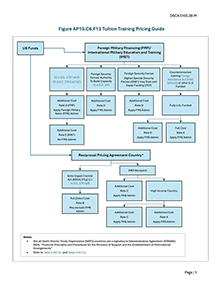
AP10.C6.22.1. Types of Training.
AP10.C6.22.1.1. Standard Formal Training. Formal training provided to international students may consist of flying training courses, technical training courses, language training, and other training not specifically addressed in Section AP10.C6.22.1.2. Tuition rates are generally shown as a cost per student or cost per student week. Refer to Section AP10.C6.23. for pricing of tuition-based training.
AP10.C6.22.1.2. Nonstandard Formal Training. Nonstandard formal training courses follow the same pricing concepts as formal training with the following noted exceptions:
AP10.C6.22.1.2.1. Observer Training. Observer training where International students, who audit a course, must be charged the same price as enrolled students; and
AP10.C6.22.1.2.2. Distance Learning. Distance learning or other technology-based training as follows:
AP10.C6.22.1.2.2.1. A material-only training course that is provided solely by computer media (e.g., computer disc), satellite video teleconference (VTC), or closed circuit VTC, is non-resident, and is being developed solely for the training of international students (one country or a group of cooperating countries), must be priced to fully recoup all costs to the USG including the costs (in-house and contractual) to develop and produce the training, and the costs of the materials (such as a computer disc) (see Section AP10.C6.19.2. for publication/software pricing);
AP10.C6.22.1.2.2.2. A material and proctor/online service, non-resident training course developed solely for the training of international students (one or more countries) that is provided by computer media (e.g., computer disc), plus online services (proctor), to include testing, must be priced to recoup all costs (in-house and contractual) to develop and produce the training; the costs of the materials (such as a computer disc); and the actual, or estimated, costs of the services (see Section AP10.C6.23.1. for training cost categories and Section AP10.C6.19.2. for publication/software pricing); and
AP10.C6.22.1.2.2.3. Resident courses developed solely for the training of international students that is on computer media (e.g., computer disc), plus on-line services (proctor), must be priced to recoup all costs (in-house and contractual) to develop and produce the training; the costs of materials (such as computer disc); the actual, or estimated, costs of the services; and the costs for resident training (see Section AP10.C6.23.1. for training cost categories and Section AP10.C6.19.2. for publication/software pricing).
AP10.C6.22.1.2.3. Dedicated Training Courses. For purposes of this section, a dedicated training course is a training course developed or provided solely for the training of international students (one or more countries). Pricing of dedicated training courses must be in accordance with Section AP10.C6.24.
AP10.C6.22.1.2.4. Contractor-Provided Courses. Contractor-provided courses must include the applicable contract costs. If taught at a government-owned/government-operated facility, the pricing of indirect costs must be in accordance with Section AP10.C6.23.
AP10.C6.22.1.2.5. Inter-American Air Forces Academy and Western Hemisphere Institute for Security Cooperation Courses. Training costs associated with courses offered at the Inter-American Air Forces Academy (IAAFA) and Western Hemisphere Institute for Security Cooperation (WHINSEC) Courses must exclude the fixed costs of operating and maintaining the schools (e.g., costs that do not vary with student load).
AP10.C6.22.1.2.6. Specialized/Dedicated Training Programs. Refer to Section AP10.C6.24. for specialized/dedicated training program guidance.
AP10.C6.22.1.2.7. Training Teams. Refer to Section AP10.C6.25. for pricing guidance for the training team.
AP10.C6.22.2. Courseware Development.
AP10.C6.22.2.1. Recoupment of Nonrecurring Development Costs. International student participation in any of the aforementioned types of courses that have been developed for use by U.S. DoW personnel must not include the recoupment of nonrecurring development costs. Since these courses/courseware are not items of Significant Military Equipment (SME) or Major Defense Equipment (MDE), the nonrecurring development costs of the original U.S. courses/courseware must not be included in the price. The costs of providing unique training material based on U.S. developed course/courseware (e.g., sanitizing, customizing, and country standardization) must be recouped.
AP10.C6.22.2.2. Pricing of Non-Inventory Courseware.
AP10.C6.22.2.2.1. When an international partner has requested that specific courseware be developed to meet its training requirements, either for training in the U.S. or for its own in-country training purposes, and the U.S. does not currently offer or have such courseware developed, the full costs of developing that courseware must be charged to the international partner. Assumptions used in pricing include: courseware does not currently exist, country-specific requirements being addressed/developed, work hours required to prepare/develop the courseware, courseware may require materials, and courseware may be used in the future for another country if deemed appropriate.
AP10.C6.22.2.2.2. The cost must include but is not limited to, the personnel or contractor costs incurred in the development of the courseware material, and/or supply costs incurred for the cost of publishing the courseware, and any shipping costs that may be incurred if delivering the courseware in-country. The guidance for applying costs to publications, if applicable, may be found in Section AP10.C6.19.
AP10.C6.22.2.2.3. When determining the pricing for personnel services, every attempt should be made to use actual costs. If actual cost data is not available, estimated pricing is acceptable. The costs must be substantiated by a reliable audit trail. Pricing of civilian/MP will be in accordance with Section AP10.C6.20.
AP10.C6.22.3. Liability for Damages.
AP10.C6.22.3.1. Training cases that involve the use of U.S. equipment (e.g., aircraft, trucks, or simulators), but do not include charges for attrition, must include the statement regarding liability for damages, “The Purchaser is liable for any and all damages to U.S. Government equipment caused by negligence on the part of the student.” For students attending training under the IMET program, the student’s Invitational Travel Order (ITO) must include the liability statement. The cost of replacing equipment that is destroyed as a result of student negligence must be reimbursed in full. See Section AP10.C6.15. for instructions on pricing replacement equipment. Refer to Appendix 10, Chapter 3 for guidance on attrition charges.
AP10.C6.22.3.2. Claims arising out of combined exercise activities with USG under an Letter of Offer and Acceptance (LOA) with North Atlantic Treaty Organization (NATO) countries must be dealt with under the Agreement between the Parties to the North Atlantic Treaty, regarding the Status of their Forces, Article VIII. This also applies to the Agreement among the States Parties to the North Atlantic Treaty and the other States participating in the Partnership for Peace (PfP) regarding the Status of their Forces.
AP10.C6.22.4. Training Obligation.
AP10.C6.22.4.1. General. In general, a training course is an entire effort. This is particularly evident with USG contracted training. However, USG-provided training funded by DoW or Department of State (State) appropriations must end by the funds expiration date, as this training is severable and must not cross an fiscal year (FY), unless crossing an FY is authorized for a specific authority or program (i.e., Foreign Security Forces (FSF): authority to build capacity under 10 U.S.C. 333, IMET, Irregular Warfare Center and Regional Defense Fellowship Program (RDFP) (10 U.S.C. 345) and the DoW Regional Centers for Security Studies (RCs) (10 U.S.C. 342)).
AP10.C6.22.4.2. Obligations. Funds for training are obligated on the date the student enters the course. In some cases, due to the long-range nature of planning required to support students’ participation in a training course, funds can be obligated prior to the start date of the course, so long as the obligation meets a bona fide need of the current FY and are obligated during the appropriated period of availability.
AP10.C6.22.5. Annual Publication of Tuition Rates. Tuition rates must be computed annually by the Military Departments (MILDEPS) and published in the Training Military Articles and Services List (TMASL) (Section C10.4.3.). Every effort should be made to publish these rates by October 1st of each year. Tuition rates must be those in effect for the year in which the student enters the course or phase of a course. Approved rates must remain constant for the year.
AP10.C6.22.6. Adjustments to Tuition Rates and Training Obligations.
AP10.C6.22.6.1. Current Year. Adjustments must be made only to correct significant errors in computation, change in syllabus, or major unanticipated increases or decreases in the cost of such items as petroleum, oil, and lubricants (POL) and salaries. The foreign country must be billed for the actual time the student is in training when it varies from the scheduled length of the course. Any adjustments must be made as soon as possible, but not later than 90 days after completion of the course.
AP10.C6.22.6.2. Future Year. Tuition rate estimates for future years must be adjusted for inflation. Office of the Under Secretary of War (Comptroller) (OUSW(C)) published rates will be used. See OUSW(C) DoW Budget Request, “National Defense Budget Estimates (Green Book),” for treatment of inflation.
AP10.C6.22.7. Training Cancellations.
AP10.C6.22.7.1. Dedicated Courses/Contract Provided Training. Once a contract is awarded or a quota is confirmed, a 100 percent charge (cancellation charge) will apply to any country that fails to send a student to the identified training, unless another international student is identified and the quota is filled. Dedicated/contract training will only apply to certain courses. This training will include courses that rely on contract support and courses that are designated for international students only. A list of these courses will be identified by the Implementing Agencies (IAs).
AP10.C6.22.7.2. All Other Confirmed Training. A 50 percent cancellation charge will apply for all confirmed training canceled or rescheduled with less than 60 days notification unless training is reallocated and filled by another international student. The cancellation policy will be applied to all confirmed training within the 60-day window. Additionally, the cancellation charge will be applied to all training that falls within and outside the 60-day window if the training is part of a sequential pipeline that a student would attend as part of a complete curriculum.
AP10.C6.22.7.3. Other Cancellation Charges. The IA will determine all other cancellation charges. To the extent that there are costs that would not exist but for the international student, such costs must be considered by the IA in determining the appropriate cancellation charge (e.g., cost of the International Military Student Office (IMSO)). Request for waivers to these cancellation charges should be addressed to the IA. The funding status of a training line has no bearing on whether the cancellation charge applies. The cancellation charge will not be applied when the cancellation is due to:
AP10.C6.22.7.3.1. USG decisions, such as deletion or rescheduling of classes;
AP10.C6.22.7.3.2. Unavoidable circumstances within a country, such as national disaster; or
AP10.C6.22.7.3.3. The quota being used by another country.
AP10.C6.22.8. Student Costs.
AP10.C6.22.8.1. Certain costs associated with the support of international students and/or their dependents are considered to be a responsibility of the foreign government and are not included in the tuition rate for a training course(s). The student’s ITO will contain details about the level of support provided in accordance with the Foreign Military Sales (FMS) LOA; see Section C10.11. for more information. Compute and bill these costs as follows.
AP10.C6.22.8.2. Meals. Meal rates are set annually by OUSW(C) and published at OUSW(C) Department of Defense FY 2026 Reimbursable Rates website, Tab G, “Food Service Charges at Appropriated Fund Dining Facilities.”
AP10.C6.22.8.3. Medical. Medical care (including outpatient) for students and dependents must be charged in accordance with the procedures identified in Section C10.9. If included on the LOA, these costs must be shown as a separate line and billed to the foreign country.
AP10.C6.22.8.4. Travel. Student travel, living allowances, and related costs must be paid to the commercial carrier, or other service provider, by the foreign country or student. For any U.S. services supplied (e.g., Air Mobility Command (AMC) transportation), the non government rate must be applied and billed to the foreign country or student, as appropriate. The government rate applies for IMET or non-repayable Foreign Military Financing (FMF).
AP10.C6.22.8.5. Lodging.
AP10.C6.22.8.5.1. Family Housing. International students may occupy DoW student family housing only after a determination has been made that U.S. student requirements are satisfied and must be satisfied for the projected duration of the international student’s occupancy. Under these circumstances, the amount to be charged must be, at a minimum, the cost incurred by DoW for the operation and maintenance of family housing units. When international students occupy family housing that is not in excess of U.S. Military Service needs, the amount to be charged must be equal to the cost of housing U.S. military service personnel on the economy.
AP10.C6.22.8.5.2. Government Quarters. When international students occupy government quarters, they must be required to pay, at a minimum, the local custodial and non-appropriated fund fees.
AP10.C6.22.8.5.3. North Atlantic Treaty Organization Standardization Agreements /Reciprocal Pricing Agreement Countries. Lodging costs may be excluded from reimbursement for the billeting of trainees except to the extent that members of the Armed Forces occupying comparable accommodations are charged for such accommodations by the U.S.
AP10.C6.22.9. Field Studies Program.
AP10.C6.22.9.1. In accordance with DoDI 5410.17, “United States Field Studies Program (FSP) for International Military and Civilian Students and Military-Sponsored Visitors,” tuition rates must include the costs associated with the implementation of FSP.
AP10.C6.22.9.2. Included Costs. Costs that may be included in the computation of the FSP include the following:
AP10.C6.22.9.2.1. Transportation - car, bus, rail, air (if applicable to the Washington D.C. trip), and baggage (non-excess);
AP10.C6.22.9.2.2. Meals - costs should be limited to those rates as specified in the Joint Travel Regulations, (JTR);
AP10.C6.22.9.2.3. Lodging - if applicable, the costs of lodging will be based on double occupancy for those International Military Students (IMS) in the rank/equivalent grade of O-6 and below. Single-room accommodations are allowed for escorts and those IMS in the rank/equivalent grade of O-7 or higher;
AP10.C6.22.9.2.4. Admission (except as noted in Section AP10.C6.22.9.3.4.);
AP10.C6.22.9.2.5. Tours and associated fees (e.g., brochures, pamphlets, maps);
AP10.C6.22.9.2.6. Appropriate gratuities, where applicable;
AP10.C6.22.9.2.7. Service charges (e.g., tolls and parking fees);
AP10.C6.22.9.2.8. Costs associated with authorized guests at FSP functions such as luncheons, dinners, and receptions planned to facilitate IMS and U.S. personnel meetings and engaging in conversation. The ratio of International Military Student (IMS) to guests will not be less than 20 percent in gatherings of fewer than 30 persons. When 30 or more persons are present, the ratio of IMS to guests will not be less than 50 percent;
AP10.C6.22.9.2.9. Mementos (e.g., coins and plaques) for sponsors, guest speakers, and other individuals/institutions that support the FSP at a cost not to exceed $100; and
AP10.C6.22.9.2.10. Distinctive medallions, plaques, or ornaments, one per IMS, which serve to commemorate the IMS’s experience for participating in a particular FSP activity.
AP10.C6.22.9.3. Excluded Costs. Funds may not be obligated or expended to pay for the following:
AP10.C6.22.9.3.1. Alcoholic beverages;
AP10.C6.22.9.3.2. Excess baggage;
AP10.C6.22.9.3.3. Support for purely academic objectives (i.e., costs for trips that are an integral part of the training curriculum must be included in the course tuition rate);
AP10.C6.22.9.3.4. Entertainment expenses for activities that are substantially of a recreational character, including but not limited to entrance fees at sporting events, theatrical and musical productions, and amusement/theme parks;
AP10.C6.22.9.3.5. Personal costs of the IMS for laundry, cleaning, telephone service, room service, and all other costs not directly associated with the programmed tour; and
AP10.C6.22.9.3.6. Dependents authorized to accompany an IMS in the U.S. participating in selected FSP activities; such participation is subject to space availability and at no cost to the FSP. Costs related to such participation must be paid by the IMS in advance of the event.
AP10.C6.22.9.4. International Military Student Office Costs.
AP10.C6.22.9.4.1. Local area travel costs are reimbursable in accordance with the Joint Travel Regulations (JTR).
AP10.C6.22.9.4.2. Washington, D.C. trip costs will include all appropriate costs for the IMS as well as the escort officer(s) (e.g., transportation, meals, lodging, and admissions). For more information on visits to Washington, D.C., see Section C10.18.5.
AP10.C6.22.10. Retainable Instructional Materials. Much of the Retainable Instructional Materials (RIM) issued to an IMS is provided via compact disk; however, if there is a need to ship RIM, include the cost of the shipment in the tuition cost. RIM must be packed and labeled at the training installation and shipped to the U.S. Military Group (MILGP) of the country for delivery to the IMS. A copy of the student’s ITO must be placed inside the package. The training installation must ensure that no personal baggage or other unauthorized matter is shipped with RIM. See Section C10.20.6. for additional information.
AP10.C6.23.1. Cost Categories.
AP10.C6.23.1.1. The pricing of training tuition rates falls under one of two costing schemes – full cost or incremental cost. Within each cost scheme, costs are segregated into three categories: direct costs, indirect costs, and other billable costs.
AP10.C6.23.1.2. Direct Cost. A direct cost is any cost that is identified specifically with the training of a student. Direct costs also include directly associated costs that would not have been incurred had the other direct costs not been incurred (e.g., costs that are allocated on a specific measurable basis - cost per student week, cost per flying hour/sortie, costs per steaming hour, costs per range hour).
AP10.C6.23.1.3. Indirect Cost. Indirect costs are costs of resources that are jointly or commonly used by all activities at an installation but are not specifically identifiable with any of the users. These costs are not directly related to training but instead are associated with a variety of activities and services.
AP10.C6.23.1.4. Other Billable Cost. Other billable costs are those required by legislation or policy that are additive to the cost of training an international student (e.g., Foreign Military Sales (FMS) administrative surcharge, Field Studies Program (FSP), attrition, and Retainable Instructional Materials (RIM).
AP10.C6.23.2. Pricing of Personnel.
AP10.C6.23.2.1. Military Pay.
AP10.C6.23.2.1.1. Full Costs. Price military pay using the FMS composite standard rates, which include the per capita normal cost of Medical Eligible Retiree Health Care (MERHC) and the acceleration factor for the Defense Health Program (DHP) published at Office of the Under Secretary of War (Comptroller) (OUSW(C)) DoW Reimbursable Rates website, under “Military Personnel Composite Standard Pay and Reimbursement Rates,” (Tab K). In addition, see Section AP10.C6.20.2. and Figure AP10.C6.F12. for pricing applicability.
AP10.C6.23.2.1.2. Additional Cost. Base pay and allowances of U.S. active duty personnel, including MERHC and DHP costs, are considered sunk costs and are normally not considered an additional cost, except as noted in Section AP10.C6.23.4. Additional costs related to military deployment as part of a training team could include such costs as hazardous duty pay, family separation pay, travel, and per diem. Exceptions are:
AP10.C6.23.2.1.2.1. Military positions coded as reimbursable billets applicable to FMS must be considered additional costs. Budget materials must clearly reflect the reimbursable nature of the billet;
AP10.C6.23.2.1.2.2. Military Personnel (MP) assigned to Defense Working Capital Fund (DWCF) activities must be considered additional costs; and
AP10.C6.23.2.1.2.3. Pay and allowances of National Guard/Reserve members called to active duty in support of FMS must be considered additional costs.
AP10.C6.23.2.2. Civilian Pay.
AP10.C6.23.2.2.1. Full Cost. Price civilian pay in one of two ways:
AP10.C6.23.2.2.1.1. Using actual costs plus inflation and applicable acceleration factors (recommended for tuition pricing); or
AP10.C6.23.2.2.1.2. In accordance with Section AP10.C6.20.1. and Figure AP10.C6.F11.
AP10.C6.23.2.2.2. Additional Cost. Base pay and allowances of U.S. civilians are not necessarily considered sunk costs and may/may not be considered an additional cost. Additional costs related to civilians deploying as part of a training team could include such costs as hazardous duty pay, travel, and per diem. See Figure AP10.C6.F13. for tuition training pricing applicability. Additional costs would include:
AP10.C6.23.2.2.2.1. Civilian positions coded as reimbursable billets applicable to FMS. Budget materials must clearly reflect the reimbursable nature of the billet; and
AP10.C6.23.2.2.2.2. Civilian personnel assigned to DWCF activities.
AP10.C6.23.3. Pricing of Full Cost of Training (Tuition Rates A and B).
AP10.C6.23.3.1. Full cost includes all direct costs and a proportional share of indirect costs to the USG for providing the training, regardless of funding sources. When developing the full cost of training, take into account the cost of training both U.S. and international students. For international students, the full cost will also include the other billable costs. Rates priced using full cost principles include Rates A and B in Table AP10.C6.T3. Training price exceptions are found in Section AP10.C6.21.2.
Table AP10.C6.T4. Tuition Rate Pricing Structure
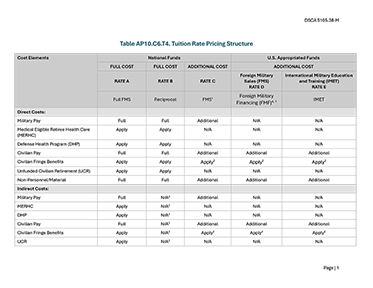
AP10.C6.23.3.2. Direct Costs. Certain costs can be directly identified in training courses. Once identified, the direct cost is divided by the total number of students that can be enrolled in a course to determine the cost per student. Add together all direct costs per student to be included in the tuition rate.
AP10.C6.23.3.2.1. Instructors and School Support Staff.
AP10.C6.23.3.2.1.1. Instructors.
AP10.C6.23.3.2.1.1.1. Average Instructor Costs. The cost of instructor salaries, allowances, and other entitlements is computed by dividing the annual instructor cost by 52 weeks and multiplying the result by the number of weeks in the applicable course (see Section AP10.C6.20.). Divide this cost by the maximum class size to develop the instructor cost per student.
AP10.C6.23.3.2.1.1.2. Instructor Contact Hours. Instructor costs may be allocated on an instructor contact-hours basis (e.g., total platform work hours allocated as instructor contact hours per student); this is one method to allow for equitable distribution.
AP10.C6.23.3.2.1.1.3. Total Training Man Weeks. Instructor costs are calculated by multiplying the number of weeks for given courses times the total number of students enrolled to derive the total “Training Man Weeks” for a given course. The “Training Man-Weeks” for all courses at a training activity are summed together to calculate the Total Training Man Weeks (TTMW) for a training activity. The total salaries for a training activity are then divided by the TTMW to develop a weekly rate. The weekly rate is then multiplied by the number of weeks for a given course to calculate the instructor cost per course.
AP10.C6.23.3.2.1.2. School Support Staff.
AP10.C6.23.3.2.1.2.1. Average School Support Staff Costs. Compute the cost of salaries, allowances, and other entitlements of administrative and other personnel supporting training by dividing the total annual cost by the total course weeks of training and multiplying the result by the number of weeks in the applicable course. Divide this cost by the maximum number of students in the class to develop the school support staff cost per student.
AP10.C6.23.3.2.1.2.2. Total Training Man Weeks. School support staff costs are calculated by multiplying the number of weeks for given courses times the total number of students enrolled to derive the total “Training Man Weeks” for a given course. The “Training Man Weeks” for all courses at a training activity are summed together to calculate the TTMW for a training activity. The total salaries for a training activity are then divided by the TTMW to develop a weekly rate. The weekly rate is then multiplied by the number of weeks for a given course to calculate the school support staff cost per course.
AP10.C6.23.3.2.1.3. International Military Student Office and Staff. Allocate the cost of the IMSO and staff to courses based on actual or programmed international student weeks.
AP10.C6.23.3.2.2. Temporary Duty and Per Diem. The cost of Temporary Duty (TDY) must be allocated to courses based on a causal or beneficial relationship. Accordingly, TDY must be segregated into two categories: direct TDY that is caused by or benefits a specific course or courses and indirect TDY that benefits the training operation as a whole. TDY that is directly related to (or benefits) one or more courses must be directly allocated to those courses. To preclude "double charging" TDY to a course, care must be taken to ensure that all directly allocable travel is eliminated from the TDY included in the indirect cost pool.
AP10.C6.23.3.2.3. Equipment Overhaul and Maintenance.
AP10.C6.23.3.2.3.1. Depot Level Maintenance. The depot-level maintenance cost of aircraft, engines, motorized vehicles, and equipment must be charged to the applicable course at the budgeted average hourly item repair cost that includes civilian pay, contractual effort, and supplies. These costs must be adjusted to include military pay and centrally procured equipment and parts. Multiply this average hourly cost by the hours programmed for use in the specific course.
AP10.C6.23.3.2.3.2. Base Level Maintenance. Base-level aircraft and equipment maintenance costs (including munitions maintenance) must be allocated to courses on the basis of total maintenance costs divided by the total training hours supported, if not identifiable and chargeable on a job order basis. Costs must include military and civilian pay, supplies and equipment (including replenishment spares), and contractual support. If there are a significant number of transit or non-training aircraft at the base, aircraft operating costs must be initially distributed between training and non-training on the basis of percentage of number of takeoffs, number of sorties per year, or maintenance direct labor hours, whichever results in the best allocation of costs in relation to the benefits received. For this purpose, aircraft used by personnel supporting training for proficiency flying must be classified as training aircraft.
AP10.C6.23.3.2.3.3. Range Maintenance. Range maintenance and operating costs must be computed and allocated to courses based on the percentage of sorties or rounds fired in the course compared to the total sorties or rounds fired or any other basis that results in an equitable allocation of these costs.
AP10.C6.23.3.2.4. Simulators. Simulator costs must include pay of the operators, supplies, and equipment maintenance. Simulator costs must be allocated to the course in the same ratio as hours used to the total hours available.
AP10.C6.23.3.2.5. Supplies, Material, Training Aids, and Ammunition.
AP10.C6.23.3.2.5.1. The cost of Petroleum, Oil, and Lubricants (POL) for aircraft (rotary/fixed wing), motorized equipment, ships, landing craft, and other equipment must be computed by multiplying the equipment hourly cost of POL times the number of operating hours for the course.
AP10.C6.23.3.2.5.2. The costs for training materials, equipment, supplies, aids, munitions, flight clothing, and personal equipment must be charged to the applicable course. Training material and aids prepared above base level that are readily identifiable to a course, must be included as a direct cost of the course. If not readily identifiable to a specific course, these costs must be distributed to courses in the same manner as indirect TDY costs. Care must be taken to ensure against "double charging" a course.
AP10.C6.23.3.2.6. Directly Associated Costs.
AP10.C6.23.3.2.6.1. Other directly associated costs allocable to training operations must be distributed to courses based on total training hour support or any other logical method of measurement (e.g., square footage of buildings, flying hours/sorties, or any other usage factor). Costs in this category include costs generated as a result of the incurrence of another cost and would not have been incurred had the other cost not been incurred (e.g., flight line operations costs in direct support of flying training and port operations in direct support of shipboard training, without which there would be no flying training operations or shipboard training operations).
AP10.C6.23.3.2.6.2. The cost for training U.S. instructor pilots, including proficiency and continuation training, must be limited to special aircraft not in the active U.S. aircraft inventory. These costs must be divided by the normal tour of duty for an instructor pilot to arrive at an annual cost that must be distributed to courses in the same manner as instructor salaries and allowances.
AP10.C6.23.3.3. Indirect Costs.
AP10.C6.23.3.3.1. Indirect Base Operating Support Costs.
AP10.C6.23.3.3.1.1. Allocation. Indirect base operating costs must be initially allocated to major claimants (e.g., training activities and tenants) at the installation level using engineering estimates or some other basis to ensure that allocations are commensurate with the benefits received. The amount allocated to training must then be distributed to areas of training that are significantly different (e.g., flying operations, classroom training, and equipment maintenance). The amount allocated to each area of training must then be distributed to the tuition rate by dividing the amount allocated by the annual estimated student weeks of training.
AP10.C6.23.3.3.1.2. Exclusions. No costs to support or operate quarters, a family housing complex, and food service activities that are applicable to instructors and training support personnel may be allocated to tuition rates if these costs are recouped in base personnel salaries.
AP10.C6.23.3.3.2. Maintenance and Repair of Facilities. Maintenance and repair of facilities must be considered part of the normal base operating support costs, unless these costs can be directly identified to a specific user (e.g., dedicated facility, specific to a course or courses). When non-dedicated facilities are used for training, the costs are included as indirect costs in the tuition rates. These costs may be combined with other indirect costs and allocated at the installation level or allocated based on a separate cost pool. IAs may not unilaterally dedicate facilities for international student use and then recoup the full cost of the maintenance and repair of the facilities through tuition rates. Such maintenance and repair costs will be combined with other indirect costs and allocated at the installation level. See Section AP10.C6.10. and Section AP10.C6.11. for more information on facility usage.
AP10.C6.23.3.3.3. Indirect Temporary Duty. TDY that is caused by or benefits the training operation as a whole must be allocated to courses by dividing these total indirect TDY costs by the total number of students to determine the course cost per student.
AP10.C6.23.3.3.4. Training Material and Aids. Training material and aids not readily identifiable to a specific course must be distributed to courses in the same manner as indirect TDY costs.
AP10.C6.23.3.3.5. Exclusions. Exclude the following from indirect allocations:
AP10.C6.23.3.3.5.1. Costs associated with combat development, training development (less course development), non-resident instruction, or other activity that offers no support to the training mission, and a pro rata share of school overhead costs to support these elements;
AP10.C6.23.3.3.5.2. Costs associated with units attached to the training installation with duty stations at another location that are not involved in the training of international students; and
AP10.C6.23.3.3.5.3. Costs related to underutilized capacity and mobilization requirements, when specifically identified and documented.
AP10.C6.23.3.4. Other Billable Costs.
AP10.C6.23.3.4.1. Attrition Rate/Liability Statement. For fiscal year (FY) 1996 through FY 2016, Tuition Rate A will include the attrition factor (See Table C9.T4.) whenever the training or education course includes the use of training equipment or operational equipment used as training aids. For all FYs, Tuition Rate B will include the liability statement in Section AP10.C6.22.3.1. Arms Export Control Act (AECA), Section 21(a)(1)(C) (22 U.S.C. 2761(a)(1)(C)) states the full cost of the service must be paid by the purchaser.
AP10.C6.23.3.4.2. Field Studies Program. Tuition rates must include the costs of the Field Studies Program (FSP) if a program exists at the training location. Do not include if there is no FSP at the training location. See Section AP10.C6.22.9. and Chapter 10 for more information on FSP.
AP10.C6.23.3.4.3. Retainable Instructional Materials. Tuition rates must include the costs of Retainable Instructional Materials (RIM), if applicable. See Section AP10.C6.22.10. for more information on RIM.
AP10.C6.23.3.4.4. Foreign Military Sales Administrative Surcharge. The current FMS administrative surcharge must be applied to Tuition Rate A. Exceptions are contained in the Table C10.T13. and Table C10.T14.
AP10.C6.23.4. Pricing of Additional Cost Training (Rates C, D, and E).
AP10.C6.23.4.1. Additional costs represent the increase incurred in the full cost of training due to the addition of international students. AECA, Section 21(a)(1)(C) (22 U.S.C. 2761(a)(1)(C)) provides the authority to apply additional cost pricing to training sold to a purchaser concurrently in receipt of IMET or a purchaser designated as a high-income country. Foreign Assistance Act, Section 514(b) (22 U.S.C. 2347(b)), provides the authority for FMF recipients (Rate D) to be charged at a rate comparable to IMET (Rate E). AECA, Section 30(a)(3) (22 U.S.C. 2770(a)(3)) provides the authority to exclude military salaries from additional cost pricing when the training is funded with U.S. appropriated funds; see Figure AP10.C6.F14.
Figure AP10.C6.F14. Incremental Tuition Based Pricing (Rate C)
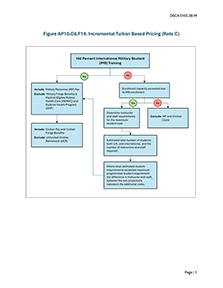
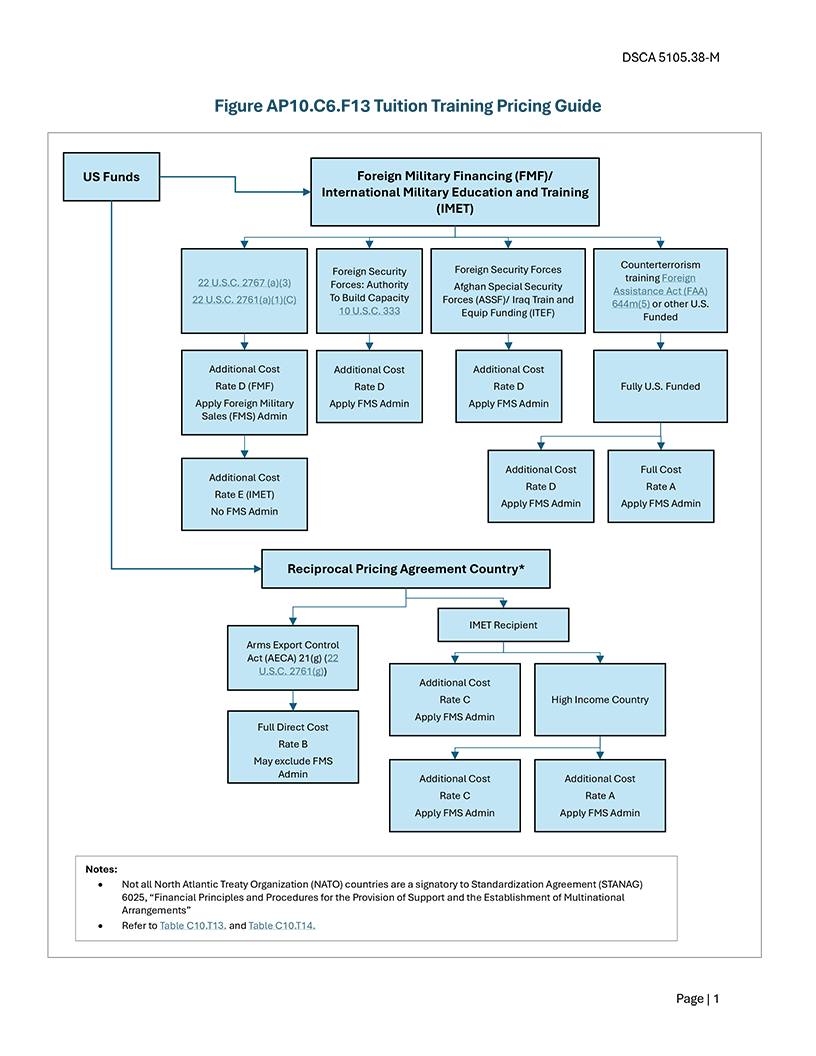
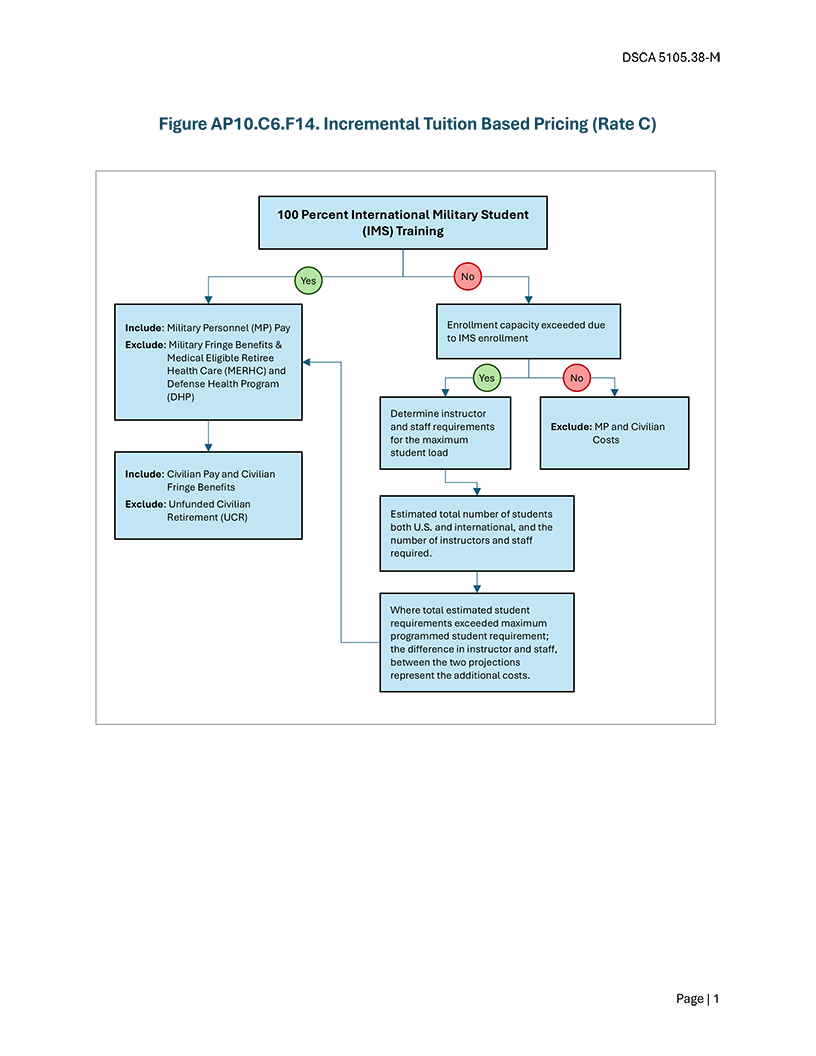
AP10.C6.23.4.2. Direct Costs.
AP10.C6.23.4.2.1. Instructors and School Support Staff.
AP10.C6.23.4.2.1.1. Courses must be reviewed to determine if the additional cost should be developed for a specific course (e.g., pilot training) or a group of courses. For classroom or technical courses that are similar or that utilize instructors who teach more than one course, such courses may be grouped for computation purposes.
AP10.C6.23.4.2.1.2. For courses that contain both U.S. and international students, determine instructor and staff requirements for the programmed (maximum) U.S. student load. Estimate the total number of students, both U.S. and international, and the number of instructors and staff required. Where total estimated student requirements exceed maximum programmed student requirements, the difference in instructor and staff between the two projections represents the incremental costs. This value, divided by the total number of international students, represents the incremental cost per student for the course(s).
AP10.C6.23.4.2.1.3. When there is a one-for-one or one-for-two relationship of instructor to student, the instructor in all cases must be considered an additional cost. If the entire class is composed of international students, the instructor and staff must always be considered additional.
AP10.C6.23.4.2.1.4. It is anticipated that the additional cost charged for instructors must be minimal for courses or groupings of courses when the ratio is high of either students to instructors or U.S. students to international students.
AP10.C6.23.4.2.2. Temporary Duty and Per Diem. The costs for all student travel and per diem associated with the training must be considered an additional cost. Refer to Section AP10.C6.23.3.1.2. for additional TDY and per diem information.
AP10.C6.23.4.2.3. Equipment Overhaul and Maintenance. The cost for overhaul and maintenance of major items of equipment, when computed on an hourly use basis, must be an additional cost to a course based on estimated utilization hours. Refer to Section AP10.C6.23.3.1.3. for additional information.
AP10.C6.23.4.2.4. Simulators. The cost for simulator hours must be an additional cost. Refer to Section AP10.C6.23.3.1.4. for additional information.
AP10.C6.23.4.2.5. Supplies, Material, Training Aids, and Ammunition. The associated additional cost must be the replacement price of items that are not returned or reusable (including POL) used in conducting the training.
AP10.C6.23.4.2.6. Directly Associated Costs.
AP10.C6.23.4.2.6.1. Instructor Training. The training of U.S. instructors or other personnel for special courses normally not conducted for U.S. personnel must be considered an additional cost. When the required training is conducted at a U.S. training facility, the benefiting country must be charged the course cost established in accordance with instructions for computing training costs in Section AP10.C6.23.3.
AP10.C6.23.4.2.6.2. Facilities and Equipment. The costs for any facilities or equipment acquired primarily for the support of international students, and the support costs thereof, must be considered incremental.
AP10.C6.23.4.3. Indirect Costs. Standard weekly rates for base operating support must be charged to additional cost training rates, as developed by the Implementing Agencies (IAs), and adjusted annually. Include only those additional base operating support costs that are incurred because of international student attendance. See Section AP10.C6.23.3.3. for additional information on indirect costs.
AP10.C6.23.4.4. Other Billable Costs.
AP10.C6.23.4.4.1. Attrition Rate/Liability Statement. For FMS training sold using additional cost pricing (Tuition Rates C-D in Table AP10.C6.T3.), include the liability statement in Section AP10.C6.22.3.1.
AP10.C6.23.4.4.2. Field Studies Program. The full cost to the USG of FSP must be considered an additional cost. See Section AP10.C6.22.9. for more information on FSP.
AP10.C6.23.4.4.3. Retainable Instructional Materials Shipment. If RIM is applicable for a course, then the costs must be considered an additional cost. See Section AP10.C6.22.10. for more information on RIM.
AP10.C6.23.4.4.4. Foreign Military Sales Administrative Surcharge. The current FMS administrative surcharge must be charged on FMS training cases/lines receiving incremental pricing (Tuition Rates C-D in Table AP10.C6.T3.). Tuition Rate Expanded International Military Education and Training (E-IMET) is exempt from paying the FMS administrative surcharge.
AP10.C6.23.4.5. Exclusions. The unfunded civilian retirement charge that is deposited to the Miscellaneous Receipts Account of the U.S. Treasury must be considered a fixed cost and not included in incremental priced training rates (Tuition Rates C-E in Table AP10.C6.T3.).
When pricing specialized dedicated training programs, full cost-pricing principles (refer to Section AP10.C6.23.3.) must be applied. Appropriate legislative authority and terms of the formal agreement must be taken into consideration. The information in Section AP10.C6.24.1., Section AP10.C6.24.2., and Section AP10.C6.24.3. is provided for current specialized/dedicated training programs. General guidelines for other types of training events are found in Chapter 10.
AP10.C6.24.1. Army Specialized/Dedicated Training Programs.
AP10.C6.24.1.1. The Republic of Singapore Air Force Peace Prairie CH-47 Chinook Helicopter Training Program. The Peace Prairie Program is conducted under the authority of the Arms Export Control Act (AECA), Section 21(a)(1)(C) (22 U.S.C. 2761(a)(1)(C)). As a high-income country, Singapore is eligible to receive training priced using the additional cost concept. Absent a formal agreement, costing procedures should follow the guidelines in Section AP10.C6.23.4. Costs associated with the salaries of activated troops of the Reserve Component/National Guard would be considered an additional cost.
AP10.C6.24.1.2. The Republic of Singapore Air Force Peace Vanguard AH-64 Apache Helicopter Training Program. The Peace Vanguard Program is conducted under the authority of AECA, Section 21(a)(1)(C) (22 U.S.C. 2761(a)(1)(C)). As a high-income country, Singapore is eligible to receive training priced using the additional cost concept. Absent a formal agreement, costing procedures should follow the guidelines in Section AP10.C6.23.4. Costs associated with the salaries of activated troops of the Reserve Component/National Guard would be considered an additional cost.
AP10.C6.24.2. Navy Specialized/Dedicated Training Programs.
AP10.C6.24.2.1. The Naval Small Craft Instruction and Technical Training School (NAVSCIATTS) provides specialized instruction and technical training through formal courses of instruction or mobile training teams to friendly foreign military and other security forces related to naval small craft instruction and training and to increase professionalism, readiness, and respect for human rights. Section 1202 of the National Defense Authorization Act (NDAA) for FY 2025 (P.L. 118-159) amended 10 U.S.C. 352(e) to authorize the use of various appropriations to the Department of the Navy for NAVSCIATTS operation and maintenance and School requirements for equipment, military construction, food, and food services. To avoid Antideficiency Act (ADA) violations, the Navy must reference 10 U.S.C. 352(e), for which appropriations the Navy must use for each area listed in the paragraph.
AP10.C6.24.3. Air Force Specialized/Dedicated Training Programs.
AP10.C6.24.3.1. Euro- North Atlantic Treaty Organization Joint Jet Pilot Training Program.
AP10.C6.24.3.1.1. The Euro- North Atlantic Treaty Organization (NATO) Joint Jet Pilot Training (ENJJPT)multinational cooperative training program at Sheppard Air Force Base, Texas is an activity authorized by the AECA, Section 21(g) (22 U.S.C. 2761(g)). The Letters of Offer and Acceptance (LOAs) clearly indicate that the AECA is the authority of the program but remain silent as to which exact section authorizes the activity. Associated program documents (Memorandum of Understanding (MOU) and Plan of Operations) clearly state that the activity is undertaken "in furtherance of NATO rationalization and standardization" and "in the cooperative spirit of the NATO alliance," while also citing the NATO Status of Forces Agreement (SoFA).
AP10.C6.24.3.1.2. While a NATO or Major Non-NATO Ally may also be in receipt of IMET funds, once a cooperative training agreement of the type envisioned by AECA, Section 21(g) (22 U.S.C. 2761(g)) is signed, it becomes the section of the U.S. Code (U.S.C.) that determines the terms under which the training activities are conducted if the financial principles are based on reciprocity. These reciprocal agreements include reimbursement for all direct costs and may exclude reimbursements for indirect costs, the FMS Administrative Surcharge, and the cost of trainee billeting (unless U.S. forces are charged to occupy like accommodations). The application of the FMS Administrative Surcharge and Contract Administration Services (CAS) Surcharge to the ENJJPT Program is waived.
AP10.C6.24.3.2. Dutch F-16 Training Program.
AP10.C6.24.3.2.1. The Dutch F-16 training program is conducted under the authority found in AECA, Section 21(g) (22 U.S.C. 2761(g)). Based on that authority, the program must recoup reimbursement for all direct costs but may exclude reimbursement for indirect costs, the FMS administrative surcharge, and the cost of trainee billeting (unless U.S. forces are charged to occupy like accommodations).
AP10.C6.24.3.2.2. The U.S.C. allows for some flexibility when it comes to the billing of indirect costs under AECA, Section 21(g) (22 U.S.C. 2761(g)) so those preparing the costs can properly account for sharing of the total cost of the program. Unique program agreements may provide specific reimbursement details to which the parties have agreed. The FMS administrative surcharge has not been excluded for this program. Costs associated with the salaries of activated troops of the Reserve Component/National Guard would be a cost to the program.
AP10.C6.24.3.3. The German Air Force Tornado Program. The German Air Force (GAF) Tornado Program is a dedicated training program, authorized by AECA, Section 21(g) (22 U.S.C. 2761(g)). Based on that authority, the program must recoup reimbursement for all direct costs but may exclude reimbursement for indirect costs, the FMS Administrative Surcharge, and the cost of trainee billeting (unless U.S. forces are charged to occupy like accommodations). Again, the U.S.C. allows for some flexibility when it comes to the billing of indirect costs under AECA, Section 21(g) (22 U.S.C. 2761(g)), so those preparing the costs can properly account for the sharing of the total cost of the program. Unique program agreements may provide specific reimbursement details to which the parties have agreed. The FMS Administrative Surcharge has not been excluded for this program.
AP10.C6.24.3.4. The Republic of Singapore Air Force Peace Carvin V F-15 Training Program. The Republic of Singapore Air Force (RSAF) Peace Carvin (PC) V program is authorized by AECA, Section 21(a)(1)(C) (22 U.S.C. 2761(a)(1)(C)). Singapore is identified as a high-income country under the Foreign Assistance Act, Section 546(b) (22 U.S.C. 2347e(b)) and is eligible to receive training priced using the additional cost concept. Absent a formal agreement, costing procedures should follow the guidelines in Section AP10.C6.23.4.
AP10.C6.24.3.5. The Republic of Singapore Air Force Peace Carvin II F-16 Training Program. The RSAF PC II program is authorized by AECA, Section 21(a)(1)(C) (22 U.S.C. 2761(a)(1)(C)). As a high-income country, Singapore is eligible to receive training priced using the additional cost concept. Absent a formal agreement, costing procedures should follow the guidelines in Section AP10.C6.23.4.
AP10.C6.24.3.6. Taiwan Air Force Peace Feng Huang F-16 Training Program. Taiwan’s Peace Feng Huang program is conducted under the authority of AECA, Section 21(a)(1)(C) (22 U.S.C. 2761(a)(1)(C)). Taiwan is not under special pricing authority and therefore pays the full cost of training. Refer to Section AP10.C6.23.3.
AP10.C6.24.4. Personnel.
AP10.C6.24.4.1. Specialized/dedicated training programs may be supported by U.S. personnel, international personnel, or a combination of the two. When establishing a specialized/dedicated training program, an assessment must be performed to determine whether additional U.S. personnel are required to support the training. Care should be taken to ensure these individuals are properly coded as reimbursable billets and whether they are considered a direct cost or an indirect cost. Other personnel billets may provide support to the training.
AP10.C6.24.4.2. Military Personnel. Pricing for U.S. Military Personnel (MP) must be in accordance with Section AP10.C6.23.2.1. Where international military members are filling training instructor billets, apply the comparable U.S. rate if computing costs to charge or compensate.
AP10.C6.24.4.3. Civilian Personnel. Pricing for U.S. civilian personnel must be in accordance with Section AP10.C6.23.2.2. Apply the unfunded civilian retirement factor where applicable.
AP10.C6.24.5. Inflation Factors. Estimates for future years must be adjusted for inflation. OUSW(C) published rates will be used. See Section AP10.C6.22.6.2.
AP10.C6.24.6. Start-up Costs. The FMS purchaser is responsible for all costs, including expenses incurred by Implementing Agency (IA) activities assisting in the establishment of the training. Costs to consider in the start-up of a specialized/dedicated training program may include, but are not limited to, the following: environmental analysis/assessment/impact; construction of, alteration of, or expansion of existing facilities (refer to Section AP10.C6.10.); a pro rata share of the costs for joint use of USG facilities (refer to Section AP10.C6.11.); acquisition of equipment required to execute the program; commercially-leased space (i.e., off-base offices, on-base modular buildings); and one-time site activation costs, if applicable.
AP10.C6.24.7. Direct Costs. Refer to Section AP10.C6.23.3.2. (full cost) or Section AP10.C6.23.4.2. (additional cost) for the types of costs appropriate to charge as direct costs.
AP10.C6.24.8. Indirect Costs. Refer to Section AP10.C6.23.3.3. (full cost) or Section AP10.C6.23.4.3. (additional cost) for the types of costs appropriate to charge as indirect costs.
AP10.C6.24.9. Other Billable Costs.
AP10.C6.24.9.1. Attrition Surcharge/Liability Statement. If specific program agreements do not address the application of the attrition surcharge, the liability statement in Section AP10.C6.22.3.1. must be included on the LOA.
AP10.C6.24.9.2. Field Studies Program. Specialized training programs may include the costs of the Field Studies Program (FSP) if the purchaser(s) desires to participate in such. Refer to Section AP10.C6.22.9.
AP10.C6.24.9.3. Retainable Instructional Materials. If there is a need to ship Retainable Instructional Materials (RIM), include the cost of the shipment in the pricing of the specialized training program. Refer to Section AP10.C6.22.10.
AP10.C6.24.9.4. Foreign Military Sales Administrative Surcharge. The current FMS administrative surcharge must be applied to the specialized training program, where applicable. Refer to Section AP10.C6.23.3.4.4. and Section AP10.C6.23.4.4.4.
See below for procedures related to teams fully financed by Foreign Security Forces (FSF) funding, teams fully financed by Military Assistance Program (MAP) merger, Foreign Military Financing (FMF), International Military Education and Training (IMET), or Building Partner Capacity (BPC) funding; Teams financed by an IMET recipient country/high-income country; and teams using national guard/reserve personnel.
When training is conducted by a Security Cooperation (SC) or Security Assistance (SA) Team (e.g., Management Service Team, Technical Assistance Field Team (TAFT), Extended Training Service Specialist, or Mobile Training Team (MTT)) away from the normal training institution, the services of the team must be treated as a service and priced in accordance with Section AP10.C6.23.2. Training aids must be included in the pricing. All pay and allowances, travel, and per diem paid to members of the team established to conduct in-country training must be considered costs of the training team except as noted in Section AP10.C6.25.1. through Section AP10.C6.25.4.
AP10.C6.25.1. Teams Fully Financed by Foreign Security Forces Funding.
AP10.C6.25.1.1. Military Pay and Allowances. Exclude the cost of military pay and allowances.
AP10.C6.25.1.2. Civilian Pay and Allowances. Exclude the cost of civilian pay and allowances.
AP10.C6.25.1.3. Attrition/Liability Statement. Include the liability statement, “The Purchaser is liable for any and all damages to USG equipment caused by negligence on the part of the student.”
AP10.C6.25.2. Teams Fully Financed by Military Assistance Program Merger, Foreign Military Financing, International Military Education and Training, or Building Partner Capacity Funding.
AP10.C6.25.2.1. Military Pay and Allowances. Exclude military pay and allowances from the costs established for teams conducting in-country training fully financed by MAP Merger or FMF, financed under the IMET program, or DoW-funded BPC teams. Should a MAP/MAP Merger case be less than 100 percent financed by such funds, it must be re-priced to include the full cost of the MP.
AP10.C6.25.2.2. Civilian Pay and Allowances. Exclude civilian unfunded retirement from the costs established for teams conducting in-country training fully financed by MAP Merger or FMF, financed under the IMET program, or DoW-funded BPC teams. Refer to Section AP10.C6.23.2. for an explanation and pricing.
AP10.C6.25.3. Teams Financed by an International Military Education and Training - Recipient Country/High-Income Country. For teams conducting in-country training financed by a high-income country or an IMET recipient country using its own national funds, determine whether personnel costs are considered an additional cost to the USG. Refer to Section AP10.C6.23.2. for an explanation and pricing.
AP10.C6.25.4. Teams Using National Guard/Reserve Personnel. If National Guard or Reserve personnel are activated solely to conduct FMS training, those costs must be considered additional costs to the USG and must be properly charged to the country or countries receiving the training. Refer to Section AP10.C6.23.2. for an explanation and pricing.